Manufacturing employment illustration: Chen Xia/GT
Employment-intensive growth was a phrase that stood out in a PTI report on Wednesday, reflecting the growing focus on job creation in India's economic debate. D. Subbarao, the former governor of India's central bank, was quoted as saying that the challenge now is not merely to grow fast, but to make growth productive, employment-intensive and resilient.
This offers a practical lens through which to assess India's manufacturing prospects. According to the United Nations Population Fund, India's population stood at 1.464 billion in 2025, with those aged 10 to 19 accounting for 17 percent. Given the country's sheer population size, this represents a vast pool of potential workers in the years ahead. For Indian manufacturing, this is both an advantage and a responsibility.
As more young Indians enter the labor market, the sector will face mounting pressure to create enough jobs to absorb them. Manufacturing progress, therefore, cannot be measured solely by how much domestic value is added, but also by how many jobs the sector creates.
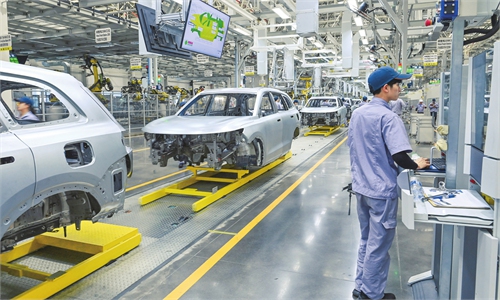
From the perspective of job creation, assembly and other processing activities deserve greater attention. These activities span a range of tasks, from assembling components and operating production lines to inspection and packaging, creating jobs for workers with different skill levels. Even when some manufacturers rely on imported core components and retain a relatively small share of a product's total value added, they can still employ substantial numbers of workers if production is carried out at scale. Such activities can therefore play an important role in labor-intensive manufacturing, helping translate industrial expansion into employment-intensive growth.
China's processing trade offers one example. In the early decades of China's reform and opening-up, processing trade became an important way for Chinese manufacturers to enter global production networks. Under this model, firms imported components and materials, processed or assembled them in China, and exported the finished goods. They could thus participate in international production without having to manufacture every component themselves.
The model generated jobs on a large scale. The value of processing-trade imports and exports grew from less than $1.7 billion at the early stage of reform and opening-up to more than $1.4 trillion in 2014. At the time, about 100,000 processing-trade enterprises directly employed 40 million people. Although many firms captured only a modest share of the value of finished products, they still provided jobs on a large scale through their role in production.
The point is not that India should replicate China's processing-trade model, but that it reflects a broader economic logic: manufacturing employment can grow through participation in global production.
Imports are an important part of this process. Greater access to imported components and materials can help expand processing and manufacturing in India, enabling the country to produce more goods for export and create more jobs at home. Both export growth and job creation are integral to the employment-intensive growth India is seeking.
This does not mean that India should stop developing its own capacity to produce critical components. But imports also have an important role to play, particularly in supporting manufacturing employment. The two can complement each other, allowing India to expand production now while strengthening its manufacturing base for the future.
For India, creating enough jobs for its large workforce is an inherent part of the manufacturing sector's role in the economy. Expanding production is not just about building industrial capacity; it is also about creating jobs for young Indians entering the labor market.
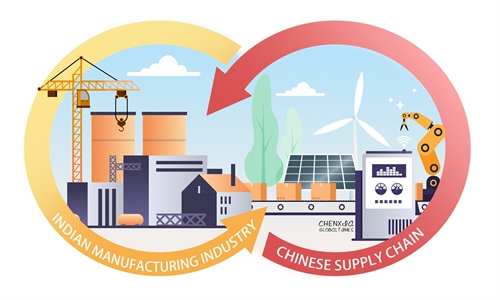
As India expands its manufacturing base, access to competitively priced components from international suppliers, including those in China, can help businesses lower costs, scale up production and create more jobs. Greater integration into global supply chains can therefore support both India's export growth and its pursuit of employment-intensive growth.
The author is a reporter with the Global Times.
bizopinion@globaltimes.com.cn