Illustration: Chen Xia/Global Times
Apple's growing business in India is adding a new dimension to the debate over whether the country can become "the next China." The Economic Times reported on Tuesday that Apple's India business surpassed 1 trillion rupees ($10.5 billion) in fiscal 2026. Yet even as Apple, one of the world's best-known smartphone makers, expands its presence in India, some international commentators continue to question whether the country can replicate China's manufacturing success.
Andy Mukherjee, a Bloomberg Opinion columnist, published a piece on Tuesday headlined "Apple's iPhone Factories Won't Make India the Next China." Whether or not one agrees with his assessment, the piece offers a glimpse into how some international commentators view India's manufacturing prospects.
In recent years, Apple has expanded its presence in India not only as a market for its products but also as a manufacturing base. News reports have described how the company has been shifting a growing share of iPhone production to India. The company has thus become, in some observers' eyes, a lens through which to view the broader development of India's manufacturing sector.
For India, it may be worth considering why, even as Apple continues to reach new milestones in the country, some still doubt that it can become "the next China." It is like a train gathering speed but still falling short of its destination. Perhaps the problem lies not with the train, but with the destination itself. Rather than viewing Apple's expansion in India through the lens of competition with China, it may be more revealing to consider what the company's growth says about India's manufacturing prospects and the opportunities that extend beyond a race to replicate China's success.
The global manufacturing landscape has changed considerably since Apple began manufacturing in China. Supply chains are now more interconnected, and the international division of labor continues to evolve. Judging India's manufacturing progress and Apple's growing presence in the country against China's experience risks using an outdated yardstick to assess a different set of circumstances. India's manufacturing future need not follow the path China took, nor does Apple's expansion there have to be measured by whether India can become "the next China." The question is not how closely India can replicate China's experience, but how it can develop its own manufacturing strengths in today's global economy.
India has already made progress. Even as the Bloomberg Opinion piece argues that Apple won't turn India into "the world's next factory," it describes how Indian manufacturing is moving beyond basic assembly. As the article notes, Indian factories are no longer just assembling finished products, but are also plugging electronics into circuit boards and assembling chassis, capturing a growing share of the production process.
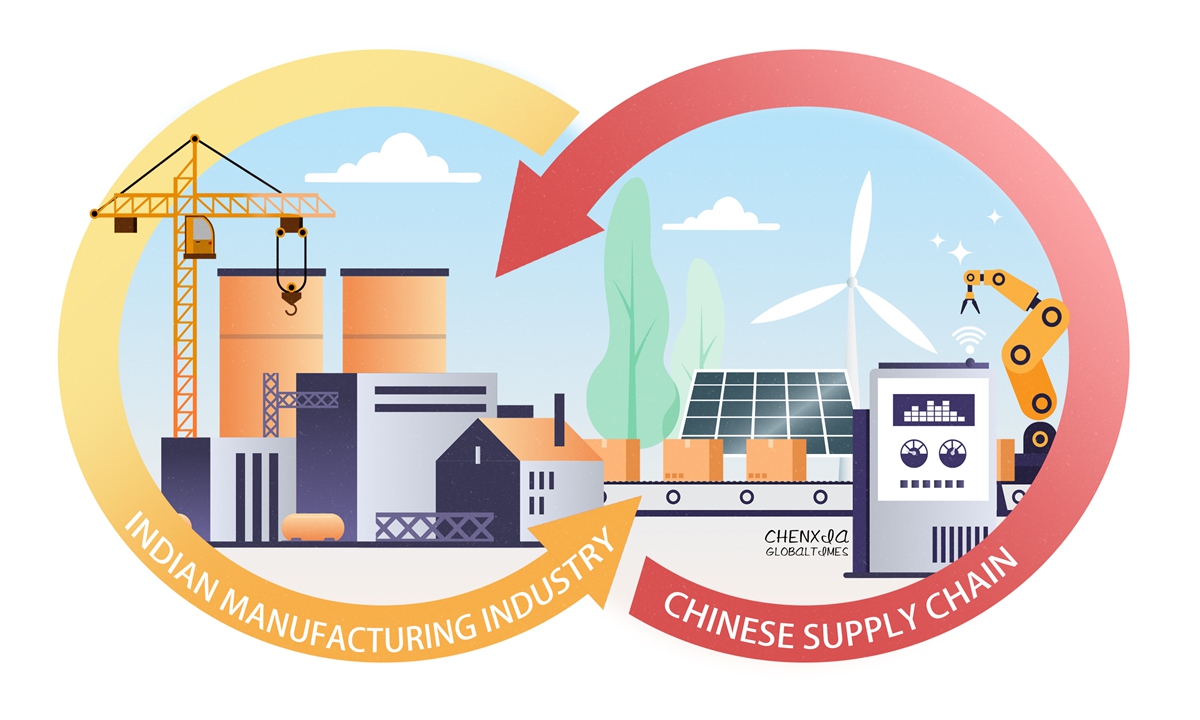
India may not need to rush to replicate China's extensive manufacturing ecosystem or become "the world's next factory." Across manufacturing, from smartphones to other industries, cooperation that draws on the strengths of different players in the supply chain may offer India greater economic returns than trying to recreate China's manufacturing model. For Indian businesses, access to established supplier networks, production expertise and a wider range of industrial inputs could help lower costs and make local manufacturing more competitive.
China's manufacturing ecosystem, built up over decades, could offer Indian industries opportunities to connect with established supply chains and draw on a wider base of industrial capabilities.
As India expands its manufacturing base and attracts global manufacturers such as Apple, developing local suppliers will remain important. But building manufacturing capacity does not mean building everything from scratch. Access to international markets, supplier networks and industrial inputs will also be essential to India's manufacturing growth.
The smartphone industry still offers a useful lens through which to assess this progress. For India, the more revealing question may not be whether it can become "the next China" but how deeply its manufacturing sector can integrate into global supply chains. The extent of that integration may matter more to India's manufacturing future than how closely it follows China's path.
The author is a reporter with the Global Times. bizopinion@globaltimes.com.cn
RELATED ARTICLES