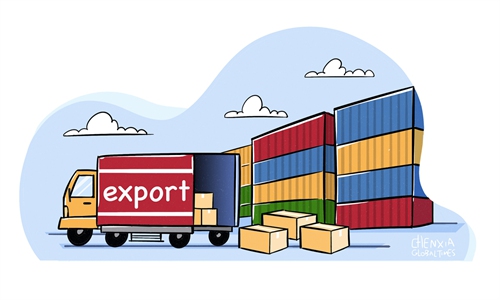
Illustration: Liu Xiangya/GT
The Indian rupee traded in a narrow range on Wednesday after opening higher, Reuters reported, following gains in the previous session. The currency had risen to a two-month high against the US dollar on Tuesday, amid volatility in global financial markets and continued uncertainty over external conditions.
The recent gains came after a period of weakness for the Indian rupee. In August, NDTV reported that the Reserve Bank of India had stepped into the foreign exchange market by selling dollars to keep the rupee's depreciation orderly. The currency's recent recovery suggests that India has the policy tools to smooth short-term volatility, although longer-term stability will still depend on deeper economic fundamentals.
India's growth momentum remains strong, with GDP expanding 7.8 percent in the April-June quarter. Such growth can provide support for the rupee over time. But a more fundamental question is whether India's economy, particularly its manufacturing sector, can strengthen its capacity to earn foreign exchange. A stronger industrial base could help India build a more sustainable source of foreign exchange earnings and provide a firmer foundation for the rupee's long-term stability.
Building manufacturing capacity requires more than capital alone. For India, deeper integration with global manufacturing networks could help strengthen its industrial base and enhance its capacity to earn foreign exchange over time.
From India's perspective, attracting foreign investment, particularly that linked to manufacturing and supply chains, is consistent with its broader industrial goals. Such investment can bring additional capital inflows while helping expand production capacity, strengthen industrial linkages and connect Indian manufacturers with global markets.
Investment that brings supply-chain links can be particularly valuable for India. China, as one of the world's largest manufacturing economies, has built extensive capabilities in sectors such as electronics, new-energy vehicles, auto components and industrial equipment. These are areas where India is seeking to expand its manufacturing capacity, and where foreign investment can play an important role. This creates potential for greater industrial complementarity between the two economies.
Foreign investment in manufacturing can serve both immediate and longer-term objectives. In the near term, capital inflows associated with such investment can provide support to the foreign exchange market and help ease pressure on the rupee. Over time, investment that expands production capacity, develops local suppliers and strengthens export competitiveness can improve India's external balance, creating a more sustainable foundation for currency resilience.
Beyond their impact on foreign exchange flows, foreign investments can also contribute to India's industrial development. In this sense, improving currency resilience and expanding manufacturing capacity are not competing objectives. They can reinforce each other over time.
Turning this potential into reality, however, requires a stable and predictable investment environment. Manufacturing investment is a long-term decision, and companies need confidence in policy consistency, market access and the broader business environment before making these decisions.
India has shown signs of easing some long-standing restrictions on trade and investment with China. Further progress in this direction could help strengthen investor confidence and create more room for industrial investment.
Further progress in this direction could unlock greater opportunities. China and India have areas of economic complementarity, particularly in manufacturing and supply chains. Greater Chinese investment in India could create value on both the financial and industrial fronts, supporting foreign exchange resilience while strengthening manufacturing capabilities.
For many economies, exchange-rate resilience ultimately depends on the strength of the real economy. India is no exception. In a complex and volatile world, strengthening currency resilience and expanding manufacturing capacity are closely connected parts of the broader economic picture. In this process, the role of Chinese investment deserves closer consideration. Greater opening-up to Chinese investment could help India strengthen industrial capacity, improve export competitiveness and build a stronger foundation for long-term economic resilience. The opportunity is there; the next step is for India to seize it.
The author is a reporter with the Global Times. bizopinion@globaltimes.com.cn
RELATED ARTICLES