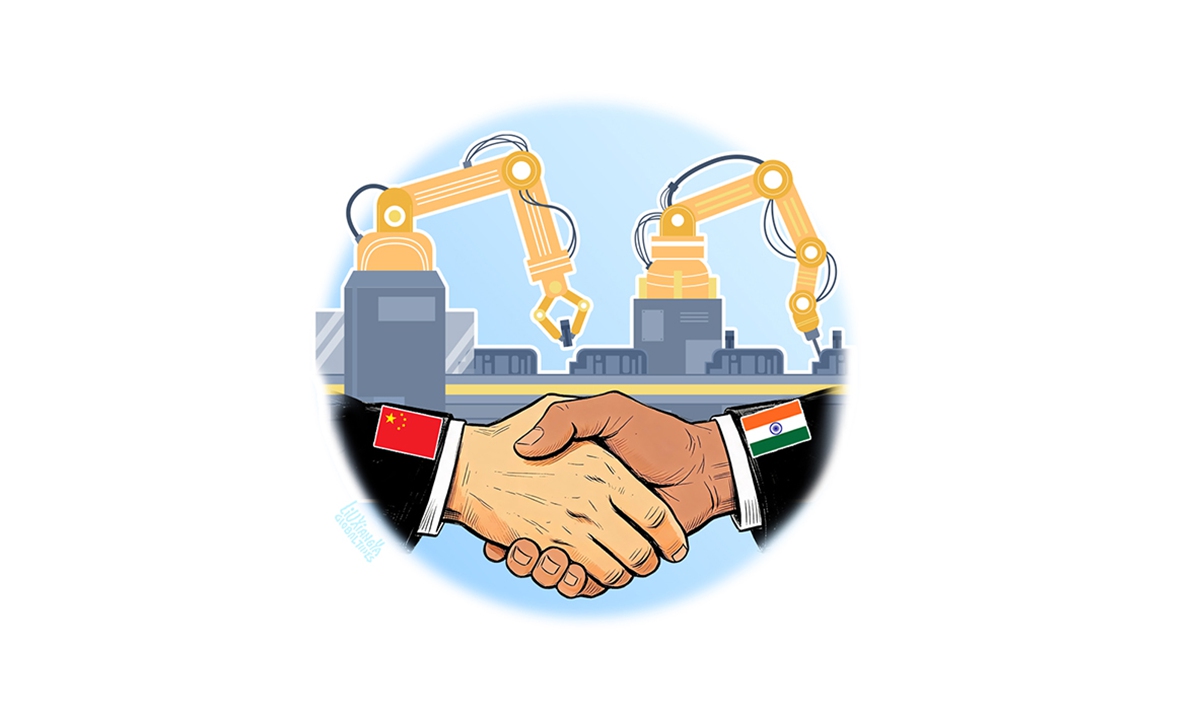
China-India economic coorperation Illustration: Liuxiangya/GT
How many components does a car contain? The answer may be tens of thousands. Underpinning each vehicle is a fairly complicated and ripe manufacturing ecosystem. This simple fact highlights the complexity of modernizing an economy.
It is against this backdrop that India's External Affairs Minister S Jaishankar's recent remarks on China have attracted attention. Speaking at the Economic Times World Leaders Forum, Jaishankar said that India has to do business with the entire world, and "that includes China too." He said that India's engagement with China should be driven by the need to modernize the Indian economy and strengthen its domestic capabilities.
India's manufacturing goals and its economic engagement with China appear to be moving toward greater alignment. As two important players in global economy, China and India have often been portrayed by the Western media as being locked in a fierce competition, which is not true.
Jaishankar's remarks come at a time when New Delhi is placing greater emphasis on manufacturing as part of its economic development. The country aims to develop a complete value chain, from components and design to the manufacturing of complete products, and position itself as a "trusted center" of the global supply chain.
Now, a more important question is emerging: how India can use ever broader economic engagement with China to modernize its economy. The fact that this discussion is taking place in India reflects a more practical view of how economic engagement with China could contribute to India's manufacturing sector development. It creates additional space for cooperation between China and India, particularly in areas related to supply chains and industrial capacity. The key issue now is how this space can be turned into more concrete outcomes.
This is an area where India could consider going further. More specific measures to facilitate bilateral trade, investment and industrial cooperation could help create a more predictable environment for companies from both countries and support deeper participation in manufacturing and supply chains.
Trade offers a good perspective. China-India trade reached $155.6 billion in 2025. India's exports to China increased 9.7 percent year-on-year, with China's large consumer market, including more than 400 million middle-income consumers, providing opportunities for more Indian products. Greater access to this market could help Indian companies expand their scale, improve their competitiveness and contribute to the bigger goal of modernizing the Indian economy.
Imports from China are another part of this picture. Many Chinese exports to India consist of industrial inputs, including raw materials, components and equipment that support India's manufacturing sector. These inputs serve as building blocks for industrial development in India. Access to such inputs can help Indian manufacturers improve efficiency, expand production capacity and strengthen its domestic capabilities.
The importance of these industrial inputs becomes clearer when looking at what lies behind modern manufacturing. A new-energy bus, for example, is not simply a finished product, but the result of a vast network of components, materials and manufacturing processes. From precision components that improve power transmission efficiency to high-strength aluminum profiles used in vehicle structures, every vehicle reveals the complexity of an industrial ecosystem.
The next angle is to look beyond trade flows. Many intermediate goods exported from China to India are already supporting Indian industries. If these links develop further into investment and industrial cooperation, they could help strengthen India's manufacturing capabilities and supply-chain integration.
Industrial modernization is a complex process that requires suppliers, technology, skills and accumulated manufacturing experience. Deeper economic engagement with China will benefit the formation of this ecosystem in India. The role of this engagement is already evident in many manufacturing sectors.
The focus is on how to translate existing economic links into greater support for India's industrial development. The earlier this potential is realized, the greater the benefits can be.
The author is a reporter with the Global Times.
bizopinion@globaltimes.com.cn
RELATED ARTICLES