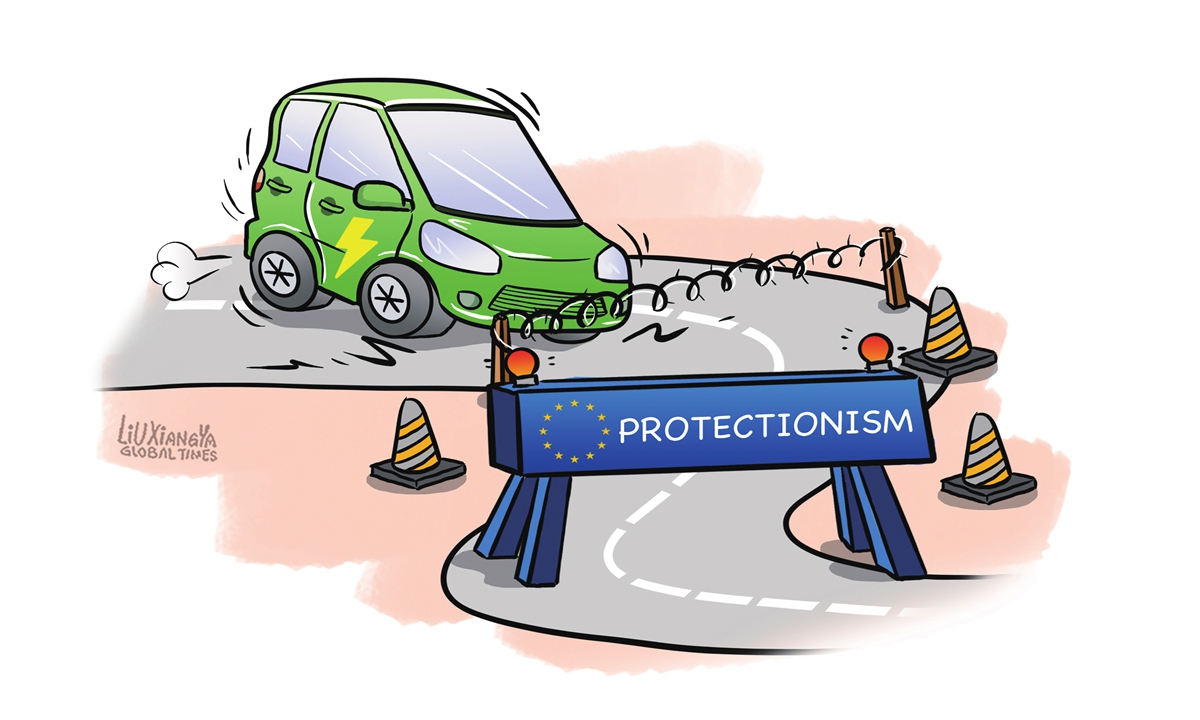
Illustration: Liu Xiangya/GT
Sebastian Lechner, state chairperson of the Christian Democratic Union in Germany's Lower Saxony, has called for the EU to quickly impose import tariffs on Chinese hybrid cars, Reuters reported on Friday.
For some time, European media have reported that the European Commission plans to impose countervailing duties on such vehicles, which will amplify concerns over China-EU trade tensions.
As the home to Volkswagen's global headquarters, Lower Saxony has been bearing the brunt of industrial restructuring amid the global energy transition. So, the politician's call for imposing tariffs on Chinese hybrid cars is essentially an attempt to curry favor with local manufacturers and local workers in exchange for gaining political support from them.
But turning the operational pressure of local carmakers into political demand to erect trade barriers will not solve Germany's industrial problems. On the contrary, protectionism will almost certainly steer German auto sector further down the wrong path.
For years, a number of European politicians and industry players have attributed the rapid growth of Chinese new-energy vehicles to the so-called "subsidies," hoping that erecting higher tariffs can shield European carmakers from global competition. Yet, the growing popularity of Chinese hybrid vehicles in the European market stems from nothing but their perfect alignment with the most pressing consumer demands.
For starters, it's very expensive for ordinary European consumers to replace vehicles due to the persistently high prices of local cars. The EU has unveiled a plan to drop the ban on new combustion-engine cars from 2035, which would allow continued sales of non-electric vehicles including plug‑in hybrids (PHEVs). Market acceptance of PHEVs is relatively high in Europe.
As a matter of fact, Chinese PHEVs have helped fill a critical market gap and provided European consumers with a pragmatic and affordable low-carbon mobility solution. Resorting to protection by imposing higher trade tariffs will deprive European consumers of the right to buy high-quality and cost-effective cars.
If anything, the market performance following the EU's imposition of new tariffs on Chinese electric vehicles (EVs) has already proven that trade protectionism only delivers limited effects in the long run.
A report published by The Guardian revealed this month that despite EU tariffs of up to 35.3 percent on the EVs made by some Chinese manufacturers, on top of the standard 10-percent import duty, Chinese EV sales have still risen across Europe to hit a record high.
The share of EVs sold by Chinese brands rose to 14.2 percent across western European markets - or one in every seven EVs - in the first five months of this year, according to Schmidt Automotive Research.
Following a brief sales drop caused by tariff shocks, Chinese cars have quickly regained growth momentum, as their appeal to European consumers who favor affordable, high‑quality electric mobility has not changed.
If the EU extends protectionist measure to Chinese PHEVs, European consumers will bear the full brunt of higher prices. Elevated prices could erase the new energy consumption push in Europe. The European auto market, which has just begun to show signs of recovery, will once again be dragged into a prolonged slump by protectionism.
According to China Automotive News, more than 40 percent of the complete vehicles exported from China to the EU market come from joint ventures or wholly foreign‑owned factories in China. That means for every five cars shipped to Europe, roughly two are produced by European or other foreign manufacturers - including BMW and Mercedes‑Benz, all of which rely on China's mature supply chains to build highly competitive models and ship them back to Europe. Imposing punitive duties on these vehicles would raise their costs and disrupt their integrated production strategies.
In addition, China's stance on tackling trade issues with the EU has always been clear. In May, a spokesperson from China's Ministry of Commerce said that China will take resolute countermeasures if the EU insists on imposing discriminatory restrictions on Chinese companies.
Ultimately, the competitiveness of the global auto industry is never decided by tariffs. The race toward electrification and intelligence is one of technological innovation, supply‑chain efficiency, and cost control. Tariff pushes by certain politicians may win favor from local workers, yet they will trap Europe's automotive industry in a vicious cycle of protectionism. In the long run, such short-sighted moves will undermine the long-term vitality and competitiveness of European carmakers.
RELATED ARTICLES