India eases China investment, trade curbs: Indian media; economic ties likely entering a new stage: Chinese expert
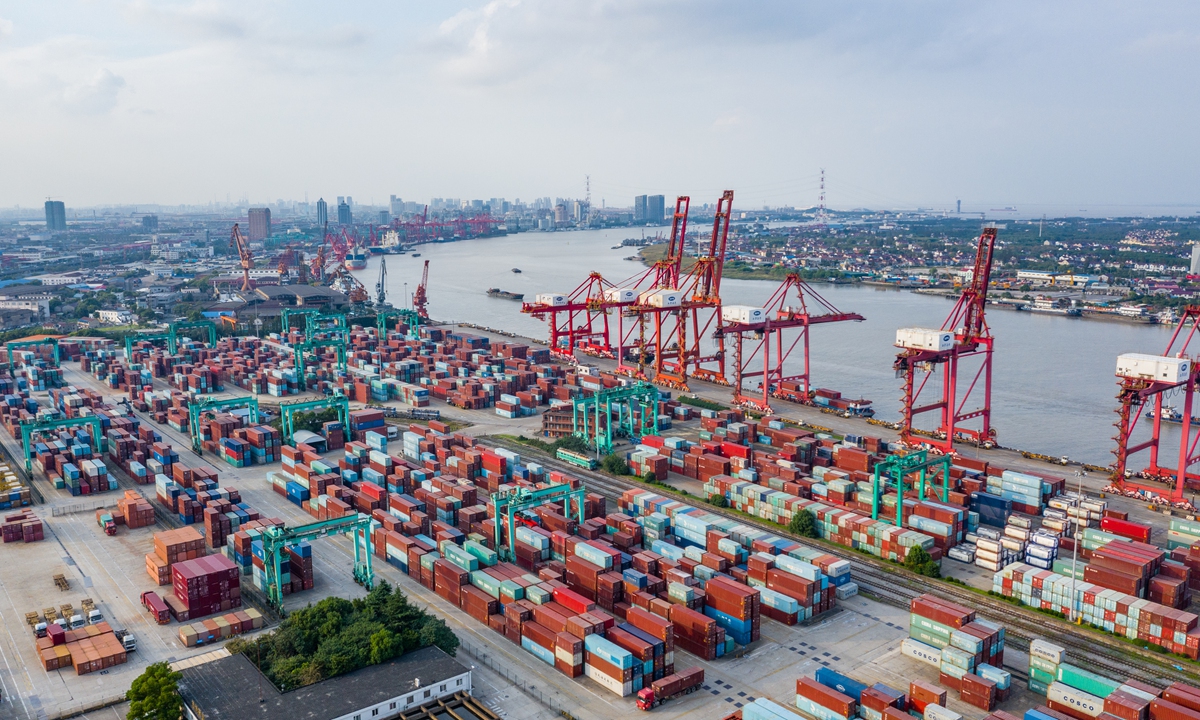
Aerial view of Shanghai Port in Baoshan district, Shanghai Photo: VCG
India has recently shown signs of easing some long-standing restrictions on trade and investment with China, as the country seeks to balance strategic considerations with the need to attract more economic engagement from the world's two largest economies, the US and China, The Hindu reported.
A Chinese expert said that India's recent adjustments to its China-related economic policies may have been driven by its growing recognition of China's importance to its economic development, and a desire to create a more favorable environment for improving bilateral ties.
The Indian government has in recent months been "walking a tightrope" between maintaining its strategic objectives and encouraging more trade and investment from the US and China, The Hindu reported on August 1.
The balancing act has led to gradual policy adjustments, including easing restrictions on foreign direct investment (FDI) in e-commerce, allowing FDI from companies with Chinese ownership, and taking measures against trade partners' so-called dumping practices in India, according to the report.
The Hindu reported that "one arena in which this balancing act is playing out is in the manner in which the country uses its anti-dumping duties." Data compiled by the Centre for Digital Economy Policy (C-DEP) showed that the Directorate General of Trade Remedies (DGTR) made 1,052 recommendations to the Ministry of Finance on imposing or extending anti-dumping duties between 1991 and 2020, of which only five, or 0.5 percent, were rejected.
The trend shifted after 2020, with the rejection rate rising to 50-62 percent in each of the 2020-21, 2021-22 and 2022-23 financial years, before falling to 20.8 percent in 2023-24 and 6.1 percent in 2024-25. The rate rose again to 41.5 percent in 2025-26 through December 31, 2025, according to the data shared with The Hindu.
The data also showed that China-related cases accounted for the majority of rejected recommendations, with cases involving Chinese goods, either alone or alongside other countries, making up 72 percent of all rejected cases between 2000 and December 2025, The Hindu reported.
Qian Feng, director of the Research Department at Tsinghua University's National Strategy Institute, told the Global Times on Monday that India's adjustment of its China-related economic policies is mainly driven by its growing recognition of the importance of Chinese imports to its economy.
He said rising trade frictions with the US have also prompted India to seek a balance between the world's two largest economies to attract more trade and investment. In addition, India's policy adjustments also reflect its desire to improve and stabilize overall China-India relations and create a more favorable environment for bilateral ties, Qian said.
The Hindu reported that the rise in rejected "anti-dumping" duty recommendations coincided with a shift in the composition of India's imports from China, with the focus moving from finished products toward intermediate goods that can be processed in India and exported.
India's Minister of State for Commerce and Industry Jitin Prasada said in Parliament in February 2026 that most imports from China were capital goods, intermediate goods and raw materials, including active pharmaceutical ingredients, auto components, electronic parts and mobile phone components, which are used to produce finished goods that are also exported from India.
The Hindu reported that, in a bid to increase investment into India, the Indian government has made several changes to long-standing policies concerning China. In March 2026, the Union Cabinet approved a limited relaxation of rules introduced in 2020 by allowing investments from companies with up to 10 percent Chinese ownership to enter India through the automatic route, meaning they no longer require explicit government approval.
China-India exchanges are also increasing in other areas. According to TTG China, Air India has notified travel agents that it will resume direct flights between Shanghai Pudong and Delhi from September 2026, operating five flights a week with Boeing 787-8 aircraft. The resumption marks the full restoration of Air India's services in the Chinese market.
Also, Rakesh Mohan, a member of Prime Minister Narendra Modi's Economic Advisory Council, has called for further easing restrictions on business travel and people-to-people exchanges, including expanding business visa access, strengthening academic exchanges and restoring more flight routes, according to The Economic Times.
Mohan said deeper economic engagement with China had become unavoidable as India's reliance on Chinese imports continues to grow, with imports from China exceeding $130 billion in the fiscal year ended March. He also urged New Delhi to reconsider its decision not to join the Regional Comprehensive Economic Partnership (RCEP) and seek membership in the Comprehensive and Progressive Agreement for Trans-Pacific Partnership (CPTPP), the report said.
Qian told the Global Times that a series of recent policy adjustments show China-India economic ties are likely entering a new stage after years of frictions, and India is seeking more pragmatic and deeper cooperation with China.
RELATED ARTICLES