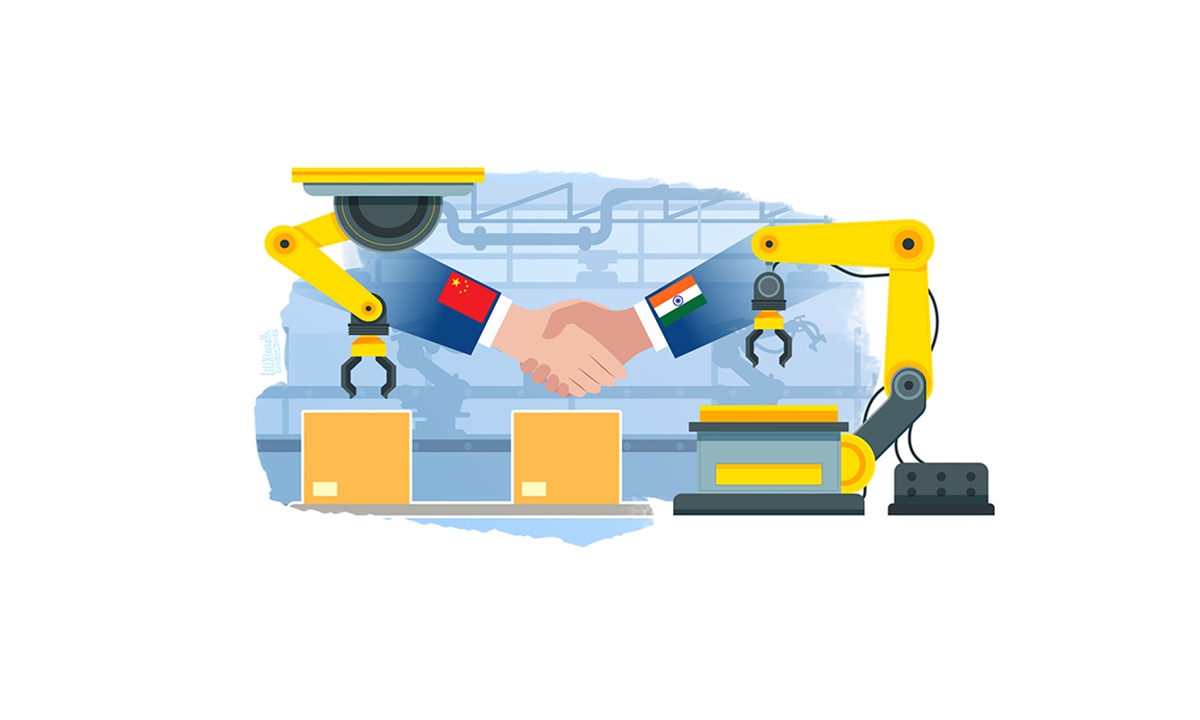
China-India industrial cooperation potential Illustration: Liu Xiangya/GT
India's manufacturing sector has been drawing fresh attention in recent days. One point that stands out is a new report from NITI Aayog.
Cited by Indian media ThePrint, the report showed that India's share in global manufacturing value grew from about 1.5 percent in 1995 to only 3.2 percent in 2023. China, by contrast, saw its share increase from about 5 percent to nearly 32 percent over the same period. The comparison highlights a wide gap: China's share is roughly 10 times that of India.
The comparison comes as India is seeking to further develop its manufacturing sector. For India, expanding manufacturing has become an important part of its broader economic development agenda. The NITI Aayog report noted that manufacturing currently accounts for 17.5 percent of India's gross value added, while the Indian government has set a goal of raising manufacturing's contribution to the economy.
India's commitment to expanding manufacturing is clear, but the way forward matters. A growing view is that India needs to move beyond assembly-led and lower-value manufacturing and seek deeper participation in global value chains. This points to a crucial area in India's manufacturing upgrade: supply chains.
Moving beyond assembly-oriented manufacturing and building deeper supply chains is part of India's industrial upgrading. It marks a natural stage in the development of a manufacturing economy, as companies seek to strengthen their supplier networks, improve production capabilities and become more deeply integrated into global value chains. For India, this means entering a deeper stage of industrial development.
The development of stronger supply chains needs to be viewed in a broader global context.
Over the past decade, production networks across Asia and the world have become more interconnected and sophisticated. Advances in technology, along with rising demand for manufacturing precision and increasingly complex components, have pushed companies to continuously reorganize their supply chains. As a result, trade in intermediate goods and critical components has expanded, while regional production networks have become increasingly dense and integrated.
From an economic perspective, building a completely self-contained manufacturing network would be highly unrealistic. For India, the more practical path lies in deeper integration into existing global and regional production networks and gradually strengthening its position within them.
Achieving this goal will require India to remain open to trade, investment and broader economic cooperation. Stronger supply chains cannot be built through domestic efforts alone; they also depend on deeper connections with other economies. A more open business environment would help attract investment, encourage industrial collaboration and allow companies to participate more effectively in global production networks.
In this process, China is likely to remain an important factor. China has been the world's largest exporter of intermediate goods in recent years, reflecting the depth of its manufacturing ecosystem and its extensive role in global supply chains. While competition between Chinese and Indian industries is likely to continue, the potential for cooperation deserves greater attention. Deeper engagement could create new opportunities as India is seeking to strengthen its position in regional and global production networks.
At the industrial level, cooperation between Chinese and Indian companies is already expanding through market-driven forces. Trade offers one indication of this trend. Rising bilateral trade reflects not only commercial exchanges, but also the growing demand for closer supply chain links and deeper industrial integration.
Such industrial demand requires a policy environment that supports, rather than constrains, cooperation based on market realities. From this perspective, providing Chinese companies with fair and predictable treatment would not only benefit individual businesses, but also contribute to India's broader manufacturing development, particularly by strengthening supply chains and industrial capabilities.
For India's manufacturing development, building strong supply chains will provide the foundation for growth. A deeper and more resilient industrial base will take time to develop, but it will create the capacity needed for long-term expansion.
The author is a reporter with the Global Times. bizopinion@globaltimes.com.cn
RELATED ARTICLES