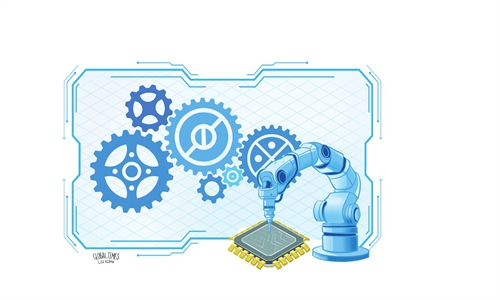
Illustration: Chen Xia/GT
India has recently approved Semicon 2.0 for the development of the country's semiconductor design and manufacturing ecosystem, with a total budget outlay of 1.28 trillion rupees ($13.3 billion). The move comes as the global chip industry undergoes a broad restructuring, with economies placing greater emphasis on this strategically important sector amid intensifying competition. In this context, the Semicon 2.0 could be viewed as a step in India's efforts to move into technology-intensive manufacturing and establish a semiconductor industry capable of producing chips at scale under the made-in-India label.
Yet semiconductor manufacturing is not an industry that can be built through investment alone. It depends on a much broader industrial foundation, including specialized equipment and materials, manufacturing expertise, downstream demand and reliable infrastructure. Global experience shows that semiconductors are among the most technology-intensive industries, with competitiveness built over time through accumulated industrial capabilities. Without a mature manufacturing base to underpin it, developing a competitive semiconductor industry can be a difficult task.
Industrial development ultimately depends on the strength of the foundations beneath it. India's power system offers one example. In May, Reuters reported that some parts of India were grappling with power cuts as record-breaking heat pushed electricity demand to a record high in excess of 270 gigawatts. The episode highlighted the continued scope for India to strengthen its power infrastructure and other foundational industries that underpin industrial growth. For India, reinforcing these foundations will be an important part of the longer-term effort to develop more sophisticated manufacturing capabilities.
Under Semicon 2.0, India is seeking to attract more manufacturers to set up fabs to make chips. Expanding semiconductor manufacturing capacity would be an important step toward building a domestic chip industry. Yet such facilities depend on a much broader industrial foundation, including a reliable supply chain, technical expertise and supporting infrastructure, all of which take years to develop. For India, gradually strengthening these underlying capabilities could provide a more solid foundation for its goal of producing chips domestically.
For India to accelerate semiconductor manufacturing, the pace of development in its foundational industries will need to accelerate. These sectors would need to reach a sufficient level of maturity within a relatively short timeframe to provide the industrial support required by chip production. Achieving this would be a significant test for India's manufacturing base, which is still building the capabilities needed for more advanced industries.
These foundations extend beyond power supply to include clean energy, basic materials, electronics manufacturing and other elements of the industrial system that support advanced manufacturing.
One way for India to accelerate the development of these sectors is to draw more actively on global resources, including by attracting international investment and ensuring access to critical components and technologies through global supply chains. A more open approach can help reduce the time needed to build the capabilities that underpin advanced manufacturing.
Against this backdrop, a strategy centered on reducing reliance on overseas suppliers could prove counterproductive. Deeper integration into regional supply chains and broader industrial cooperation could offer a more practical path, allowing India to draw on external resources and shorten the time needed to build its own industrial capabilities.
In areas such as power infrastructure, clean energy and electronics manufacturing, China and India have developed supply chains with areas of complementarity. China's years of industrial accumulation in these sectors could provide opportunities for cooperation, enabling both sides to capture potential gains from greater economic engagement.
In these areas, the benefits of cooperation may outweigh those of competition. A more open approach, including providing foreign companies with a fair and predictable business environment, could accelerate the broader development of India's manufacturing ecosystem.
Ultimately, India's semiconductor manufacturing prospects will depend not only on attracting chip facilities, but also on strengthening the wider industrial base that supports them. Building that foundation through steady industrial development and broader cooperation would allow India's efforts to produce chips domestically to advance on a more sustainable footing.
The author is a reporter with the Global Times. bizopinion@globaltimes.com.cn
RELATED ARTICLES