China’s economy sustains stable momentum in Nov
Favorable conditions to help achieve full-year targets: NBS spokesperson
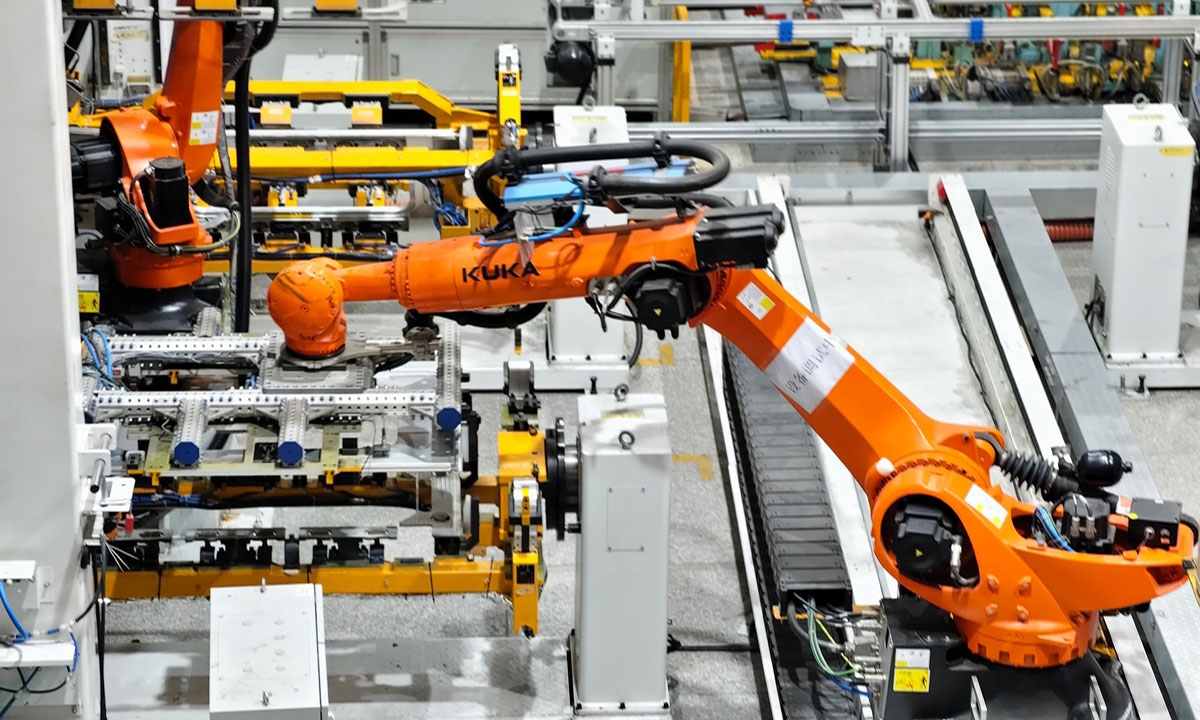
Robotic arms perform precision operations at an intelligent factory in Nanjing, East China’s Jiangsu Province, on September 20, 2025.Photo: VCG
China's economy sustained stable momentum with steady progress in November, with new quality productive forces developing at a solid pace, an official of the National Bureau of Statistics (NBS) on Monday, as the NBS released a slew of economic data.
The official noted that despite difficulties and pressures, the country's economy demonstrates strong resilience, with robust macroeconomic policy support and steady growth in new drivers, creating favorable conditions for achieving the full-year targets.
According to data released by the NBS, the value-added of industrial enterprises grew by 4.8 percent year-on-year in November. The value-added of the equipment manufacturing industry increased by 7.7 percent year-on-year, while that of high-tech manufacturing rose by 8.4 percent year-on-year, 2.9 percentage points and 3.6 percentage points faster than the value-added of all industrial enterprises, respectively.
The output of 3D printing equipment increased by 100.5 percent, industrial robots by 20.6 percent, and new-energy vehicles by 17 percent year-on-year, the NBS said.
Retail sales reached 4.39 trillion yuan ($622.3 billion), up 1.3 percent year-on-year. From January to November, retail sales totaled 45.6 trillion yuan, up 4 percent year-on-year, with online retail sales up 9.1 percent, data from the NBS showed.
In the first 11 months, fixed-asset investment (excluding investments by rural households) decreased 2.6 percent year-on-year. Investment in the information services sector grew by 29.6 percent year-on-year, and in the aviation, spacecraft, and equipment manufacturing sector by 19.7 percent year-on-year.
"Since the beginning of this year, industrial production has made important contributions to promoting stable economic development. The accelerated integration of scientific and technological innovation with industrial innovation has effectively driven growth in industrial output, facilitated orderly progress in transformation and upgrading, and provided strong support for high-quality economic development," NBS spokesperson Fu Linghui told a press conference on Monday.
According to Fu, the value-added of high-tech manufacturing grew by 9.2 percent year-on-year, while that of smart consumer equipment manufacturing increased by 7.6 percent in the first 11 months. The value-added of digital product manufacturing rose by 9.3 percent.
Li Chang'an, a professor at the Academy of China Open Economy Studies at the University of International Business and Economics, told the Global Times on Monday that the performance of industrial value-added was attributable to the implementation of national policies supporting the real economy and advanced manufacturing, and new quality productive forces have continued to drive high-quality development in China's economy.
The relatively rapid growth in investment in the equipment manufacturing and high-tech industries also reflects the trend of optimization and upgrading in China's economic structure, Li added.
Noting the recent slowdown in the growth rate of retail sales, Fu said that it was mainly due to a higher base last year.
Wen Bin, chief economist at China Minsheng Bank, told the Global Times on Monday that during the same period last year, the trade-in subsidy policy had a pronounced effect on boosting consumption, which significantly elevated the base.
From a cumulative perspective, this year's growth in total retail sales has outperformed that of last year. In November, market sales continued to expand, services consumption grew relatively quickly, and new forms of consumption continued to flourish, Fu noted.
Fu said that as policies to boost consumption continued to take effect, retail sales of cultural and office supplies grew by 11.7 percent year-on-year, and communication equipment by 20.6 percent year-on-year, in November. Digital consumption, green consumption, and health consumption are increasingly becoming new consumption hotspots, he added.
Highlighting expanding market demand, and strengthening new growth drivers and effective macroeconomic policies, Fu noted there are favorable conditions for achieving the full-year targets.
Looking ahead to next year, Fu said that the international environment will feature numerous unstable and uncertain factors, with the negative impacts of protectionism and unilateralism continuing to manifest, and geopolitical conflicts remaining unpredictable.
Domestically, accelerating the building of a new development pattern, strengthening domestic economic circulation, and promoting dual circulation between the domestic and international markets will still require sustained efforts., the official said.
"While acknowledging risks and challenges, we must also recognize that China's economy has a solid foundation, abundant advantages, strong resilience, and great potential. The supporting conditions and basic trend of long-term positive development remain unchanged," Fu said.
The role of innovation-driven growth is strengthening, reform and opening-up are deepening continuously, and the modernization of the industrial system is accelerating, all of which will powerfully support favorable economic development, the spokesperson noted.
The recently concluded Central Economic Work Conference clarified work priorities for 2026, providing key guidance for high-quality economic development. Policies will also support innovation-driven development and deploy the formation of a complete chain encompassing talent, platforms, enterprises, and industries, Wen said.
RELATED ARTICLES