Powerhouse provinces unveil local development visions, expert says the pledges align with China’s 15th Five-Year Plan, promote wider range of growth
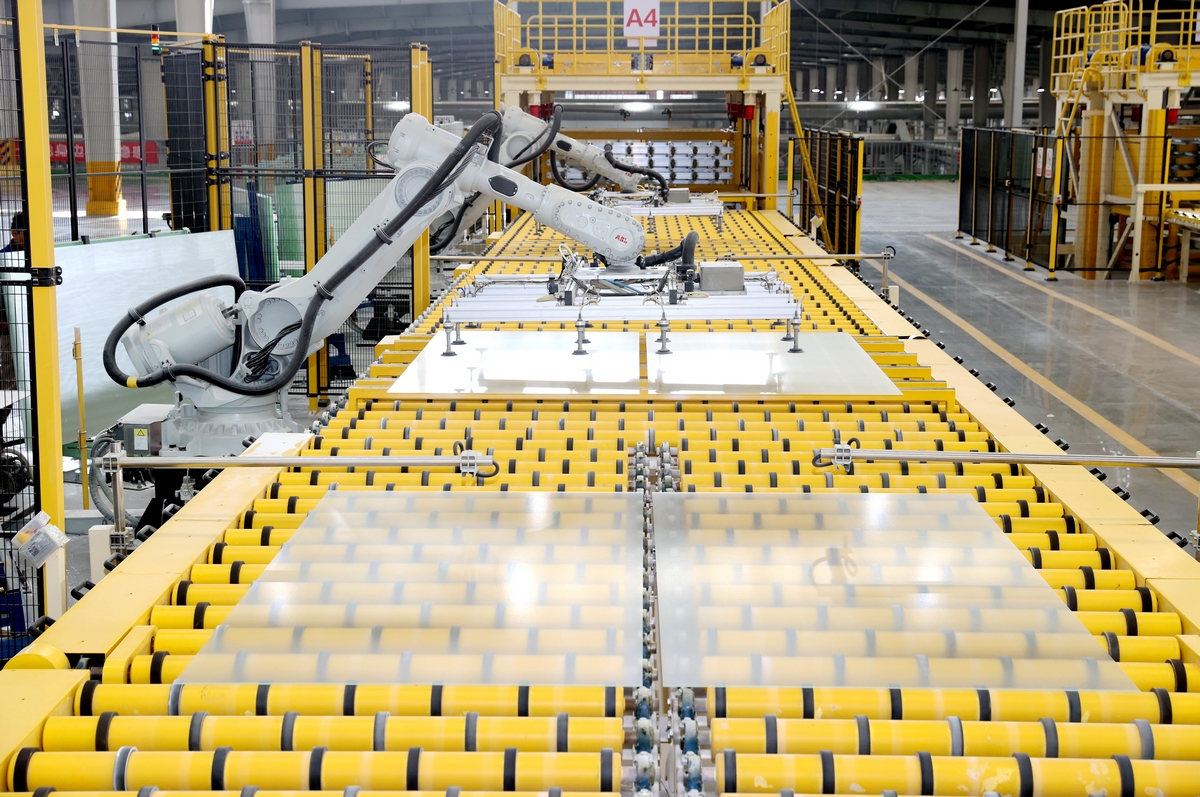
Robotic arms whirl and flip, stacking sheets of glass on a smart production line in Suqian, East China's Jiangsu Province, on December 10, 2025. Photo: VCG
Chinese economic powerhouses have unveiled recommendations for formulating their local 15th Five-Year Plan for economic and social development, pledging to shoulder greater responsibility in promoting high-quality development.
East China's Jiangsu Province on Thursday unveiled the recommendations of the Jiangsu Province for formulating the 15th Five-Year Plan for economic and social development, outlining measures to consolidate its leading position in traditional industries. The province calls for support for sectors such as metallurgy, chemicals, light industry, textiles, machinery, shipbuilding and marine engineering, and building materials in moving up the value chain toward mid- to high-end segments, according to the local government.
The province will also strengthen the competitiveness of strategic emerging industries, foster new growth engines such as aerospace and the low-altitude economy, and build internationally competitive clusters in strategic emerging sectors to cultivate new pillar industries. Jiangsu pledged to further integrate into the Yangtze River Delta's large aircraft industrial cluster.
Last year, Jiangsu's GDP reached 13.7 trillion yuan ($1.94 trillion), ranking second nationwide, with a growth rate of 5.8 percent year-on-year. In the first three quarters of 2025, the province's GDP totaled 10.28 trillion yuan, up 5.4 percent year-on-year.
Other major economic provinces also emphasized their responsibility to take the lead in driving national development in their respective recommendations.
On Monday, the recommendations of South China's Guangdong Province, which logged the highest GDP nationwide in 2024, highlighted further enhancing the integration of the Guangdong-Hong Kong-Macao Greater Bay Area (GBA) market. The province aims to work with Special Administrative Regions of Hong Kong and Macao to improve consultation and cooperation mechanisms, building a multi-level, comprehensive and three-dimensional collaboration framework, and turning the GBA into a powerful engine that radiates across the province and leads both domestic and international development.
Also on Monday, East China's Shandong Province's recommendations for the 15th Five-Year Plan period stressed strengthening the resilience and security of industrial and supply chains, including nurturing specialized and innovative enterprises, promoting integrated development among large, medium-sized and small businesses, and consolidating the advantages of its high-end manufacturing sector. The province logged the third-highest GDP in 2024.
Ranked fourth place in the 2024 GDP chart, East China's Zhejiang Province outlined recommendations on December 3 to deepen the integration of technological and industrial innovation, advance the development of artificial intelligence, and leverage the province's advanced manufacturing clusters to drive upgrades in traditional industries, foster emerging sectors, and strategically lay the groundwork for future industries.
The recommendations put forward by major economic provinces aim to set an example in economic and social development, high-quality growth, structural transformation, and the cultivation of new quality productive forces, while expanding their influence to surrounding areas and even to more inland provinces, Li Changan, a professor with the Academy of China Open Economy Studies at the University of International Business and Economics, told the Global Times on Thursday.
These major economic provinces have advantages such as large economic scale, rich innovation ecosystems, and a concentration of production factors, making them well-positioned to lead technological and industrial innovation over the next five years, Dong Shaopeng, a senior research fellow at the Chongyang Institute for Financial Studies at Renmin University of China, told the Global Times on Thursday.
Dong noted that equipment manufacturing, biomedicine, and new energy will be key industries for these provinces, which are also expected to actively engage with inland regions, using lower business costs to facilitate industrial transfers and result in a broader driving effect.
The Political Bureau of the CPC Central Committee on Monday held a meeting to analyze and study the economic work of 2026 and review a set of regulations on the CPC's leadership over law-based governance in all respects, the Xinhua News Agency reported.
The meeting called for efforts to advance the development of new quality productive forces in light of local conditions. It stressed the need to uphold innovation-driven development and accelerate the cultivation and expansion of new growth drivers.
RELATED ARTICLES