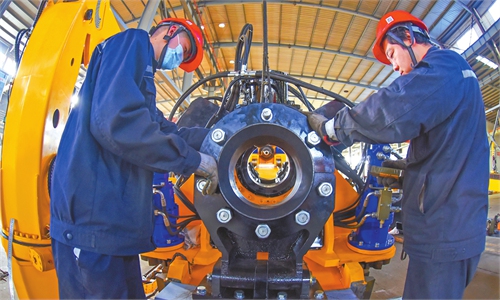
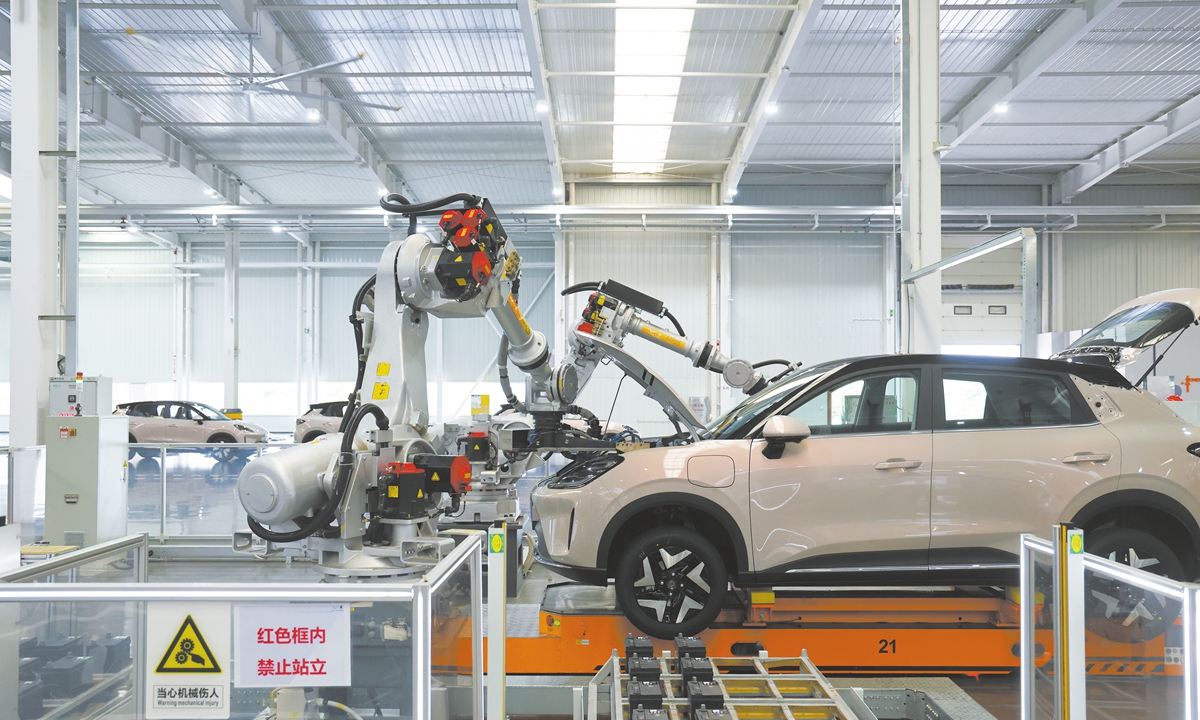
Robotic arms assemble vehicles on an automated production line at SAIC-GM-Wuling's Baojun manufacturing base in Liuzhou, South China's Guangxi Zhuang Autonomous Region, on November 17, 2025. Photo: VCG
As the Central Economic Work Conference was held last week, observers are closely watching the direction and priorities of China's economy for the coming year. Looking back at the economic performance in 2025, it is clear that current development reflects an ongoing, deepening structural transformation, and external shocks have in fact accelerated the shift toward high-quality, innovation-driven growth in China.
As 2025 draws to a close, China's economic development is shaped less by short-term fluctuations than by a deliberate reorientation of the growth model. Rather than merely recovering from previous disruptions, the economy has moved steadily toward a framework centered on innovation, industrial upgrading, and structural balance. This shift reflects a longer trajectory visible since the late 2010s. External pressures - trade tensions, technological restrictions, and global uncertainties - have, to some extent, functioned as catalysts for internal modernization.
China's economic growth in 2025 is largely stable. More important than the headline figure, however, is the composition of that growth.
Expansion is increasingly driven by sectors aligned with long-term strategic priorities, such as advanced manufacturing, green technologies, and new quality productive forces. High-tech industries, equipment manufacturing, and digitalized services have gained weight in the economic structure. China's position in global green and intelligent industrial chains - electric vehicles (EVs), batteries, photovoltaics, and high-end machinery - has underpinned China's exports.
Domestic consumption continues to recover in a measured but discernible way. Households are more selective, shifting demand toward higher-quality goods and services.
Policy initiatives such as trade-in programs for appliances and digital equipment, as well as improvements in digital public services, have supported the trend. While the rebound is uneven, the underlying direction is clear: Rising interest in sustainable products, improved social services, and a growing middle-class preference for quality over quantity suggest that future consumption growth will be anchored in a more mature, innovation-oriented ecosystem.
Industrial and technological development remains the most dynamic component of China's economy in 2025. The interaction among scientific research, industrial capacity, and large-scale implementation continues to be a distinctive strength. Progress in AI, bio-manufacturing, new materials, new-energy technologies, and aerospace reflects a coordinated system in which national strategies, entrepreneurial initiative, and well-planned market mechanisms coexist.
The concept of new quality productive forces has taken concrete shape in digitalized production, intelligent logistics, and low-carbon manufacturing. The experience of adapting to the tariff shocks of the late 2010s - initially viewed as a major threat - has left an important institutional imprint.
The country's supply chains have become more resilient, diversified, and technologically sophisticated. Rather than contracting, China's global manufacturing footprint has evolved toward higher value-added segments.
The long-discussed shift toward high-quality growth is visible in practice. Traditional industries are undergoing modernization through digital tools and energy-efficient processes. Meanwhile, emerging sectors - clean energy, robotics, EVs, digital platforms, and smart manufacturing - continue to expand at a rapid pace. These trends strengthen the coherence of China's modern industrial system and align with the strategic objectives expected to shape the forthcoming 15th Five-Year Plan (2026-30).
Looking toward 2026, the foundations for steady development are robust. International institutions have revised China's growth forecasts upward, noting its strong industrial capacity, technological momentum, and continuing investment in green transformation. Several drivers are likely to support the next stage of development.
Sustained global demand for high-value exports - particularly low-carbon and intelligent technologies - coincides with China's innovation translating into productivity as AI, cloud computing and automation are increasingly integrated across manufacturing and services.
A firmer basis for domestic consumption, supported by gradual improvements in welfare provision, incomes, and confidence will be reinforced by strategic direction from the 15th Five-Year Plan, which is expected to emphasize technological strength, domestic circulation, industrial modernization, and environmental goals.
China's economic performance in 2025 illustrates an ongoing structural transition rather than a short-term cycle. Past shocks - tariffs, supply-chain disruptions, and geopolitical tensions - have not reversed this trajectory but have accelerated the shift toward higher-quality, innovation-driven growth. Entering 2026, China is not simply stabilizing but consolidating the foundations of a new development stage characterized by tech upgrading, industrial modernization, and a more balanced growth structure.
The author is a full professor at the University of Vienna, a member of the Austrian Academy of Sciences, and Director of the Austrian Institute for China and Southeast Asian Studies. bizopinion@globaltimes.com.cn

Hannes Fellner Photo: Courtesy of Hannes Fellner
RELATED ARTICLES