Shifting blame to China cannot help Europe resolve its deindustrialization anxiety
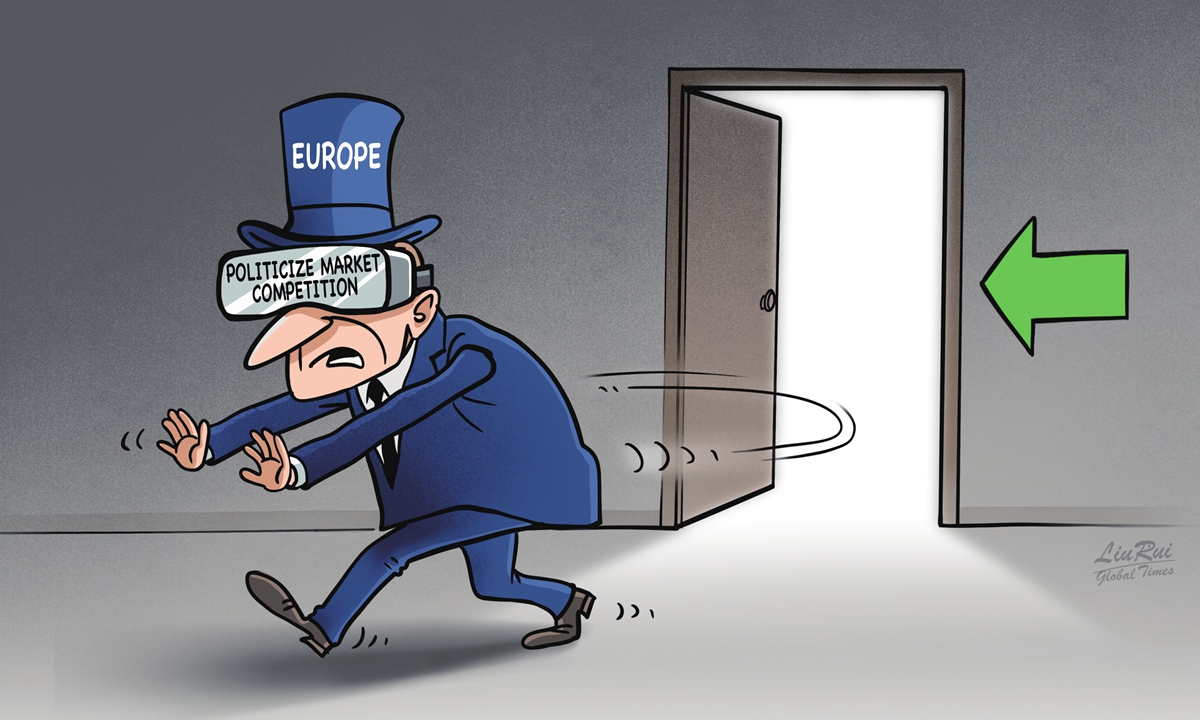
Illustration: Liu Rui/GT
In recent years, squeezed by a combination of high costs, weak demand, declining investment and industrial chain restructuring, Europe has seen its shares of global manufacturing value added and exports continue to fall. The international competitiveness of strategic emerging sectors, including new-energy companies, power batteries and solar photovoltaics, has also quietly weakened. Europe's deindustrialization has intensified anxiety across the continent. The concern is not merely about short-term orders and production capacity, but about whether Europe can maintain a foothold in advanced manufacturing, key technologies and global rule-making.Against this backdrop, European policymakers have taken frequent actions. On the one hand, they have strongly promoted initiatives such as the Net-Zero Industry Act and the Critical Raw Materials Act to support domestic industries and enhance supply chain security. On the other hand, they have sought to build "firewalls" through measures such as anti-subsidy investigations, higher tariffs and tighter foreign investment reviews, in an attempt to create a more favorable competitive environment for European manufacturing.
However, as the global landscape of competition and cooperation undergoes rapid restructuring, it remains to be seen to what extent these policies can reverse the decline in Europe's manufacturing share and ease its structural anxiety.
The claim that "China's subsidies have caused Europe's deindustrialization" is essentially just another variation of the "China threat" and "China overcapacity" narratives. In the past, Western countries attributed the competitiveness of China's labor-intensive products to a "low-cost shock." Today, as China has developed advantages in emerging industries such as new energy, electric vehicles, power batteries and solar photovoltaics, they have again reduced these advantages to the result of "subsidies."
The common thread behind such narratives is a refusal to acknowledge the changes in the competitive landscape brought about by adjustments in the global industrial division of labor and technological progress. Instead, they politicize and ideologize normal market competition.
What is particularly concerning is that the definition of "subsidies" has been continuously expanded in the West. It now not only includes direct fiscal allocations, but also covers low-interest loans, government funds, preferential land policies, tax breaks, and advantages in the prices of upstream inputs.
As a result, the comprehensive competitiveness of Chinese companies - built on complete industrial chains, economies of scale, technological advancement, a skilled workforce and a vast domestic market - has been deliberately portrayed as the outcome of "government intervention." This is not an objective analysis, but rather a process of reaching a predetermined conclusion and then piecing together so-called evidence.
Industrial policies are not unique to China. Policies such as subsidies for green transformation and broad-based tax incentives are widely adopted across major economies. World Trade Organization rules do not prohibit all forms of industrial support; rather, they primarily restrict subsidies that are tied to export performance and subsidies aimed at import substitution.
The rise of China's manufacturing sector is not the result of so-called "subsidies," but of the combined effects of decades of sustained investment, comprehensive industrial chain support, the backing of a vast market and intense market competition.
Europe's manufacturing challenges are driven by a range of factors, making it untenable to shift the blame to "Chinese subsidies." Blaming China's industrial policies for Europe's deindustrialization is a classic case of misdiagnosing domestic problems as external ones.
First, high energy costs have eroded Europe's industrial competitiveness. Since the Russia-Ukraine conflict, Europe shifted away from Russian energy and relied more on expensive liquefied natural gas imports, pushing up costs for energy-intensive industries such as chemicals, steel, aluminum and cement.
Second, carbon pricing and regulatory burdens have further squeezed industrial margins. With high EU carbon prices, the rollout of the Carbon Border Adjustment Mechanism and declining free allowances, industries including steel, cement, fertilizers and aluminum face rising compliance costs.
Third, Europe's manufacturing challenges also stem from structural issues, including high labor and compliance costs, fragmented industrial policies and insufficient investment. A long-term tilt toward finance and services has weakened manufacturing capacity and supply chain resilience.
Fourth, Europe's deindustrialization is also rooted in the coexistence of stringent regulation and market fragmentation, which has led to divergent data standards and hindered cross-border data flows. This has made it more difficult to support AI training and digital transformation, weakened the efficiency of production and supply chains, and weighed on productivity, innovation capacity and global competitiveness.
The anxiety facing European manufacturing also stems from rapid changes in the external competitive environment. The US has strengthened efforts to revive domestic manufacturing and attract high-end industries back home through initiatives such as the Inflation Reduction Act and the CHIPS and Science Act, creating a clear "siphon effect" on European companies and capital. Meanwhile, new industrial clusters in economies such as Japan, South Korea, and Southeast Asia are also increasing policy support and investment incentives in areas including new energy, electronics, automobiles, semiconductors and critical minerals, actively seeking to capture the global industrial shift.
Ignoring the collective push by the US and other major economies to expand industrial policies and reshape supply chains, while instead attributing Europe's manufacturing difficulties solely to China, is clearly an untenable example of selective reasoning.
The reshaping of the global manufacturing landscape should not be viewed simply as a zero-sum game in which one side's gains come at the expense of another. Instead, it should be seen as a process in which economies seek cooperation through technological innovation and industrial development. China and Europe share tangible common interests and strong structural complementarity.
On the one hand, Europe maintains advantages in areas such as high-end manufacturing, green technologies and standard-setting. On the other hand, China also possesses significant strengths in comprehensive industrial chains, market scale and application scenarios. Amid the restructuring of global industrial chains, the upcoming China-EU economic and trade consultations provide a crucial opportunity to move from "anxiety toward constructive cooperation."
The real solution to easing Europe's manufacturing anxiety lies not only in domestic reforms and external safeguards, but also in finding a new position and partnership within the global division of labor.
The author is professor and Vice Dean of the School of Economics and Finance, Xi'an Jiaotong University. bizopinion@globaltimes.com.cn
RELATED ARTICLES