Foreign trade resilience strengthens, relying on innovation despite external uncertainties
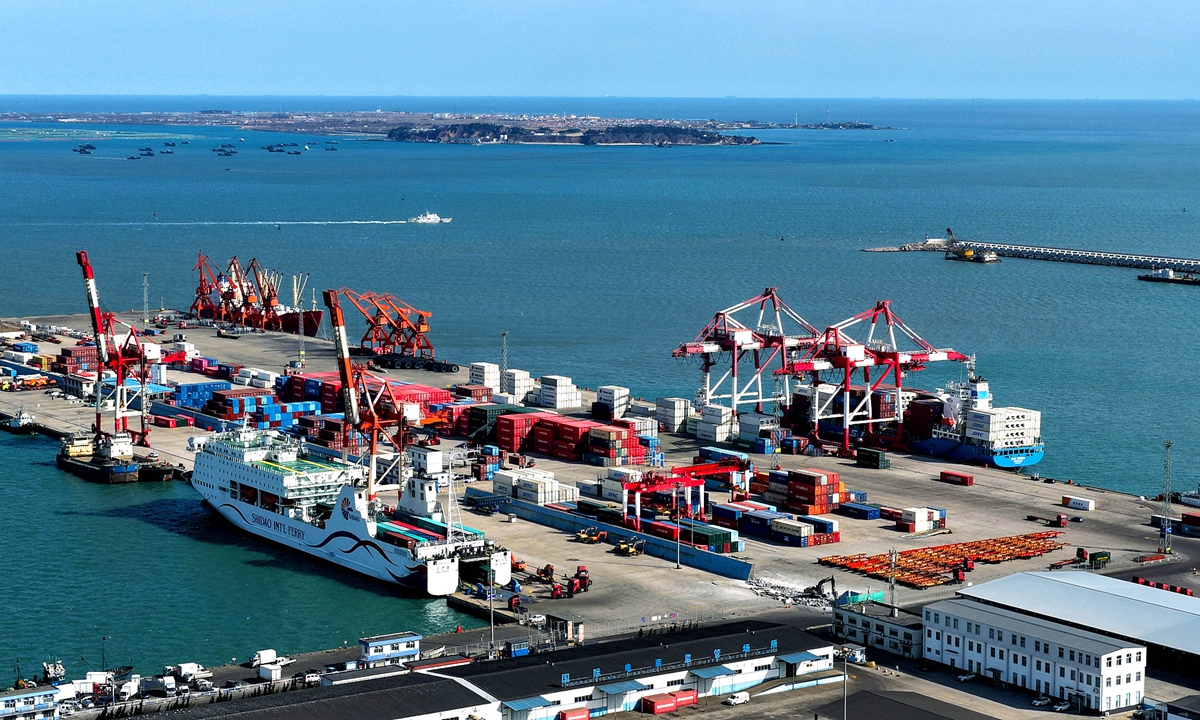
A foreign cargo ship is loaded at a berth in Rongcheng city, East China's Shandong Province, on January 30, 2026. Photo: VCG
In 2025, against a backdrop of mounting external challenges, China's foreign trade reached 45 trillion yuan ($6.48 trillion), growing by 3.8 percent year-on-year and demonstrating notable resilience. A structural reading of the data reveals the deeper forces underpinning this performance and shaping the outlook for 2026.
At the core of China's trade resilience lies the technology-driven upgrading of its industrial system. For decades, global perceptions of "Made in China" were anchored in labor-intensive, low value-added exports competing primarily on price. Yet the 2025 trade data underscores a decisive shift. Electromechanical products accounted for about 60 percent of exports, while equipment manufacturing approached a similar share, providing clear evidence that China's export mix is moving rapidly up the value chain.
This transformation reflects a systemic elevation of industrial capability. After decades of capital accumulation, supply-chain consolidation and entrepreneurial expansion, China has built one of the world's most complete manufacturing ecosystems. Competitive strength in both traditional and advanced manufacturing is not the product of short-term policy stimulus, but of sustained investment, technological learning and industrial deepening.
Equally critical is the strengthening of technological capacity. The global competitiveness of China's high-tech exports is inseparable from rising research and development intensity, policy support for innovation and the scaling up of education and research systems. As technological progress and industrial accumulation reinforce each other, high-tech production capacity continues to expand, elevating not only export volumes but also China's position within global value chains.
The trajectory of innovation-driven industrial and trade upgrading appears set to continue this year. China's foreign trade is likely to maintain steady growth while achieving further qualitative optimization in structure and value content.
As the export structure advances, imports are playing an increasingly strategic role in balancing trade and unlocking domestic demand potential. In recent years, China has placed greater emphasis on import expansion to foster a more sustainable and balanced trade framework.
Imports have long supported industrial upgrading. Large volumes of intermediate goods and high-tech components enabled Chinese manufacturers to integrate into global production networks and climb technological ladders.
That dynamic persists, as China still imports advanced intermediate goods to power high-end manufacturing. Yet the composition of imports is evolving. High-quality consumer goods and premium final products now account for a growing share, reflecting consumption upgrading and rising household incomes. This shift reflects that China's economic development is entering a new, higher-quality phase.
Institutional platforms reinforce this trend. Since its launch in 2018, the China International Import Expo has recorded rising intended deal values and expanding spillover effects. Even amid trade tensions, multinational participation remains robust, underscoring the strong appeal of China's market. The expo's role has expanded beyond trade matchmaking to investment facilitation, with some exhibitors evolving into long-term investors.

Wang Xiaosong Photo: Courtesy of Wang Xiaosong
Alongside traditional trade, new business models, especially cross-border e-commerce, are emerging as powerful growth engines.
Their rise is rooted in the convergence of digital technology and trade innovation. China's current competitiveness rests not only on manufacturing scale but also on digital infrastructure, smart manufacturing and industrial digitalization. In many segments, China has achieved leapfrog development.
Digitally enabled factories and data-linked supply chains allow firms to respond rapidly to overseas demand, enabling flexible production and customized exports.
Cross-border e-commerce is expected to further expand as logistics networks improve, overseas warehouses proliferate, and digital payment and customs facilitation advance, adding a new growth driver to China's foreign trade in 2026 and beyond.
Amid rising protectionism and global trade fragmentation, partner diversification has become another pillar of resilience.
Developed markets remain important due to their purchasing power. Signs of relative stabilization in China-US economic ties, combined with potential demand support from US macro policy, may sustain its import capacity in 2026. While Europe faces growth uncertainties, China-EU trade fundamentals remain solid.
At the same time, emerging markets are assuming greater prominence. Trade with Belt and Road Initiative participating countries exceeded 50 percent of China's total in 2025, highlighting the initiative's expanding commercial impact.
Beyond Southeast Asian economies, Africa and Latin America are becoming important incremental markets. Their aggregate demand, driven by industrialization and infrastructure needs, aligns strongly with China's manufacturing strengths.
Taken together, technology upgrading, import expansion, digital trade innovation and market diversification form a multilayered resilience framework underpinning China's foreign trade outlook in 2026.
The author is a research fellow at the National Academy of Development and Strategy, Renmin University of China. bizopinion@globaltimes.com.cn
RELATED ARTICLES