Proposed US biotech investment curbs on China risk shutting American investors out of China’s innovation boom: expert
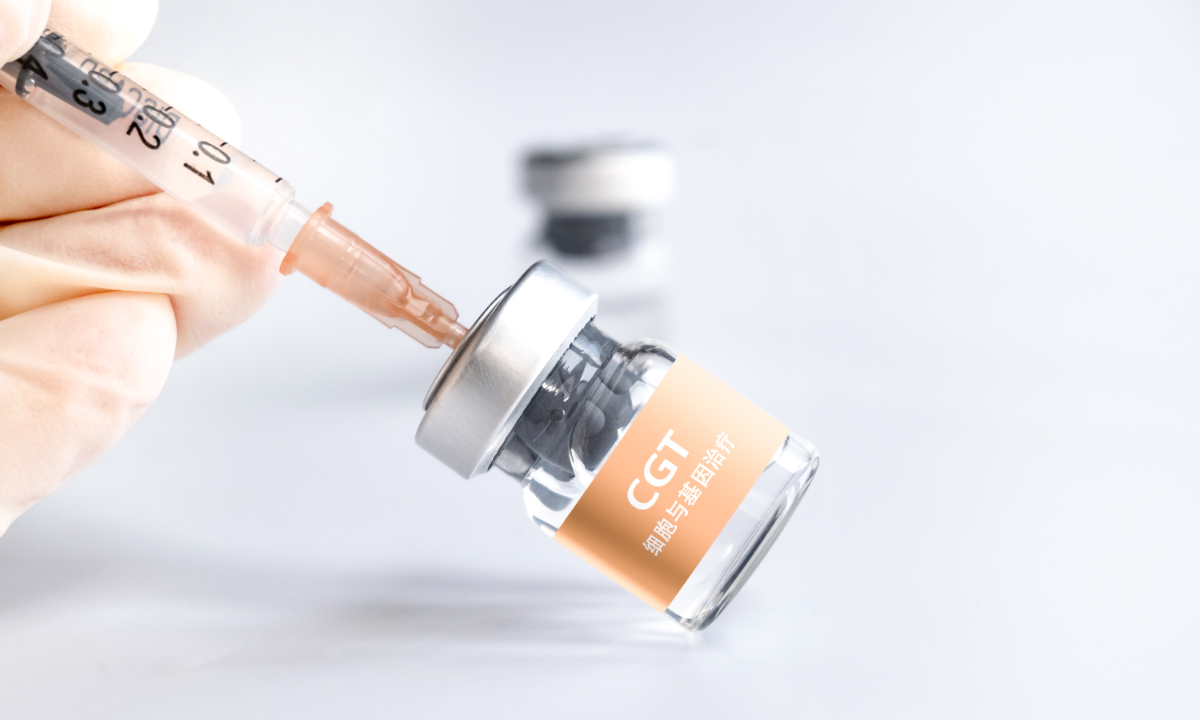
A vial representing cell and gene therapies, an emerging field in biopharmaceutical innovation. Photo: VCG
The US government's latest proposal to tighten outbound investment restrictions on China, extending scrutiny into the fast-growing biotechnology sector, signals a push to curb American capital's involvement in China's emerging industries. But an analyst warned that the restrictions could shut US investors out of China's innovation boom and slow global advances in drug development.
The move comes as global drugmakers increasingly turn to China for new treatments and research partnerships, putting Washington's security pretext-based restrictions at odds with the commercial interests of its own pharmaceutical industry.
The US Treasury Department on Thursday unveiled proposed regulations covering semiconductor technologies and microelectronics, artificial intelligence, quantum technologies, high-performance computing and supercomputing, and hypersonic systems, with biotechnology added to the list. Under the proposal, certain outbound US investments would be prohibited, while others would require notification, according to the Treasury.
Although the Treasury's announcement did not name China, an accompanying fact sheet identified China, including Hong Kong and Macao, alongside countries including Russia, Iran, and Cuba, among the "countries of concern" covered by the proposed restrictions.
Biotechnology is among the most significant elements of the proposal, as technologies shaping the future of drugs and treatments could also enhance China's military capabilities or deepen US reliance on Chinese supply chains, the Financial Times reported Thursday, citing an expert.
Zhou Mi, a researcher at the Chinese Academy of International Trade and Economic Cooperation, told the Global Times on Friday that Washington's widening investment curbs reflect an increasingly aggressive attempt to contain China's emerging sectors.
“By cutting off the flow of US technology, capital and talent, Washington seeks to protect its traditional advantages in fields such as biotechnology and prevent China from overtaking it,” he said.
But Zhou called the attempt to hold back China's progress "wishful thinking," arguing that restricting investment cannot reverse China's rapid advances in biotechnology, a field where innovation is moving at an accelerating pace.
The proposed rules, issued under the Comprehensive Outbound Investment National Security Act (COINS Act), enacted in December 2025, would update the Treasury's existing Outbound Investment Security Program.
The Treasury claimed the restrictions aim to prevent US investment in dual-use strategic technologies from supporting foreign adversaries' military modernization and surveillance capabilities.
In biotechnology, the proposal would prohibit investments involving certain technologies and activities, including biological design and sequencing, biomanufacturing equipment and brain-computer interfaces. The measures are still at the proposed rulemaking stage, with the Treasury seeking public comments through December 7, according to the Treasury.
Concerns are emerging within the US biotech industry. The Biotechnology Innovation Organization, a leading Washington-based industry lobbying group, warned that an overly broad approach could create uncertainty for innovators and investors and "may unintentionally risk weakening US biotechnology competitiveness," the Financial Times reported.
The Taxpayers Protection Alliance (TPA), a US-based consumer advocacy group, also criticized the Treasury's proposal as a "heavy-handed push" that could undermine biopharmaceutical innovation and harm patients. In a statement released Thursday, TPA warned that restricting foreign investment and cross-border licensing agreements could stifle critical capital, make it harder to bring new therapies to market and deprive American startups and laboratories of resources needed for medical breakthroughs.
Notably, the Treasury’s proposal would exempt pharmaceutical licensing deals involving cash payments but no equity investment, allowing companies such as Pfizer and Eli Lilly to continue securing rights to Chinese drugs, according to the Financial Times.
The US proposal comes as China becomes increasingly integrated into the global pharmaceutical innovation ecosystem and plays a growing role in international drug development.
Chinese drugmakers' overseas licensing deals reached a potential $139.4 billion as of October 8, surpassing the $138.8 billion recorded for all of 2025. Upfront payments also rose to $8 billion in the first three quarters, exceeding last year's full-year total of $7.2 billion, Reuters reported recently, citing data provider PharmCube.
Cross-border partnerships are also expanding. Swiss drugmaker Roche recently signed a licensing deal with China's Hansoh Pharmaceutical to develop cancer treatments, with potential milestone payments exceeding $15 billion. Hansoh will lead early-stage development, while Roche will handle further development outside Greater China, according to Hansoh's statement on Monday.
Zhou attributed China's growing appeal to strong domestic demand, diverse application scenarios and sustained industry support. "These advantages have drawn continued investment from US and European drugmakers, which increasingly tap Chinese pharmaceutical outsourcing services to advance their own drug development and technological innovation," he said.
Years of mutually beneficial China-US cooperation have accelerated the development of innovative treatments, Zhou noted. "But tighter investment curbs could slow US firms’ innovation progress, complicate technological and safety-related challenges, and limit American investors' opportunities to benefit from China's pharmaceutical innovation and market growth," he warned.
China has repeatedly opposed US restrictions imposed in the name of "national security." Responding to a US move targeting Chinese AI tools, Chinese Foreign Ministry spokesperson Mao Ning said on Tuesday that China consistently opposes overstretching the concept of national security and politicizing tech and trade issues, and will resolutely safeguard Chinese businesses’ lawful rights and interests.
RELATED ARTICLES