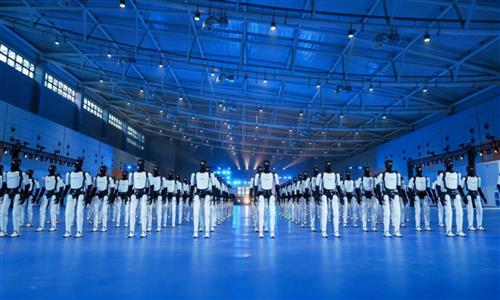
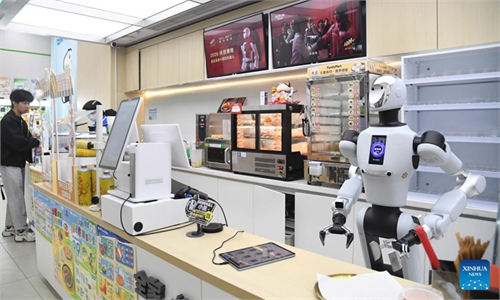
Unitree's newly unveiled humanoid robot stumbles at demo, drawing mixed reactions on Chinese social media
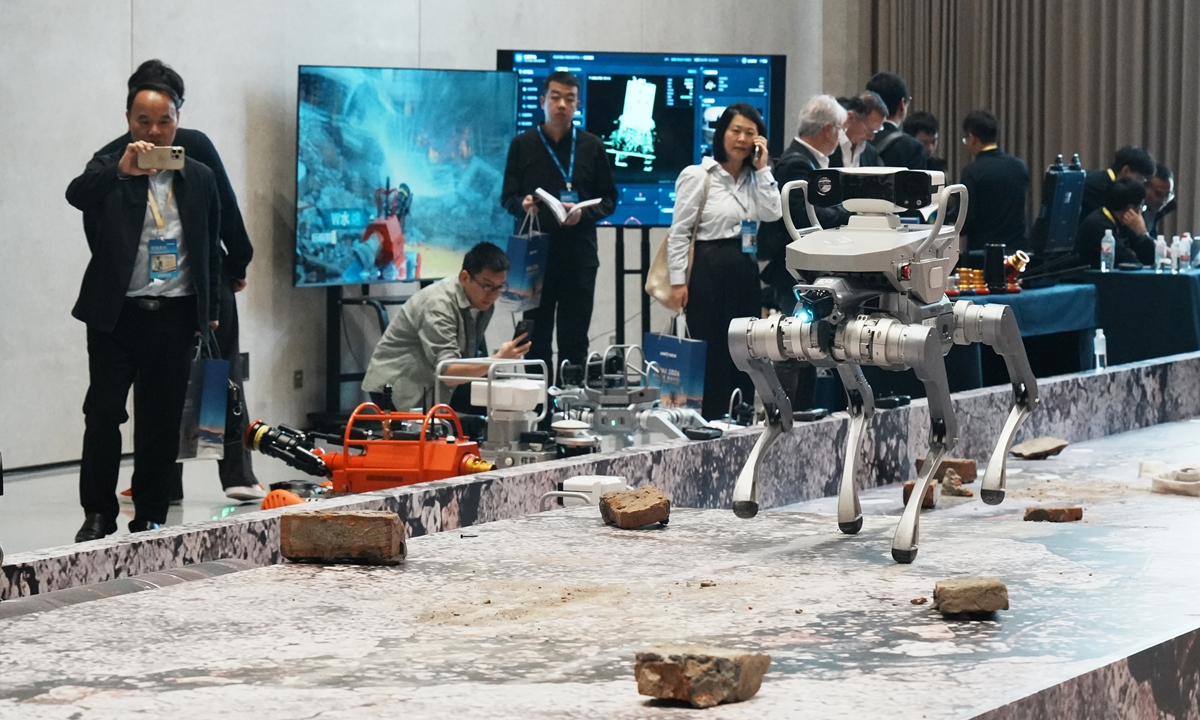
Visitors watch a robotic dog perform reconnaissance in a simulated complex environment at the 2026 World Physical AI Conference held in Hangzhou, East China's Zhejiang Province, on October 22, 2026. On-site displays featured the latest technologies from Unitree Robotics, including AI cluster demos and intelligent guidance functions for its humanoid robots such as the G1 and H2-X. Photo: VCG
Unitree's newly unveiled H2-X humanoid robot stumbled during a kung fu demo at a recent event, losing part of a leg after a failed side flip.
The incident drew mixed reactions on Chinese social media platform Sina Weibo, with some users saying that such errors should be minimized even though the robot is not yet a mass-produced product, while others maintained that the glitches are natural in the course of technological progress.
According to footage circulating online, the incident occurred on Thursday at the 2026 World Physical AI Conference & Unitree Partner Ecosystem Summit held in Hangzhou, East China's Zhejiang Province. The robot involved is the H2-X, unveiled by Unitree on Wednesday.
According to a video released by Unitree a day earlier, the robot is able to kick in a car door, lift the front of a vehicle and perform a flip after jumping from a platform approximately 4 meters high. According to the company, the H2-X is intended for security and emergency rescue applications.
Unitree had not publicly commented on the incident as of press time. The company didn't reply when reached by the Global Times on Sunday.
The incident sparked discussions on Chinese social media platform Sina Weibo lately. A netizen called "Nana" said the mishap should not be taken as a wholesale rejection of robotics technology, but highlighted room for improvement in motion algorithms and mechanical design. Another user, "Qiuyezhiyin," called for improvements to structural rigidity. Meanwhile, another net user argued that engineering design should account not only for speed but also for material strength and design redundancy, adding that extensive testing is necessary to ensure product safety and quality.
It's worth noting that at the conference held on the same day, Unitree Robotics founder and CEO Wang Xingxing had just spoken about the challenges facing the shift of robots from demonstration to real-world application.
Embodied intelligence could reach its "ChatGPT moment" as early as next year, when robots achieve a breakthrough in understanding and executing real-world tasks, pushing the industry into a new stage, Wang said, noting that "Physical artificial intelligence is showing signs of a breakthrough, most likely within the next one to two years, or two to three years," according to CCTV News.
Unitree's shares rose 20 percent on October 23, closing at 624 yuan ($93.55) per share and bringing the company's market capitalization to approximately 252.38 billion yuan, according to the Beijing Daily.
RELATED ARTICLES