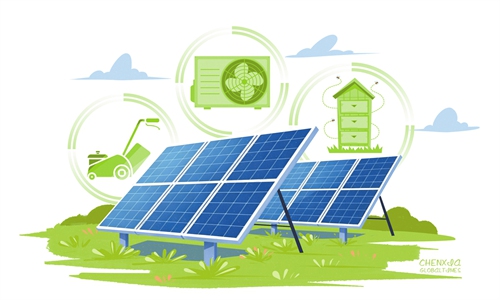
Illustration: Chen Xia/Global Times
In Nigeria, solar panels are the new wedding gift, Bloomberg reported. The trend is part of a much broader story. Even tomato sellers have reportedly put up signs advertising that they collect solar batteries and all kinds of solar waste for reprocessing.
At Lagos' Alaba International Market, a well-known electronics bazaar in West Africa, solar panels, inverters and lithium batteries are increasingly part of the bustling trade. The scene offers a glimpse into a global debate over how to expand electricity supply: are we underestimating the role ordinary households and small businesses can play?
The scale of this contribution is just striking in Nigeria. According to Bloomberg, the country's small-scale solar capacity had surpassed what the country's grid delivers as of the end of last year. So far this year, Nigeria has added as much capacity as it did in 2024 and 2025 combined.
Nigeria is not alone. Australia offers another perspective on the growth of rooftop solar. Even with a more developed economy and a mature electricity grid, Aussie households have embraced the technology at a remarkable pace. The Guardian recently quoted a resident of Tarneit, a suburb of Melbourne, as saying: "If you walk along the streets, it's actually hard to see a house without solar panels."
The figures show how far rooftop solar has gained. Ten years ago, rooftop solar reportedly generated less than 3 percent of Australia's electricity. During the last 12 months, that share has risen to nearly 14 percent.
This growth has been substantial enough to affect the wider electricity market. Solar has helped reduce consumer demand for grid-supplied electricity and contributed to wholesale prices falling to zero in the middle of the day.
The importance of reliable and affordable electricity is becoming harder to overlook as artificial intelligence technology advances around the world. Data centers and other types of computing infrastructure require substantial amounts of power, adding to the pressure to expand electricity supply. How to meet this growing demand without driving up costs is becoming an increasingly urgent question.
It may be too early to know whether Nigeria's wedding gifts and Australia's rooftops hold part of the answer to this broader economic issue. But ordinary households and small businesses are already showing how distributed solar panels could help meet growing electricity demand.
What has made solar power so accessible that it has become part of everyday life, even a wedding gift? Affordable, Chinese-made solar technologies are seen as one of the forces driving this trend.
Some in the West continue to describe China's green manufacturing capacity as "overcapacity." But this politically driven narrative becomes increasingly untenable as Chinese solar technologies find their way into everyday life, from homes and small businesses to wedding celebrations in Nigeria. When adopted across villages, communities and countries, these technologies can make a truly meaningful contribution to the global energy transition.
In Chinese culture, weddings are occasions for celebrations and good wishes. Seeing Chinese solar panels become wedding gifts in Nigeria is a happy development in its own right - and good news for the green transition on our living planet.
As AI advances and electricity demand grows, countries will need more than investment in large power plants. They can also draw on electricity generated by households and small businesses. Wider adoption of distributed solar systems, supported by storage and better grid integration, can add to electricity supply and ease some of the pressure on power systems.
Unlocking this potential depends on access to solar equipment and storage products that are both affordable and reliable. Open and free trade is particularly important. Protectionist measures that raise equipment costs are harmful because they make clean energy less affordable and slow its adoption just as demand for electricity continues to grow.
Who would have thought solar panels could become wedding gifts? In Nigeria, they have. Here's hoping there will be more such happy surprises to come.
The author is a reporter with the Global Times. bizopinion@globaltimes.com.cn
RELATED ARTICLES