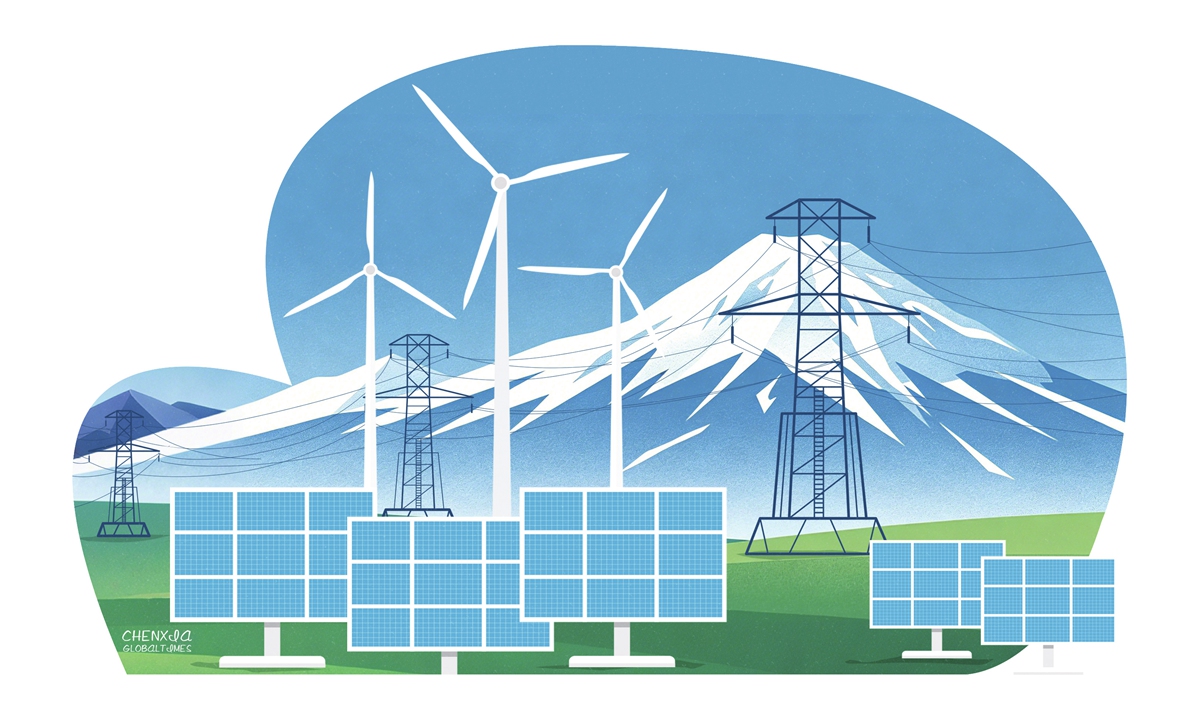
Illustration: Chen Xia/GT
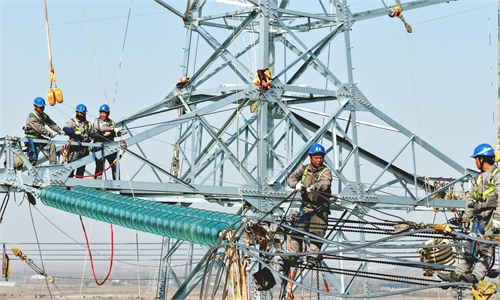
Six milliseconds to traverse 1,900 kilometers. That is how quickly electricity generated from clean-energy resources in Southwest China's Xizang Autonomous Region can reach households in Central China's Hubei Province via ultra-high-voltage direct-current transmission, according to the Science and Technology Daily.The figure highlights an often-overlooked aspect of China's energy development: generating electricity is only part of the equation, while transmitting it reliably over long distances is equally important. As many renewable-energy resources are located at some distance from major population centers, the growth of high-capacity transmission networks helps connect supply with demand and influences how far cleaner energy can reach.
Xizang, where annual sunshine exceeds 3,000 hours, offers a lens into the economic implications of renewable-energy development. The region has leveraged its solar, wind and hydropower potential to build related industries. For example, in Shannan, a city in Xizang, a clean-energy equipment industrial park reported nearly 600 million yuan ($88.7 million) in orders as of June 2025, according to the Xizang Daily.
Through an integrated industry-plus-employment model, the industrial park has encouraged the clustering of supporting businesses in the surrounding area, contributing to a 12 percent increase in the added value of Shannan's secondary industry sector.
According to the People's Daily, Xizang's installed clean power capacity exceeded 13 million kilowatts in 2025, with clean electricity accounting for more than 99 percent of total generation, the highest share among China's provincial-level regions. The development of the sector reflects a combination of factors. Among them is the expansion of long-distance power transmission infrastructure, including interregional grid connections, which have linked Xizang's generation capacity with electricity demand in other parts of China. This wider access to demand beyond the region has created additional room for the sector's development.
In recent years, Xizang has made rapid progress in expanding its power transmission network. The capacity of the four major "electricity highways" - the Qinghai-Xizang interconnection project, the Sichuan-Xizang interconnection project, the central Xizang grid interconnection project, and the Ngari interconnection project - has continued to expand, while new transmission corridors and grid infrastructure are being upgraded.
According to a People's Daily report in May, Xizang has transmitted a cumulative 16.4 billion kilowatt-hours of clean electricity to other parts of China since 2015. The electricity has reached 19 provincial-level regions, reflecting the expanding geographic reach of interregional power flows.
These long-distance transmission corridors, by linking generation capacity in Xizang with demand centers in other parts of China, have supported the development of Xizang's renewable-energy sector. They have also contributed to local economic activity by improving the utilization of clean energy resources and enabling a broader scale of production.
Xizang's experience is not unique. Across China, the long-distance transmission and interregional consumption of renewable electricity continues to expand. Data from the National Energy Administration showed that in the first four months of 2026, green electricity trading reached 105.3 billion kilowatt-hours, up 3.2 percent year-on-year.
It is this combination of measures - ranging from long-distance transmission infrastructure to market-based trading mechanisms - that has supported the development of renewable electricity in regions such as Xizang. By reinforcing the connection between generation and demand, these efforts have broadened the scope for the clean-energy industry to expand, while enabling supporting industries and local supply chains to develop alongside power output in production centers such as Xizang.
China's approach to developing the renewable-energy sector reflects a broader principle: there remains considerable scope for further efforts to expand the overall scale of the industry. At a time when many economies are pursuing renewable energy, China's experience offers a useful reference. The growth of the sector can be supported by parallel development in related areas - particularly long-distance transmission infrastructure. Strengthening these linkages allows the industry to increase in scale, creating space for a wider industrial ecosystem to emerge alongside power generation.
Some advanced economies appear to be placing greater emphasis on restricting competition and introducing trade barriers. Such approaches risk limiting the scale of development in the industry, while global electricity demand continues to expand.
If demand centers were more effectively connected across regions, the potential scale of the market would be considerable. From this perspective, the development of the sector is less about constraining competition than about expanding its overall scale. The experience of Xizang, where electricity can travel 1,900 kilometers in six milliseconds, offers a useful reference point for thinking about the sector's trajectory.
The author is a reporter with the Global Times. bizopinion@globaltimes.com.cn
RELATED ARTICLES