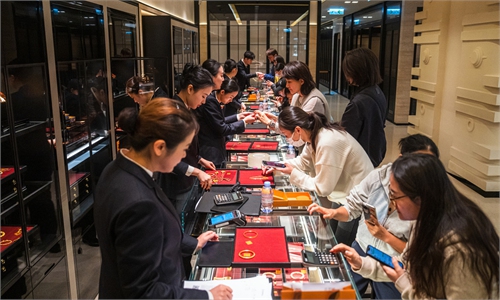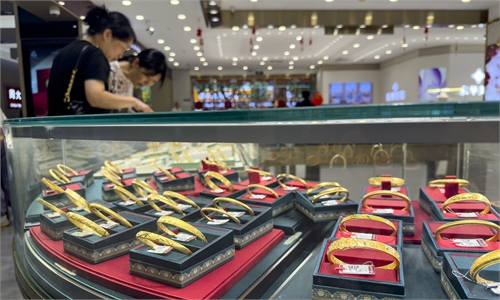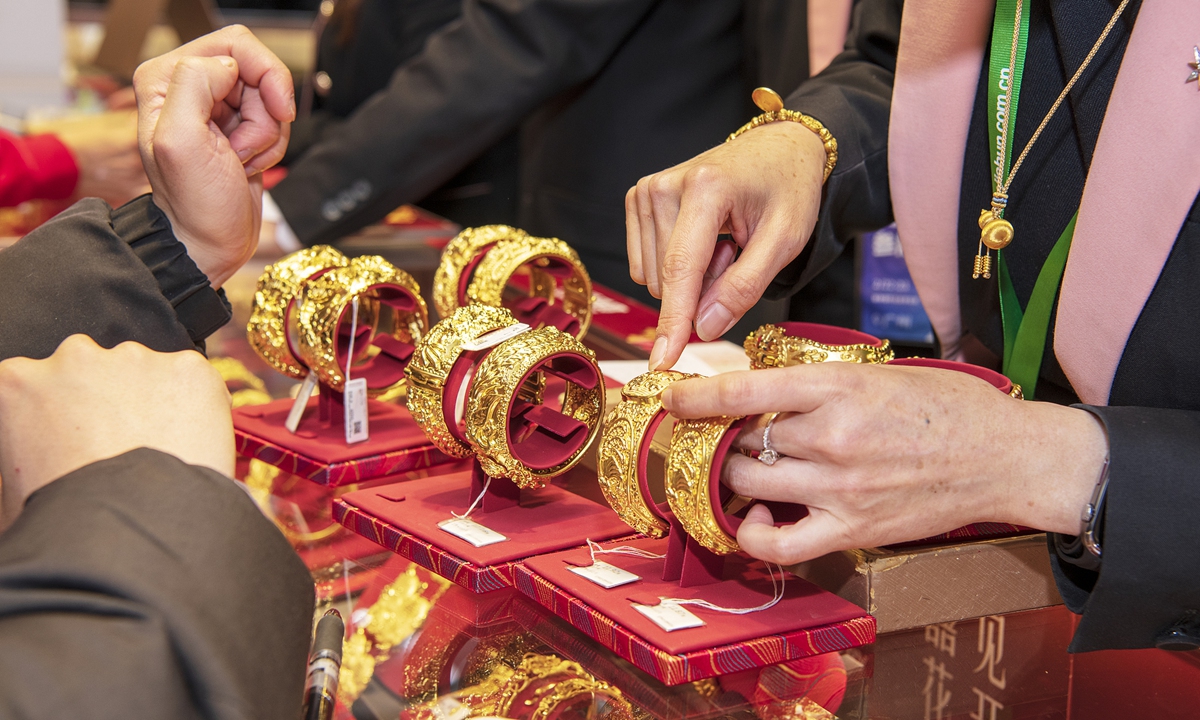
A sales representative shows a piece of gold jewelry at an expo in Guangzhou, South China's Guangdong Province. File photo: VCG
Gold prices fell over the weekend, and the Shuibei market — a gold jewelry manufacturing and trading hub in the southern metropolis of Shenzhen, South China's Guangdong Province — saw a surge of visitors. Photos posted by netizens on Chinese social media platforms showed some aisles so crowded that people could barely move.
Netizens flooded the platforms with posts like "There are more people here buying gold than you'd find at a vegetable market," while "booming" and "packed with people" became buzzwords.
The hustle and bustle in the Shuibei market reflects, to some extent, a quiet warming of China's domestic gold market.
"I'm scheduled to buy gold at the Industrial and Commercial Bank of China tomorrow. It's an investment product priced according to the Shanghai Gold Exchange's daily rates. I think spot gold at $4,000 per ounce is a relatively good entry point, with a favorable risk-reward ratio — more upside than downside," a Beijing white-collar worker surnamed Li told the Global Times on Sunday.
"If gold falls further, I'll buy more, planning to hold it long-term as a stable component of my family's asset allocation," Li said.
On Friday, spot gold fell below the $4,000 per ounce mark. By the close, spot gold was down 0.72 percent at $3,995.63 per ounce, according to CCTV News.
Following the drop in international gold prices, the prices of pure gold jewelry from several domestic brands were cut on Saturday.
Laomiao Gold's pure gold jewelry was priced at 1,196 yuan ($179.10) per gram, down 12 yuan from the previous day. The price at Chow Sang Sang was 1,200 yuan per gram, down 6 yuan, with Chow Tai Fook at 1,202 yuan per gram, also down 6 yuan.
As recently as September 24, pure gold jewelry from domestic brands was generally priced at about 1,300 yuan per gram. Within a month, jewelry prices have fallen by about 100 yuan, according to media reports.
Qu Rui, an analyst at Dongfang Jincheng, said in a statement sent to the Global Times that strong US inflation data has strengthened expectations of Federal Reserve rate hikes, weighing on gold prices. Combined with persistent geopolitical uncertainty pushing up crude oil prices, market concerns over inflation stickiness have again pressured gold, according to Qu.
"In my opinion, recent gold price fluctuations are fairly normal. US inflation pressure has led to tighter liquidity, which has had some impact on gold. I'm definitely bullish on gold in the long term. First, there's still a lot of geopolitical uncertainty; and second, central banks around the world, including China's, are accelerating their purchases, which provides support for gold prices," Li said.
Goldman Sachs wrote in a note last week that it estimates central banks globally purchased 79 tons of gold in August, more than four times the amount of the pre-2022 average of 17 tons. On a three-month seasonally adjusted basis, purchases are running at 85 tons per month, Fortune reported.
China seemingly accounts for a large portion of the demand, some 25 tons in August, Goldman noted. China remains underweight in gold relative to "plausible long-term allocations," according to the report.
According to data from the People's Bank of China, the central bank, the country's gold reserves stood at 77.47 million ounces as of the end of September, up 740,000 ounces month-on-month. It was the 23rd consecutive monthly increase, and the largest monthly addition since the current round of renewed purchases began.
RELATED ARTICLES