Chinese banks warn of precious metal price volatility as gold, silver extend sell-off after last week’s plunge
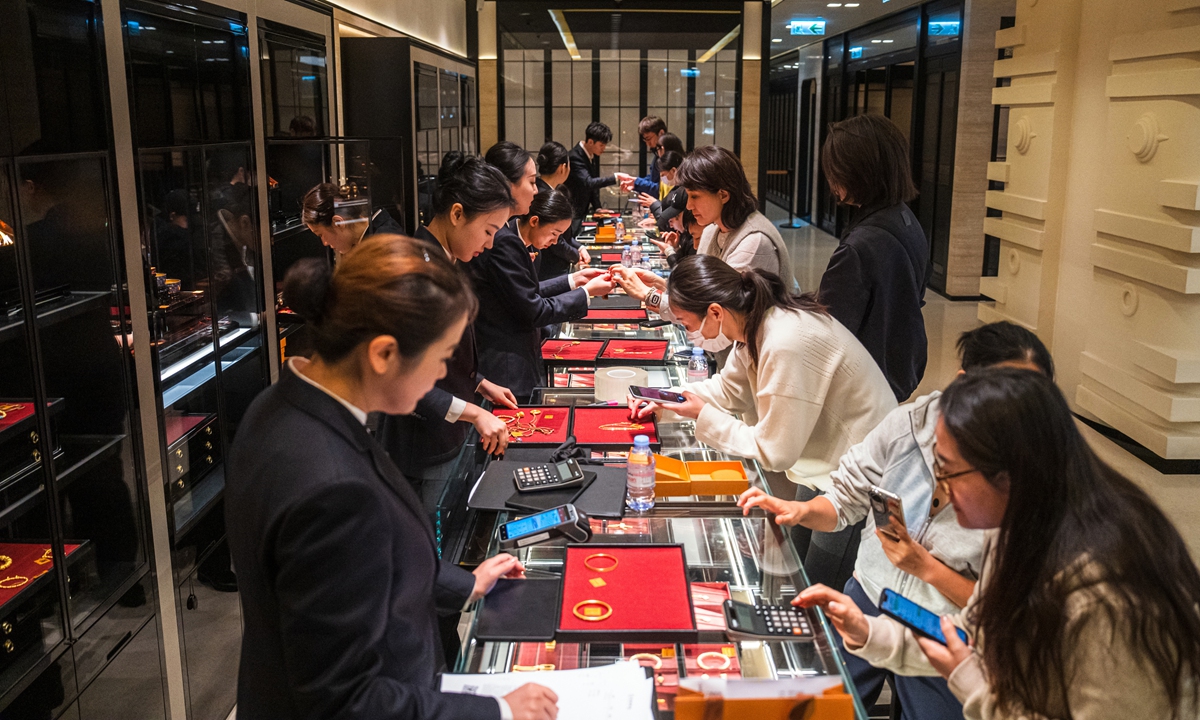
Customers inside the Laopu Gold Co store at IFC Mall in Hong Kong on December 25, 2025 Photo: VCG
Chinese banks issued notices on Monday calling for the stronger prevention of price volatility risks in the precious metals market, as gold and silver extended their sell-off following a recent historic plunge. An analyst said that the logic supporting the rise in gold prices remains unchanged, but prices are unlikely to rise as rapidly as they did in early 2026 after the recent technical correction.
Recent volatility in the international precious metals market has increased significantly, triggering rapid price changes and further highlighting emerging risks. It is advised that investors maintain a rational mindset and avoid blindly chasing rallies or selling into dips, based on a prudent assessment of personal risk tolerance, Industrial and Commercial Bank of China wrote in a notice posted on its website on Monday.
The Bank of China also reminded clients engaged in precious metals-related businesses, such as gold accumulation and precious metals accounts, to take precautions against market risks.
Four other banks - the Agricultural Bank of China, China Construction Bank, Postal Savings Bank of China, and the Bank of Communications - announced adjustments to gold-related businesses and reminded investors of ongoing trading risks.
At about 1:30 pm on Monday, spot gold was down 3.98 percent, while silver plunged as much as 8.63 percent during Asian trading hours.
"The recent crazy fluctuations in global gold and silver prices are primarily due to sudden shifts in macroeconomic expectations, heightened extreme speculative sentiment, and a technically fragile upward price structure," Zhou Yinghao, a senior gold analyst at the Bank of Urumqi, told the Global Times on Monday.
The surge in precious metal prices this year has been driven by sentiment and leverage rather than steady growth in demand. Before the recent plunge, the Relative Strength Index - a momentum oscillator that measures how fast and how strongly prices are moving - for gold and silver had remained in the "overbought" territory, and gold and silver prices soared rapidly in the short term, leading to an extremely fragile market structure, Zhou said, noting that the plunge represents a forced correction following extreme market performance in precious metals.
On Monday, the Shanghai Gold Exchange announced an adjustment in the margin rate and price limit for silver deferred contracts.
"All members are requested to enhance risk awareness, make detailed risk contingency plans, advise investors to strengthen risk prevention, reasonably control positions, invest rationally, and ensure stable and healthy market operation," read the document on the exchange's website.
Heraeus Precious Metals, a leading global precious metals company, had projected in December that the prices of precious metals in 2026 would reposition and consolidate following such a magnitude of price increases. The company forecast a gold price range of $3,750 to $5,000 per ounce this year, according to a note sent to the Global Times.
"Thanks to strong central bank demand and a favorable macroeconomic environment, gold is expected to remain the most solidly supported. Silver's performance may be more volatile due to industrial headwinds," the company noted.
After the technical correction in the precious metals market, the prices of gold and silver are expected to rebound in 2026, though the growth rate is unlikely to be as rapid as seen during the first several trading days this year, Zhao Qingming, a Beijing-based veteran financial expert, told the Global Times on Monday.
"The factors supporting the growth of gold remain unchanged," the expert said, referring to rising geopolitical tensions, global central banks' increased holdings of gold, and excess liquidity across international financial markets.
RELATED ARTICLES