ARTS / CULTURE & LEISURE
China's book market rushes to embrace Anne Carson after her Nobel win
From niche to Nobel
By Published: Oct 26, 2026 08:39 PM

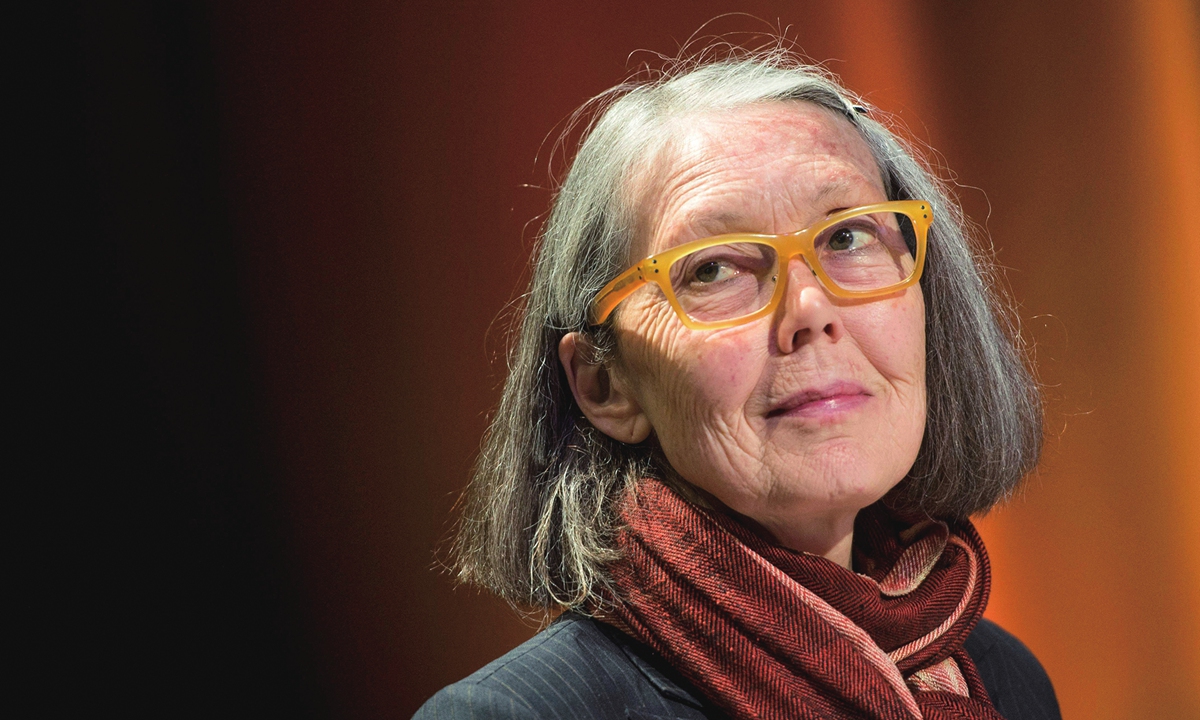
Anne Carson Photo: VCG
Canadian poet, essayist, and classicist Anne Carson's winning of the Nobel Prize in literature 2026 has turned a once-niche literary favorite into one of the most talked-about names in China's reading circles, sending sales of the Chinese translations of her works soaring and reigniting debate over what makes her writing so distinctive.
Following the Nobel announcement, the remaining stock of Nox (Latin for night), a limited-edition poetry collection featuring a 26-meter accordion-fold design, sold out. The edition was limited to 2,026 copies, and resale prices on secondhand platforms have reportedly climbed by four times.
At Yilin Press, which published her Autobiography of Red and The Beauty of the Husband in Chinese as a single volume, the response was equally swift.
The publisher reprinted the combined book twice within a week of the announcement, an editor surnamed Zhuang told the Global Times.
More titles are on the way. Men in the Off Hours, by the Sichuan People's Publishing House, and Plainwater: Essays and Poetry, co-published by Beijing-based Post Wave Publishing Company and Guangzhou-based Flower City Publishing House, are expected to be published, introducing Chinese readers to more of Carson's unconventional literary world.
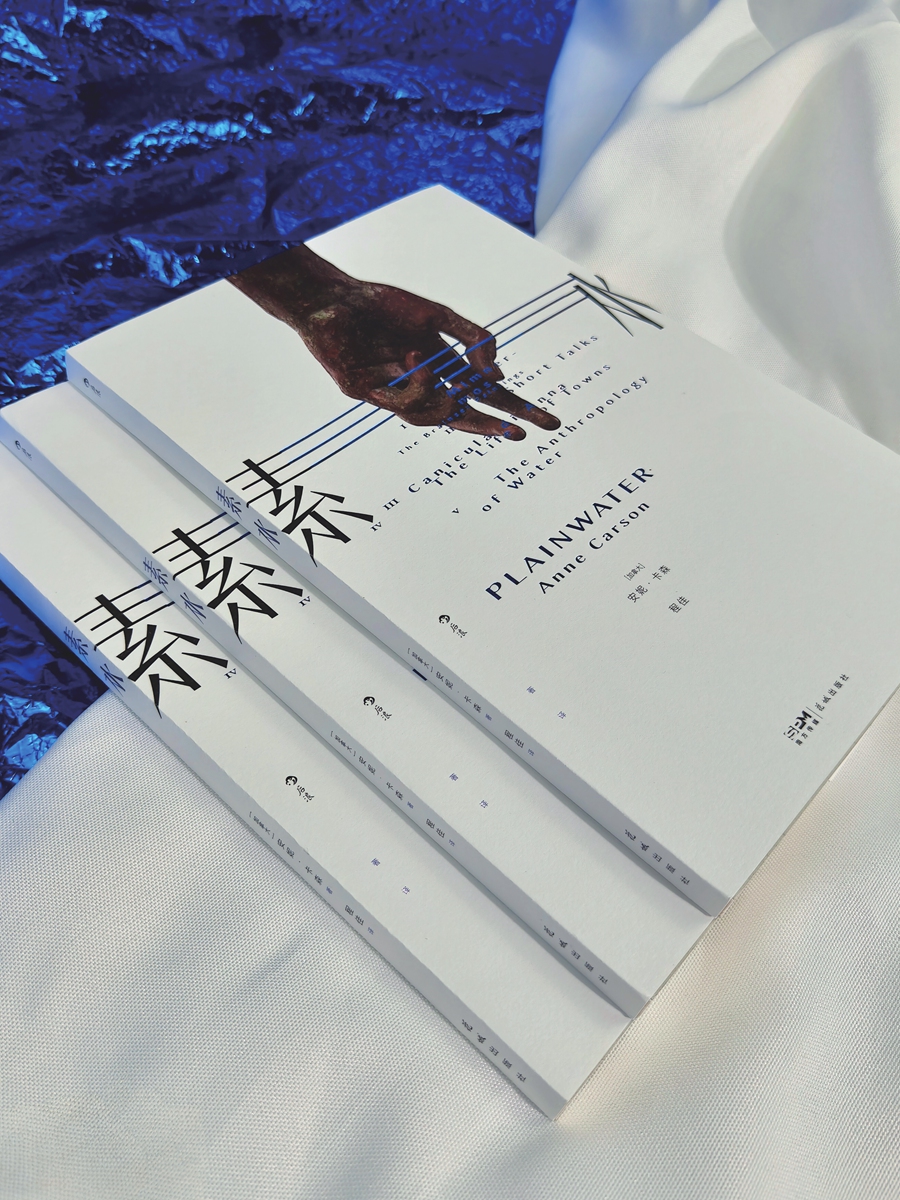
Promotional material of the Chinese edition of Plainwater: Essays and Poetry Photo: Courtesy of Post Wave Publishing Company
Yet the sudden commercial success has brought a familiar question into sharper focus: What exactly are readers buying when they buy Anne Carson?
The Swedish Academy praised her "bold and inventive" literary creation, and commented that she is a writer who, "in playful dialogue with the classical tradition, has created new forms for contemporary literature."
Cheng Jia, the translator of Plainwater: Essays and Poetry, said the Nobel citation's three key descriptors - "bold, inventive and playful"- accurately capture Carson's approach to form, punctuation and diction.
"A translation that tries too hard to domesticate her writing risks losing its essential character," Cheng told the Global Times.
Translation challenges
Although China is not a central subject of Carson's work, Chinese philosophy and poetry appear at moments when they illuminate a question Carson is pursuing.
Media reported that in a 2003 essay, Totality: The Color of Eclipse, published in the US magazine Cabinet, Carson begins her meditation on a solar eclipse not with a familiar Greek myth but with Chinese explanations of eclipses, followed by lines from the Tang Dynasty (618-907) poet Lu Tong's Poem on the Eclipse of the Moon, which invokes Laozi's warning that "the five colors blind men's eyes."
Only after having assembled these references does she turn to the Greek origins of the English word "eclipse," whose original sense is associated with abandonment.
Yin-yang thought, a ninth-century Chinese poem, a Daoist maxim and ancient Greek etymology occupy the same literary space. China is neither an exotic backdrop nor the subject of a systematic cultural study. It is one element in Carson's expansive library of world literature, placed alongside Greek lyric poet Sappho of Lesbos, British writer Virginia Woolf and American poet Emily Dickinson.
That habit of making unexpected connections also helps explain why translating her work can be such a demanding undertaking.
For Cheng, the hardest part was tracing the quotations and intertextual references embedded within them.
Cheng noted that Carson has an extraordinary ability to notice details in her reading that others might overlook and turn them into literary starting points. Some passages clearly seemed to draw on particular sources, yet identifying those sources could become an extended exercise in literary detective work.
The Chinese equivalents were not always easier to find. Cheng described the search for certain expressions that might function like Chinese idioms as frustrating, even when the meaning was clear enough to translate.
Her solution was to concentrate on conveying the original's meaning and tone rather than allowing every unresolved reference to derail the translation.
A deal for the translation was signed in 2021, while the translation itself was delivered in 2023. Cheng called it the most difficult book she had ever translated within a contractual deadline. Now that the Chinese edition is approaching publication, she said the Nobel recognition was gratifying, but had not changed her approach to the work.
"I feel honored to be one of Carson's translators," she said. "As for me, I'll carry on doing what I need to do."
Finds connections
For Zhao Bo, the Chinese editor of Plainwater: Essays and Poetry, Carson's originality lies partly in her ability to discover connections at the boundaries between apparently unrelated forms.
The collection moves among poetry, essays, lectures, interviews and translation, with five sections exploring different themes and modes of expression. Rather than following a single genre or narrative line, it creates a shifting landscape in which literary history, personal experience and intellectual inquiry continually intersect.
"Carson's study of ancient Greek and her engagement with the fragments of Sappho offer one way of understanding this approach," Zhao told the Global Times.
For readers who find Carson's more experimental passages difficult, Cheng recommends starting there. Its restrained prose and familiar experiences offer a more accessible entry point, while leaving room for different interpretations.
Cheng said Plainwater: Essays and Poetry does not need to be read from beginning to end or understood all at once. Its five sections can be approached independently, allowing readers to follow whichever thread catches their attention.
Carson had remained a major name within a relatively small circle of Chinese readers before the Nobel announcement. The new wave of interest may broaden that audience, but the lasting test will be whether readers move beyond the prestige of the prize to explore the writing itself.
"The Nobel Prize has brought Carson into the spotlight in China, but what the readers discover among her fragments, classical echoes and literary experiments is a more personal journey," said Cheng, the translator.
RELATED ARTICLES