Chinese economic powerhouses show strong high-end manufacturing momentum, keep growth engine humming
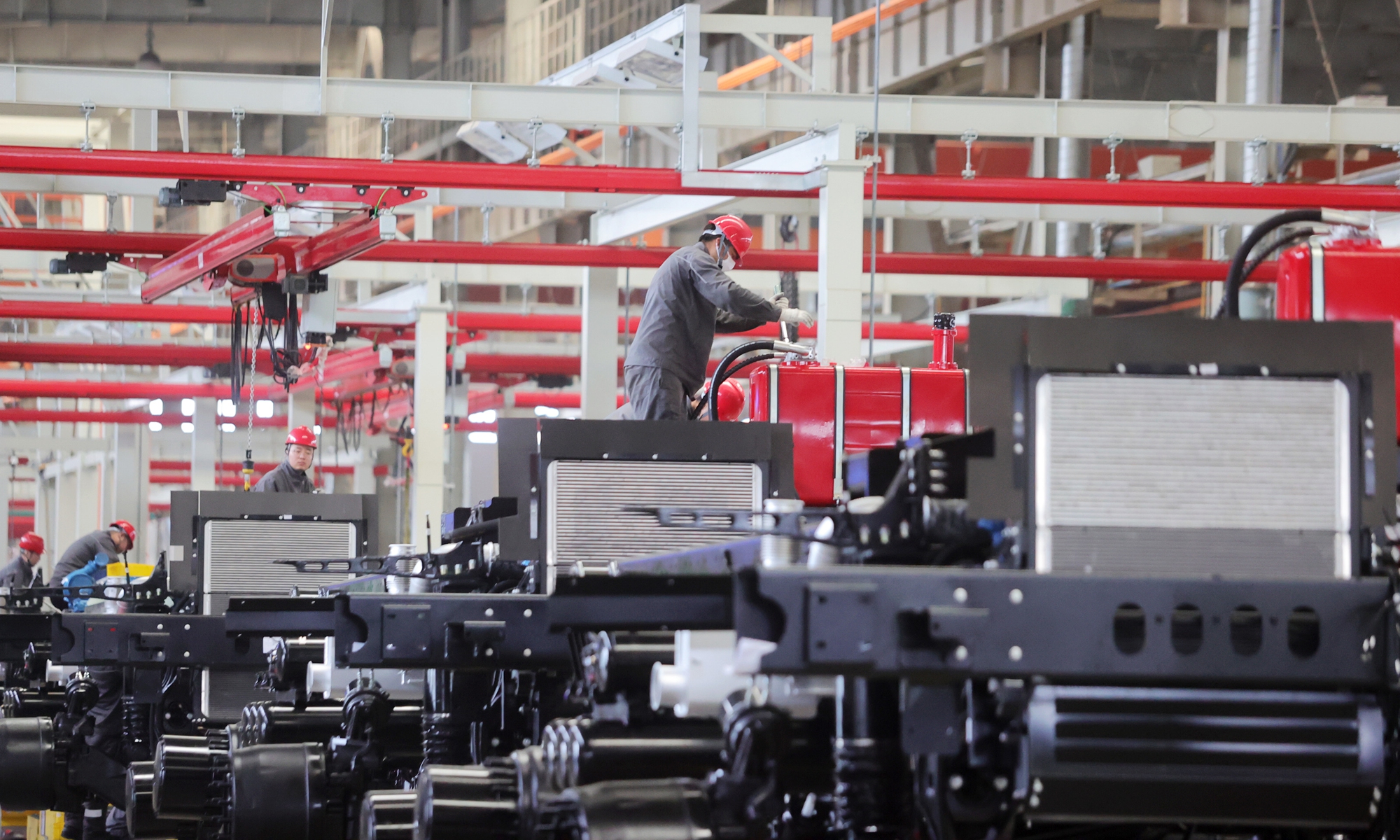
Workers operate on the production line at an intelligent workshop in Yangzhou, East China's Jiangsu Province on April 22, 2026. Photo: VCG
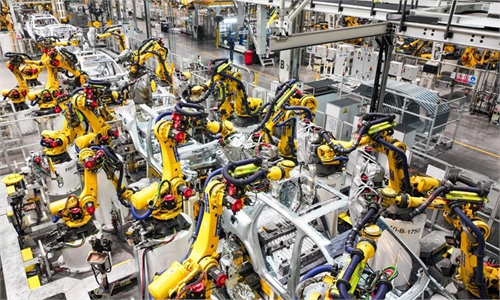
While many still fixate on humanoid robots dancing and performing parkour on stage, Zhejiang Humanoid Robot Innovation Center Co has quietly deployed batch after batch of "new employees" into factory workshops, logistics warehouses, and service venues - offering a window into how high-end manufacturing is taking root in one of China's economic powerhouses.
In the showroom, visitors encounter not stage "performers" but steady "workers" clocking in across different jobs: On the assembly line, humanoid robots sort packages with precision; at the lab bench, they inject clear liquids into containers with sub-milliliter accuracy; and in the home, they serve as "personal butlers," ironing clothes and making beds.
This shift from spectacle to shop floor shows up clearly in the data. In the first three quarters, Zhejiang posted sizzling growth in AI terminals and smart equipment, led by sharp gains in service and industrial robots. The trend is mirrored across China's major economic powerhouses, where high-end manufacturing is emerging as a signature strength in their economic reports for the first three quarters.
Major provincial-level economies, which together form the backbone of China's national growth, have outpaced the country's average expansion in the first three quarters, with booming high-end manufacturing, smart equipment and green production emerging as core growth drivers to offset headwinds from the phasing-out of old growth engines, analysts said.
Major economic powerhouses including South China's Guangdong Province, East China's Jiangsu, Zhejiang and Shandong provinces, and Shanghai have released their economic reports for the first three quarters. While growth rates vary, the data reveal a consistent narrative of structural upgrading, as high-end manufacturing takes up a larger share of local industrial output.
Guangdong and Jiangsu were the only two provincial-level economies with GDP above the 10-trillion-yuan ($1.50 trillion) threshold in the first three quarters. From January to September, Guangdong's GDP hit 11.10 trillion yuan, up 4.6 percent year-on-year, and Jiangsu registered 10.86 trillion yuan, a 5.2 percent rise.
Zhejiang and Shandong both posted 5.6 percent growth, one percentage point above the national average, followed by Shanghai at 5.5 percent.
Divergent paths, shared upgrading logic
While all five economic powerhouses see high‑tech and advanced manufacturing as core growth pillars, each has cultivated its own competitive industrial strengths built on local foundations.
AI terminals and smart equipment stood out in Zhejiang. Output of service robots, industrial control computers and systems, and industrial robots rose 91.0 percent, 50.6 percent and 37.5 percent, respectively, showing tangible gains from integrating digital technology with the real economy.
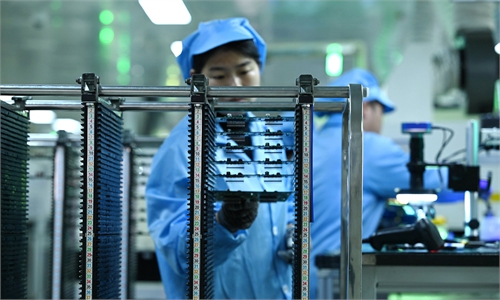
Jiangsu shines in semiconductor and robotics hardware. The integrated circuit and electronic circuit sectors grew 28.3 percent and 25.4 percent, while output of industrial robots and robot reducers jumped 47.1 percent and 44.6 percent.
Guangdong draws strength from its sprawling manufacturing base, with dual advances in advanced manufacturing and green‑tech output. Its advanced and high‑tech manufacturing sectors expanded 6.8 percent and 11.2 percent.
Shanghai prioritizes high‑value frontier innovation via its three flagship pillar industries. The manufacturing output of Shanghai's three pillar emerging industries rose 17.1 percent year‑on‑year in the first three quarters. Within this segment, integrated circuit manufacturing output grew 23.4 percent, AI manufacturing 24.8 percent, and biomedicine manufacturing 7.9 percent.
Hu Qimu, a professor at the Maritime Silk Road Institute of Huaqiao University, told the Global Times on Monday that new growth drivers are gradually replacing traditional industries in these provincial-level economies, a shift that has translated into tangible economic gains across the regions.
"Shandong leans on equipment manufacturing, Shanghai targets cutting-edge AI and biotech, while Guangdong leverages its solid manufacturing base for new-energy products," Hu said.
As both a stable anchor and growth engine for the national economy, these provincial-level economies can spur growth in less developed regions nationwide through their industrial linkages. Many innovations incubated in the Yangtze River Delta region and Pearl River Delta region can be rolled out and commercialized in other parts of the country. Such technological spillovers will underpin long-term industrial upgrading nationwide, Hu noted.
Wang Peng, a research fellow at the Beijing Academy of Social Sciences, told the Global Times on Monday that the five regions' performance acts as a critical accelerator and stabilizer for national growth, with each region carving out its own development path based on its existing industrial endowments.
The regions differ in their approaches - some rely on full-chain industrial ecosystems, some concentrate resources on specific leading sectors, and others modernize legacy industries through intelligent transformation - yet all are converging on the same goal of higher-quality, innovation-driven growth, Wang said.
Momentum to sustain
China's GDP expanded 4.6 percent year-on-year to reach 107.11 trillion yuan ($16 trillion) in the first nine months, data from the National Bureau of Statistics showed. The high-tech manufacturing value added increased 14.3 percent, outpacing overall industrial growth by 9 percentage points, making it a key engine of industrial growth.
China's top economic planner said it will work with relevant departments to expand domestic demand with greater force and more effective measures in an effort to consolidate the foundation and momentum for steady economic recovery, following the release of the latest economic data.
Looking ahead to the fourth quarter, several positive factors are accumulating, analysts said.
"The seasonal demand cycle, incremental policy support including special-purpose bonds, and improved external trade conditions versus last year are set to shore up activity. Meanwhile, a further demand recovery would make performance in the fourth quarter even more encouraging," Hu said.
Wang said that the growth momentum of these economic powerhouses is set to carry through the final quarter.
"New tracks such as AI, high-end equipment and green energy will contribute more to growth, while coordinated industrial policies and major projects will keep the economy within a reasonable range," he said.
RELATED ARTICLES