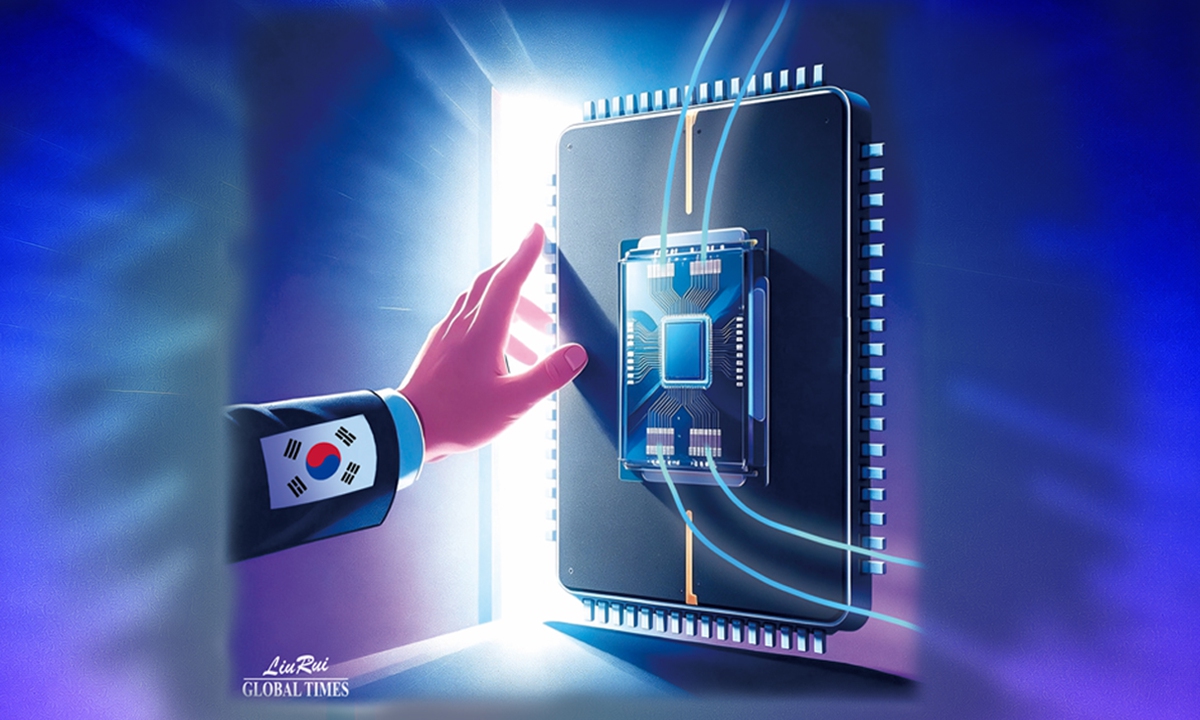
South Korea Illustration: Liu Rui/GT
Optical convergence technologies may not be familiar to most people, but they offer an intriguing way to look at South Korea's search for new sources of export growth. According to the Seoul Economic Daily on Monday, Jeonnam-Gwangju Special Metropolitan City will host a trade show that includes export consultations to help South Korean companies expand overseas.
Participating companies will showcase a broad range of technologies, including optical components for artificial intelligence (AI) data applications, AI chips and advanced packaging, quantum and security optical technologies, and smart manufacturing and digital transformation technologies.
Efforts to promote exports, including through optical technologies, come at a time when export diversification is repeatedly discussed in South Korea. Buoyed by booming semiconductor exports, the country's current account surplus reportedly exceeded the combined total of Germany and Japan in the second quarter of this year for the first time since comparable data for all three countries became available in 1996. Yet economists have cautioned against relying too heavily on the semiconductor boom to sustain that surplus.
South Korea's strong export performance masks a vulnerability: Its reliance on semiconductors leaves the broader economy exposed to swings in the global chip market. Diversifying its export base would help cushion these fluctuations and provide more sources of growth, especially as global demand and trade conditions evolve.
Where, then, might new sources of export growth lie? The rapid development of AI is generating demand for a wide range of advanced technologies. For South Korea, AI-related exports offer an opportunity to tap into this growing global market while building on its technological strengths. This could be one avenue for broadening the country's export base.
That is why the trade show and export consultations in Jeonnam-Gwangju are worth watching, even though optical convergence technologies are little known outside specialist circles. Optical components are used across a range of high-tech industries and could complement South Korea's strengths in semiconductors, opening opportunities to tap into growing global demand for AI-related technologies.
According to the Seoul Economic Daily, this year's event will include a dedicated "photonic semiconductor zone." It will showcase optical communications and data processing technologies, both of which are increasingly important to AI infrastructure.
As AI advances rapidly, Asia's industrial supply chains are evolving fast. Sustained trade can be a win-win situation: What one economy exports may be exactly what another needs to import. The success of South Korea's optical convergence technologies exports will partly depend on whether the country can become more deeply involved in Asia's evolving supply chains, expanding its own exports while contributing to the region's wider industrial upgrading.
Optical convergence technologies are not the only area worth exploring. Other high-tech sectors, including chip-related industries and technologies, could also contribute to South Korea's efforts to diversify its exports. The broader opportunity lies in identifying areas where the country can build on its technological strengths and meet growing demand from overseas markets.
Two considerations matter in identifying these opportunities. The first is whether South Korean companies have the technological capabilities to compete. The second is whether their products can meet the needs of importing economies and help their AI industries develop more efficiently. Export growth is more likely to be sustainable when it serves both sides.
China is a market South Korean companies cannot afford to overlook. With AI developing rapidly across the country, demand for imported intermediate goods and advanced components could open opportunities for foreign suppliers. For South Korea, the challenge is meeting that demand with products that complement China's fast-evolving AI industry.
Yet China's AI industry is also advancing rapidly, with Chinese companies making progress in optical components and related technologies. For South Korean exporters seeking to expand their presence in China, the key will be offering genuinely advanced products that meet the evolving needs of China's AI industry and help accelerate its development. This creates scope for mutually beneficial cooperation: South Korean companies can expand their exports, while China's AI industry gains access to technologically advanced intermediate goods that support its growth.
The author is a reporter with the Global Times. bizopinion@globaltimes.com.cn
RELATED ARTICLES