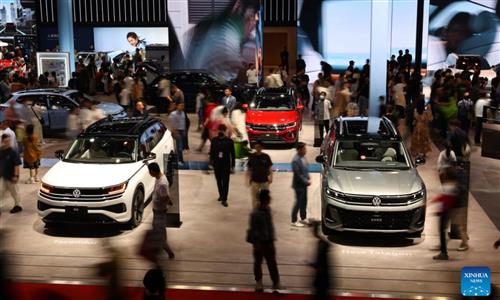
Steinmeier visits VW’s Hefei site as China-Germany auto cooperation deepens
Local innovation, partnerships key to German carmakers’ competitiveness: experts
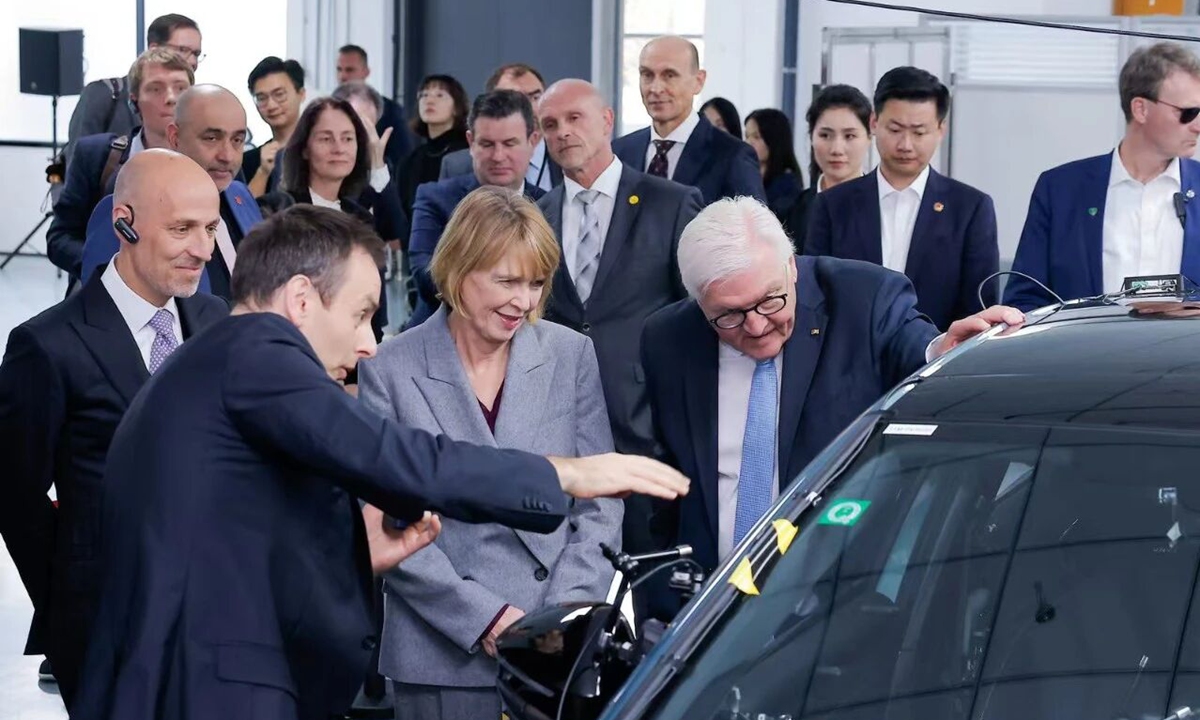
German President Frank-Walter Steinmeier visits a Volkswagen technology center in Hefei, East China's Anhui Province, on October 27, 2026. Photo: Courtesy of Volkswagen Group China
German President Frank-Walter Steinmeier visited a Volkswagen technology center in Hefei, East China's Anhui Province, on Tuesday as he began a state visit to China, following recent progress in China-EU trade talks. An expert said that the visit offers an opportunity to hear firsthand about the longstanding automotive cooperation between China and Germany, as German carmakers deepen local partnerships in new-energy vehicles and intelligent driving.
Steinmeier arrived at Hefei Xinqiao International Airport in the early hours of Tuesday, with the capital of Anhui Province serving as the first stop of his October 27-31 state visit, according to state broadcaster CCTV. It is his first visit to China in nearly eight years, according to the Xinhua News Agency.
Steinmeier toured laboratories for software and hardware integration and testing, where he learned about Volkswagen's software-defined vehicle development process based on its locally developed China Electronic Architecture (CEA), according to a statement sent to the Global Times from the Volkswagen Group China.
He also test-drove a Volkswagen ID. AURA T6 equipped with the locally developed CEA and Hyper Sense 8 advanced driver assistance system. On a test track with obstacles, he handed full control to the system and, after leaving the vehicle, used a mobile phone to have it park automatically without a driver, the company said.
Ralf Brandstätter, chairman and CEO of Volkswagen Group China, said the group combines China's capacity and speed for innovation with its own technological expertise and global presence. Sharing technologies and development results across the group strengthens its export business and global competitiveness, he said.
China's total goods imports and exports with Germany reached 1.2 trillion yuan ($179.96 billion) in the first three quarters of 2026, up 6.2 percent year-on-year, Chinese customs data showed. In September alone, trade hit 146.17 billion yuan, up 11.3 percent year-on-year. Electrical equipment, electronic components, and pharmaceuticals accounted for the lion's share of bilateral trade.
The visit comes as Volkswagen and its premium brand Audi advance their strategies in China. On Monday, Volkswagen Group China announced that it had obtained a Level 3 autonomous driving road test permit in Hefei, while Audi outlined an updated "dual-brand, dual-partner" strategy with Chinese partners.
Under Audi's plan, cooperation with China FAW Group will focus on the four-ring brand's new-energy and combustion-engine models, while its partnership with SAIC Motor will focus on the AUDI letter-mark marque and the new-energy vehicle market, according to an Audi China statement.
Li Yong, a senior research fellow at the China Association of International Trade, told the Global Times on Tuesday that Steinmeier's visit to Volkswagen's Hefei site was symbolic, as the company has participated in China-Germany vehicle cooperation for decades and witnessed the development of China's auto industry. The stop could also give the German president an opportunity to hear directly from businesses about their experience in China amid attention to differences over China-EU automotive trade, Li said.
The Volkswagen Group China Technology Company's research and development (R&D) center in Hefei offers an example of such cooperation. According to Volkswagen, the center brings together vehicle development, component R&D, procurement and testing, enabling the company to develop and validate models locally and shorten their time to market by about 30 percent, Xinhua reported.
Zhang Xiang, secretary-general of the International Intelligent Vehicle Engineering Association, said that German carmakers have increasingly given their Chinese operations a greater role in R&D as they respond to changes in the market. Developing new-energy vehicles in China allows them to draw on local engineers, suppliers and the broader industrial ecosystem, he said.
"China-Germany automotive cooperation is shifting from traditional manufacturing toward joint research and development and technological innovation," automotive expert Zhang Xiang told the Global Times on Tuesday, citing Volkswagen's cooperation with Chinese companies in intelligent driving as an example. He said that working with local technology partners can help German carmakers improve their intelligent driving and connectivity capabilities and strengthen their competitiveness in China.
The potential for cooperation extends beyond China. Volkswagen could use software developed for China in future mass-market vehicles in Europe, Reuters reported on Monday, citing Germany's Manager Magazin.
The report said that the China Electronic Architecture, developed for Chinese models in cooperation with electric vehicle maker Xpeng, could form the basis for future vehicles under Volkswagen, Skoda and Cupra.
For Volkswagen, deeper cooperation with Chinese companies can help it keep pace with local product development and consumer demand while drawing on China's advances in new-energy vehicles and batteries, Li said. It also gives the German group an opportunity to combine those strengths with its own experience to develop competitive products, he added.
Zhang said that China's comprehensive automotive supply chain and technological capabilities are valuable to European carmakers as they navigate the transition toward electrification. Restricting cooperation would risk depriving them of opportunities to develop products and compete in a changing global market.
"German carmakers need to seize the opportunity and work more closely with Chinese companies," he said.
RELATED ARTICLES