GT Voice: Caterpillar’s legal fight exposes paradox of Western protectionism against China
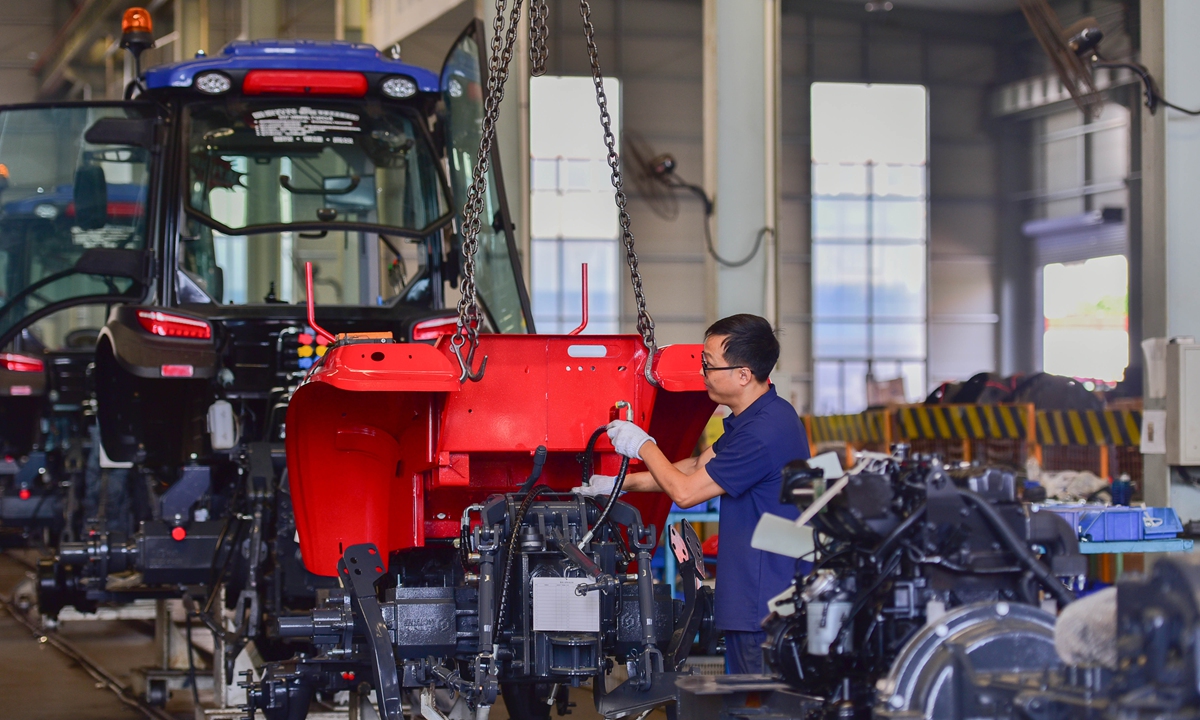
A worker assembles a tractor at a manufacturing plant in Caterpillar Industrial Park in Qingzhou, East China's Shandong Province, on September 27, 2026. Photo: VCG
US manufacturer Caterpillar's legal challenge against the UK's trade watchdog lays bare an often-overlooked fact about Western trade protectionism: When the West targets "Chinese-made goods," the real casualties may include multinational companies long intertwined with Chinese supply chains.
Caterpillar, the world's largest maker of construction equipment, is fighting to overturn an 18.81 percent anti-dumping duty that the UK's Trade Remedies Authority (TRA) has imposed on its China-built excavators, the Financial Times reported on Tuesday.
The investigation was launched by the UK following a complaint from British equipment producer JCB, which complained that excavators from China were being sold in the UK "at unrealistically low prices." But Caterpillar contends that the TRA applied flawed logic when it imposed the duty, as its UK export prices for the excavators were higher than domestic prices in China, the report said. Whatever the outcome of the case, the fact that an American giant has to go to court to fight a tariff imposed by an ally has laid bare the misalignment of the entire trade protection mechanism.
Some Western politicians have reduced trade disputes to a contest between countries and ideological blocs, deliberately ignoring a well-established reality: Global supply chains are deeply intertwined. After decades of integration driven by globalization, the ties between foreign investors and China's supply chains run far deeper than many political circles care to acknowledge.
From 2020 to 2024, China's total industrial added value grew from 31.3 trillion yuan ($4.4 trillion) to 40.5 trillion yuan, while manufacturing added value increased from 26.6 trillion yuan to 33.6 trillion yuan. Chinese manufacturing accounts for nearly 30 percent of the global total, and among 504 major industrial products worldwide, China ranks first in output for the majority.
Behind a single piece of construction machinery lies the coordinated operation of hundreds of component suppliers, skilled workers, nationwide logistics networks and large-scale manufacturing capabilities.
Moreover, multinational corporations do not set up facilities in China merely to chase low costs. Their core motivation is to access the industrial clusters built up over decades and complete supporting systems that no other market can easily replicate.
The choices of multinational corporations offer the most straightforward illustration of these deep industrial connections. In a 2026 survey by the European Union Chamber of Commerce in China, 75 percent of European companies said that their production efficiency in China outpaced that in other regions.
During the first nine months of this year, more than 47,000 foreign-invested enterprises were newly established in China. Foreign companies showed greater willingness to reinvest their profits in China. Reinvestment reached 93.99 billion yuan, up 4.7 percent year-on-year, with the growth rate expanding 1.5 percentage points compared with the previous year. New reinvestment projects continued to emerge in high-tech sectors, including artificial intelligence and biomedicine. These figures show that China is no longer just a sales market - it has become a critical hub for procurement, manufacturing and innovation in the global networks of countless multinational corporations.
When multinationals deploy production capacity in China, what they value has never been the "unfair subsidies" of certain Western narratives, but the full-chain efficiency advantage brought by China's industrial clusters, a hard-earned outcome of decades of the global division of labor and cooperation. Such supply-chain advantages do not constitute dumping.
Multinational corporations know their operational realities, and they understand the true costs of arbitrary trade barriers better than most. That reality gives them every incentive to step forward and share what operating in China is really like. The much-hyped "dumping" narratives are essentially little more than fig leaves for declining domestic industries trying to dodge fair market competition through protectionist measures. Rather than let such false narratives spread, the voices grounded in real business operations deserve to be amplified. That, in itself, is a powerful rebuttal to trade protectionism.
RELATED ARTICLES