China to continue suspending export quota management for phosphate rock, silver in 2027; policy facilitates compliant trade while retaining regulatory oversight
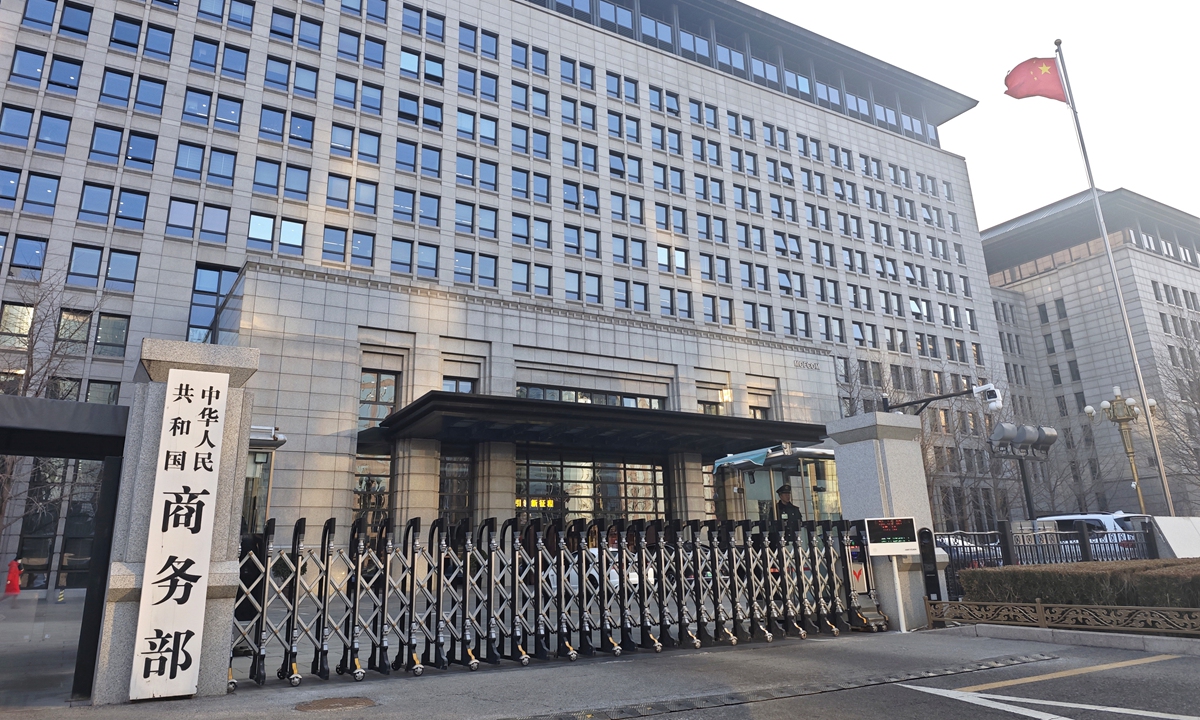
China's Ministry of Commerce Photo: Yin Yeping/GT
China will continue to suspend export quota management for phosphate rock and silver while maintaining export licensing requirements, according to the 2027 export quota arrangements released by China's Ministry of Commerce (MOFCOM) on Thursday, extending a policy in place since 2019 that an industry analyst said reflects China's commitment to facilitating legitimate trade in critical minerals, rather than using its resource advantages to restrict global supplies.The arrangement comes as critical minerals, including phosphate and silver, attract growing international attention for their importance to advanced manufacturing and the energy transition.
Under the arrangements, eligible exporters of phosphate rock or silver may apply for export licenses with valid export contracts and use the licenses to complete customs declarations and clearance procedures.
The policy adjustment first took effect on January 1, 2019, as part of efforts to improve China's export management system and streamline administrative procedures, according to an earlier MOFCOM announcement. It has since been maintained in subsequent years.
The two commodities have gained prominence in discussions over critical mineral supply chains. In November 2025, the US Geological Survey added phosphate and silver to its updated list of 60 critical minerals, reflecting their growing economic and strategic importance.
Silver, a precious metal with both financial and industrial applications, is playing an increasingly important role in emerging industries, with demand driven by sectors including solar power and new-energy vehicles, according to the Xinhua News Agency.
Phosphate rock, meanwhile, is a crucial raw material for fertilizer production and the manufacturing of lithium iron phosphate batteries, which are widely used in electric vehicles and energy storage systems.
China has also maintained measures to facilitate exports of other critical minerals. Under its 2026 export licensing rules, the country continued to suspend designated-port requirements for exports of rare earths, magnesia, antimony, and related products.
The longstanding measures allow exporters to choose ports based on logistics costs, delivery times, and market needs, helping streamline shipments and improve customs clearance efficiency, industry observers said.
Stable and predictable management
Wu Chenhui, an independent analyst who closely follows the critical minerals industry, told the Global Times that China's decision to maintain the longstanding arrangement reflects policy continuity and a differentiated approach to managing strategically important resources.
Critical minerals carry considerable economic and strategic importance, but managing their exports does not necessarily mean restricting normal trade, nor does China seek to use such measures to leverage its resource advantages to pressure other countries, Wu said.
The distinction between export quotas and export licensing is particularly important, according to the analyst.
Unlike a quota system, which allocates a limited export volume among eligible businesses, the licensing arrangement allows qualified exporters to apply for licenses based on actual contracts without being subject to an annual export quota for the two commodities.
This can reduce the uncertainty associated with quota allocation, give companies greater flexibility in arranging shipments and help stabilize expectations among overseas customers, Wu said.
China's approach also stands in contrast to the tendency in some overseas discussions to treat critical mineral export management as synonymous with supply restrictions. The arrangement retains necessary regulatory procedures while facilitating legitimate trade, showing that resource management and smoother international commerce are not mutually exclusive, he added.
China's silver exports reached around 5,100 tons in 2025, the highest level in at least 16 years, Bloomberg reported in January, despite the continuation of its export licensing regime.
The MOFCOM has also approved 44 companies to export silver in 2026-27, two more than in 2025, although exporters remain subject to qualification requirements. The figures suggest that the continuation of licensing rules has not prevented silver exports from reaching record levels.
Cooperation over confrontation
China's management of phosphate rock and silver also comes against a broader backdrop of efforts to maintain critical mineral trade and facilitate compliant exports, particularly in the rare-earth sector.
China has taken steps to facilitate rare-earth exports within its regulatory framework. In December 2025, the Ministry of Commerce said some Chinese exporters had met the preliminary requirements for applying for general licenses for rare-earth-related items, and that applications had been received and approved. The ministry said the move followed policy briefings for exporters and the accumulation of export experience and compliance practices.
China has also pledged to facilitate trade with the EU. On October 15, 2026, a MOFCOM spokesperson said that China was ready to continue to provide facilitation for the approval of rare earth export licenses to the EU, and also called on the EU side to reciprocally provide facilitation for specific priority licensing cases for China in the dual-use field.
China's exports of rare-earth permanent magnets to the EU reached 2,454 tons in September, up 20.5 percent month-on-month and the highest level since February, according to media reports citing Chinese customs data.
The increase does not by itself establish a direct link to licensing facilitation, but shows that trade in these materials continues amid regulatory scrutiny.
Global critical mineral supply chains are highly interconnected, and both China and its trading partners benefit from stable supplies and predictable commercial arrangements, according to the analyst.
Assessments of China's policies should consider actual trade flows, the processing of compliant export applications and concrete international cooperation, rather than relying on assumptions about political motives, according to Wu.
At the same time, China has a responsibility to prevent controlled materials from being illegally exported or diverted to unauthorized uses, Wu said, noting that strict oversight of such activities is consistent with international practice and helps ensure that sensitive materials are used for legitimate purposes.
At a regular press briefing in April, He Yadong, a MOFCOM spokesperson, said China remains committed to safeguarding the security and stability of global industrial and supply chains, fully taking into account reasonable civilian needs and concerns worldwide, including those of the US, and actively promoting and facilitating compliant trade.
Export applications for rare earths that meet relevant requirements and are confirmed to be for civilian use would be approved in accordance with the law, according to the spokesperson.
At the same time, Chinese authorities have repeatedly reaffirmed China's commitment to maintaining stable global critical mineral supply chains while strengthening export controls in line with international practices and fulfilling its non-proliferation obligations.
RELATED ARTICLES