US soybean exports projected to grow 5%, China market remains key: industry council
Agricultural co-op reflects deep economic complementarity: experts
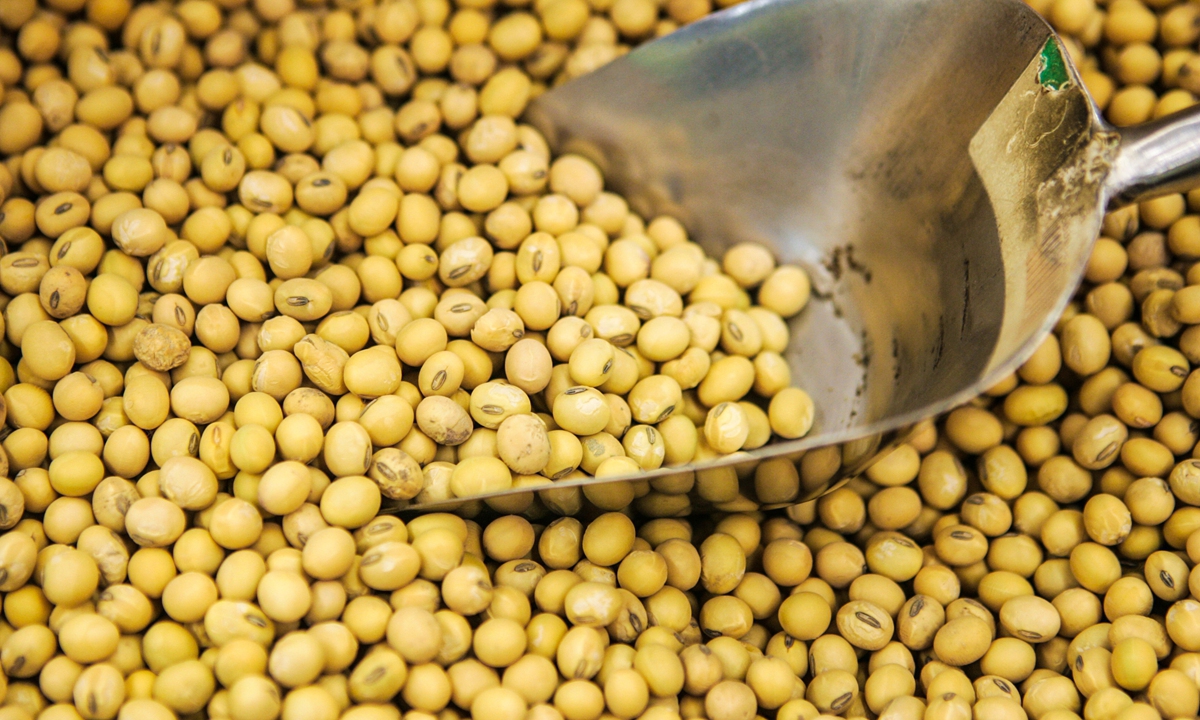
Soybean Photo: VCG
US soybean exports are projected to grow by 5 percent in the 2026/27 marketing year, driven by rising demand across multiple markets and expectations of a return to normal trade relations with China, the world's largest soybean importer and historically the top export market for US soybeans, according to a recent report sent to the Global Times by the US Soybean Export Council (USSEC).
The expanding soybean exports to China underscore the irreplaceable appeal of China's vast market to global agricultural suppliers, particularly the US, a Chinese expert said, urging the US to cherish the long-established foundation of China-US agricultural trade and take concrete actions to maintain stable and predictable bilateral economic and trade relations.
The USSEC' s projected gains follow a year-on-year decline in total US global soy exports during marketing year 2025/26, driven by US-China trade tensions. As reported in the July 23, 2026 US Department of Agriculture (USDA) Weekly Exports report, total US soy exports year-to-date are down 11 percent, with shipments to China down 45 percent.
Data from China's General Administration of Customs (GAC) also shows a sharp decline in soybean imports from the US. In the first half of 2026, China imported about 9.309 million tons of soybeans from the US, down 42.4 percent from 16.173 million tons during the same period last year.
However, according to a recent projection from the USDA, China's total global soybean imports for the 2026/27 marketing year are expected to reach 115 million metric tons, potentially setting a new record.
Meanwhile, according to the USSEC, recent data shows that China purchased 12 million metric tons of US soybeans for the 2025/26 marketing year and is now moving toward 25 million metric tons, bringing purchases back in line with the 2024/25 level of 24.2 million metric tons.
"We're seeing China's purchases return closer to normal," USSEC CEO Jim Sutter said.
The US soybean industry has attached great importance to China, one of its major export markets. Previously, Sutter told the Global Times in an exclusive interview that "China is, quite simply, our largest and, in many ways, our most irreplaceable customer for US soybeans," noting that from the US soybean industry's perspective, stable and predictable US-China economic and trade relations are essential.
"China remains a major force shaping the global soybean trade. The US soybean industry's efforts to restore and expand exports to China also underscore the irreplaceable appeal of China's vast market to global agricultural suppliers," Hu Qimu, a professor at the Maritime Silk Road Institute of Huaqiao University, told the Global Times on Thursday.
Soybean trade is a representative area of China-US economic and trade cooperation. Hu said that China's vast market and the position of the US as a major soybean producer and exporter make the two economies highly complementary.
China is the largest soybean importer in the world. Imported soybeans in China are mainly used for edible oil production and animal feed. China has also developed diversified import sources, including Brazil, the US, Argentina, Uruguay and Canada.
Among these suppliers, Brazilian soybean exports to China have remained very strong. China imported 12.08 million tons of soybeans from Brazil in June, up 13.7 percent year-on-year, while imports from the US fell 20.6 percent year-on-year to 1.27 million tons, according to data from the GAC.
Even if US soybean exports to China continue to recover, this is unlikely to change China's broader trend of diversifying its import sources, Zhou Mi, a researcher at the Chinese Academy of International Trade and Economic Cooperation, told the Global Times on Thursday.
"China will continue to source soybeans from a wide range of suppliers based on market conditions, as diversified sourcing helps reduce exposure to supply chain disruptions and related risks," Zhou said.
Meanwhile, the US should cherish the long-established foundation of China-US agricultural trade and take concrete actions to maintain stable and predictable bilateral economic and trade relations, so that mutually beneficial areas such as soybean trade can serve as a stabilizer for China-US economic and trade ties, Zhou said.
RELATED ARTICLES