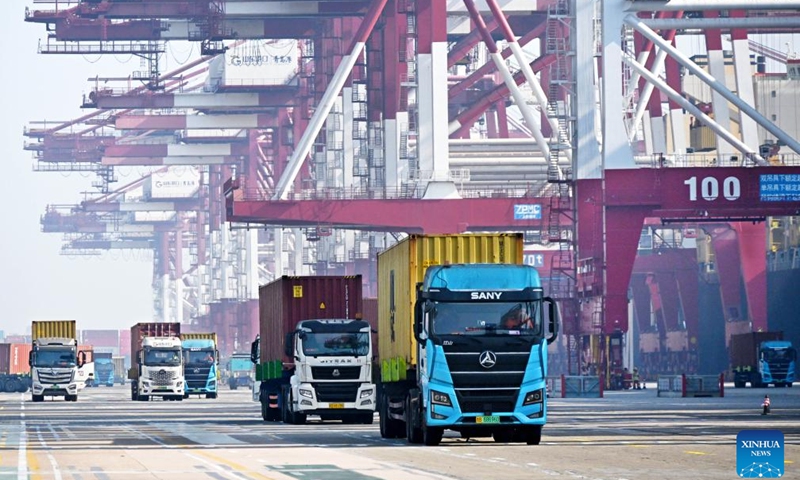
Trucks transport containers at Qianwan Container Terminal of Qingdao Port in Qingdao, east China's Shandong Province, Feb. 18, 2026. During the Spring Festival holiday, Qianwan Container Terminal of Qingdao Port has witnessed a bustling scene. (Xinhua/Li Ziheng)
For many years, foreign trade has been a major engine of China's economic growth. China's total goods trade reached 20.68 trillion yuan ($2.9 trillion) in the first five months of 2026, up 15.3 percent year-on-year, according to the General Administration of Customs.
Although imports have grown significantly faster than exports lately, China continues to maintain a substantial trade surplus in absolute terms.
Behind the figures lies a structural transformation in China's trade development. The country's exports are increasingly shifting away from primary commodities and labor-intensive processing trade toward high-tech goods with higher value-added content.
China's integration into global industrial and supply chains has deepened, while its competitive advantages have become increasingly well established. The growing strength of "Made in China" continues to provide powerful support for record-breaking foreign trade, which benefits China as well as the world.
Nevertheless, some international commentators have interpreted China's trade surplus through the lens of "excess capacity," "supply-chain security concerns," or "China shock." Claims of "unfair trade" or "export shock" are essentially variations of earlier narratives that accused China of "exporting deflation and creating global trade imbalance."
Despite such criticism and skepticism, Chinese economy, including its foreign trade sector, has continued to advance steadily amid external pressures. As China's contribution to global economic growth continues to increase, its role as a stabilizing force in the world economy has become more prominent, prompting a reassessment of China's trade by the international community.

Liao Zhengrong Photo: Courtesy of Liao Zhengrong
As global recognition of China's economic progress continues to grow, this process of reassessment is likely to deepen and attract more attention. It demonstrates the value of China's approach: learning from international experience while remaining committed to exploring its own path toward realizing modernization.
First, from a development perspective, moderate growth in China's manufacturing capacity is beneficial.
As China's manufacturing sector sizzles, a broader understanding is emerging that the breakthroughs achieved by Chinese manufacturing are the result of advances in productive forces. Through its innovation-driven development strategy, China has fostered new quality productive forces by reallocating resources and improving institutions.
To international observers, they will get to realize that China's expanding industrial capacity is driven by technological upgrading and quality improvements, which will generate positive spill-over effect for the global economy.
China has become an important contributor to easing global inflationary pressure. As the world's largest manufacturing hub, the country serves as a vast reservoir of industrial goods, continuously expanding the supply of all kinds of industrial components and consumer goods, which helps drag down price rises across global markets. This is particularly evident in China's growing exports of green electric vehicles and a wide range of digital devices.
In recent years, amid rising unilateralism, protectionism, and repeated disruptions to global supply chains caused by various "black swan" and "gray rhino" events, Chinese manufacturing has played the role of a stabilizing force in the world economy. In this sense, China's exports help extend the benefits of technological innovation across the globe. For example, many developing countries are keen on trading with China to overcome the barriers to their industrialization and economic catch-up.
Second, from the broader perspective of trade and balance of payment, China's trade and economic relationship with other countries is largely complementary and mutually beneficial.
China's goods trade surplus reflects the natural tendency of competitive industrial sectors and its enterprises to expand into the international market. It also reflects China's ability to efficiently organize all factors of production, including land, capital, labor, and data, to create internationally competitive products that meet rising global demand.
Meanwhile, China's services trade deficit reflects growing domestic demand for tourism, education, cultural services, and other forms of consumption that require imports, and foreign exchanges earned through goods exports helps finance these service imports.
China's exports account for approximately 20 percent of its GDP, far lower than Germany, France and many other economies. From 2021 to 2024, China's domestic demand contributed an average of 86.4 percent to the country's economic growth.
On the import side, China accounts for about 10 percent of global imports, second only to the US at 13.6 percent. The rapid growth of imports this year demonstrates the expanding opportunities offered by the massive Chinese market.
Third, while maintaining trade growth, China is accelerating the transition toward a new development pattern.
The country is implementing its new development philosophy and advancing the "dual-circulation" development pattern, which takes the domestic market as the mainstay while allowing domestic and international markets to reinforce each other. The objective is to achieve high-quality development through a model that promotes both internal and external trade balance.
In recent years, China has actively expanded imports and remains the only major economy to host large-scale import exposition on a regular basis. As China's economy continues to grow steadily, its society continues to advance, and the living standards continue to improve, the country will create even greater opportunities for the world. At the same time, China's new quality productive forces are benefiting more countries and regions through exports.
The author is a research fellow at the Institute of Peaceful Development of the Chinese Academy of Social Sciences. bizopinion@globaltimes.com.cn
RELATED ARTICLES