China launches two reciprocal trade barrier probes into US measures harming global production and supply chains, green product trade: MOFCOM
By Published: Mar 27, 2026 11:18 PM

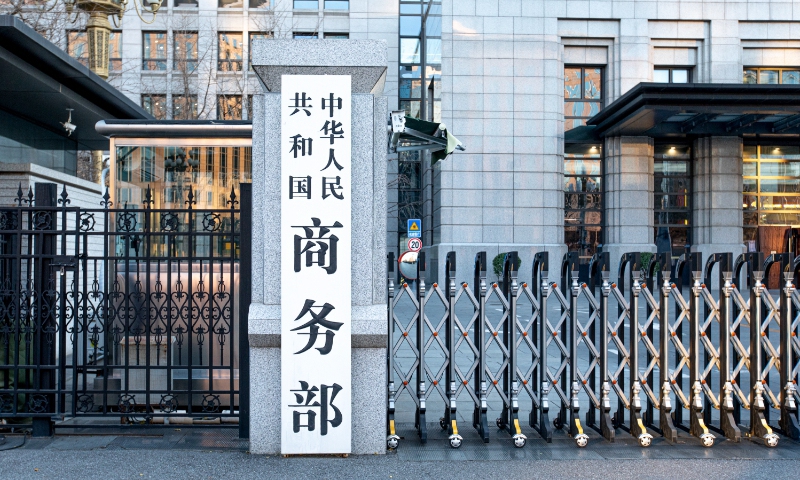
The Ministry of Commerce of China File photo: VCG
China's Ministry of Commerce (MOFCOM) on Friday announced two reciprocal trade barrier investigations into US actions and measures that harm global production and supply chains as well as those that impede trading of green products.MOFCOM said it will take corresponding measures based on the findings to safeguard its legitimate rights and interests, a ministry spokesperson said.
According to a statement published by MOFCOM on Friday, the Office of the United States Trade Representative (USTR) on March 12 initiated a Section 301 investigation targeting China and 15 other economies on the grounds of so-called "structural excess capacity in manufacturing sectors." It then launched another Section 301 investigation on March 13, targeting China and 59 other economies over what it claimed was a failure to effectively prohibit imports of goods produced with forced labor.
In response to the US actions, and to safeguard the interests of relevant Chinese industries, MOFCOM said it has launched the reciprocal trade barrier investigations, in accordance with China's Foreign Trade Law and MOFCOM rules on foreign trade barrier investigations.
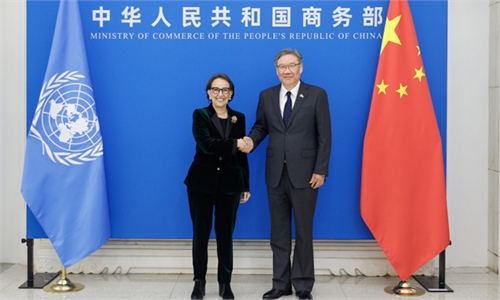
The announcements by the ministry came as China's commerce minister Wang Wentao met with US Trade Representative Jamieson Greer on Thursday on the sidelines of the 14th Ministerial Conference of the World Trade Organization (WTO) held in Yaounde, capital of Cameroon.
The two sides held in-depth exchanges on China-US economic and trade relations, and multilateral and regional economic cooperation, according to a press release on the official website of MOFCOM on Friday.
During the meeting, Wang expressed serious concerns regarding US Section 301 investigations against several economies, including China, over so-called "overcapacity" and alleged failure to ban products linked to forced labor.
Resolute response
The moves by MOFCOM represent a reasonable countermeasure by China and demonstrate China's firm stance on safeguarding its industrial interests, Chen Fengying, a research fellow at the Beijing-based China Institutes of Contemporary International Relations, told the Global Times on Friday.
The US recently launched multiple Section 301 and Section 232 investigations, attempting to reclaim tariff powers denied by its Supreme Court, which ruled many of Trump administration's tariffs illegal. This completely deviates from the principle of win-win cooperation, Chen said.
According to MOFCOM, preliminary evidence and information it obtained indicate that the US has implemented practices and measures that seriously violate global supply chains and that the US has implemented numerous practices and measures to hinder trade in green products.
These practices and measures could seriously harm the trade interests of Chinese enterprises, and some of these measures are suspected of violating WTO rules and the economic and trade agreements reached between China and the US, per a statement on the ministry's website.
The exchange of trade probes came amid recent frequent high-level exchanges between Chinese and US trade officials, highlighted by the recent round of China-US economic and trade talks between Chinese Vice Premier He Lifeng with US lead person Treasury Secretary Scott Bessent and US Trade Representative Jamieson Greer in Paris held earlier this month.
Analysts believed that China-US economic and trade relations have a significant meaning not only on the two countries but also on the broader global economy. Resolving trade issues and frictions through consultation is the right way forward, which can enhance mutual understanding and reduce misjudgments.
Avoiding vicious competition
At the Thursday meeting with Greer, Commerce Minister Wang said the two sides should properly handle the relationship between competition and cooperation and between the past and the future, strengthen mutually beneficial cooperation, avoid vicious competition, maintain close communication, "look forward" together, and promote healthy, stable and sustainable development of bilateral economic and trade relations.
The nature of competition was also mentioned by Sean Stein, president of the US-China Business Council, who was in Beijing for the China Development Forum 2026.
"Healthy competition, that's exactly what we want," Stein said during a recent interview with CGTN.
As major global powers, it is normal and inevitable for China and the US to engage in benign competition in the international market, as the development of the global market relies on fair and just competition rules, Chen said.
Chen noted that the US often uses untenable reasons such as national security, geopolitics, and geo-economics to pursue trade bullying, even blatantly violating WTO multilateral trade rules. Such behavior, which seeks unilateral gains while disregarding principles of reciprocity and fairness, is a typical example of vicious competition.
Li Yong, a senior research fellow at the China Association of International Trade, told the Global Times on Friday that the US business community has acted rationally and objectively when pursuing market opportunities in China.
US business CEOs have actively participated in major forums, including the China Development Forum, held in China this week. The CDF drew more than 30 senior executives of US companies, including Apple Inc, Eli Lilly & Co, and McDonald's Corporation, according to media reports.
In addition to US companies, China's super-sized market, stable social environment and predictable growth prospects are attracting an increasing number of multinational enterprises to seek development opportunities in the country, Li said.
The gathering of senior executives from US companies not only reflects US businesses' confidence in China's development, but also contributes to the recovering trade and business ties between the world's two largest economies, Li said.
Instead of using its technological edge as a tool for export controls and curbs on China's development, which has in fact restricted the space for China-US cooperation in emerging areas and dented the recovering trend of China-US trade, the US should take concrete actions to cement the recovering ties and create favorable atmosphere for the further high-level interactions between the two countries.
When asked whether there was more information on US President Donald Trump's expected visit to China and whether the trip would take place on May 14-15, Chinese Foreign Ministry spokesperson Lin Jian said that "China and the US remain in communication on President Trump's visit to China."
RELATED ARTICLES