China to actively boost imports during 15th FYP to promote balanced development of imports and exports: GAC spokesperson
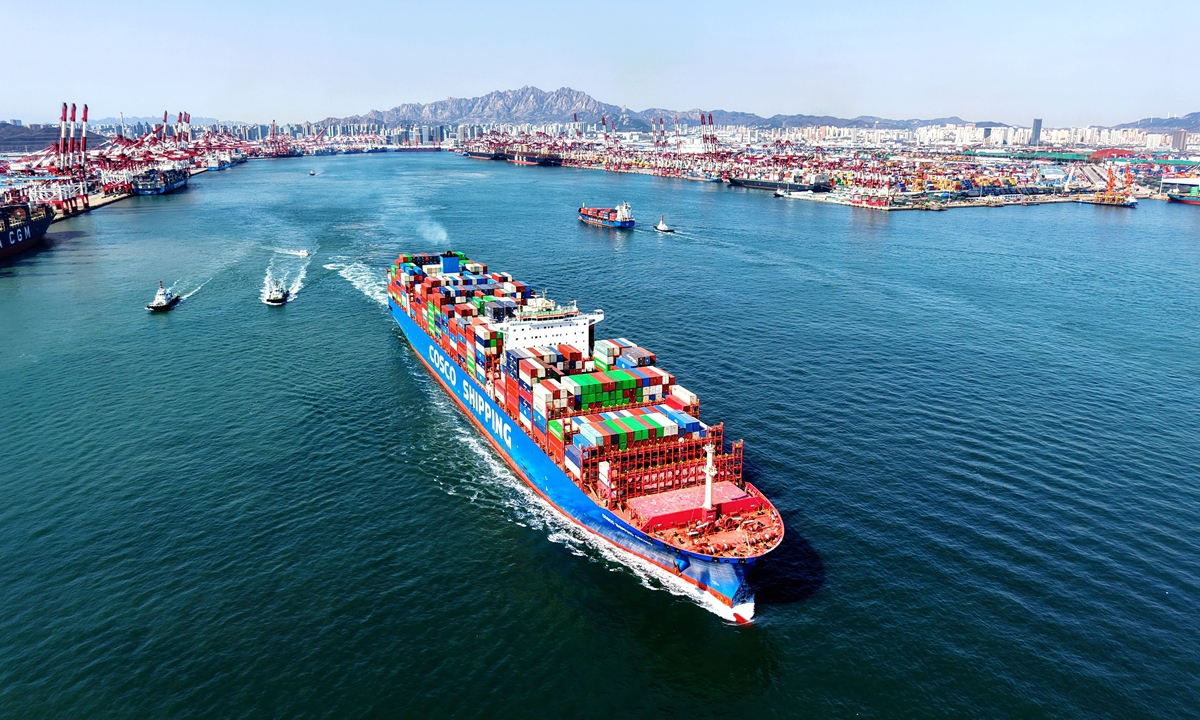
View of a container vessel near Qingdao port in East China's Shandong Province on April 7, 2026 Photo: VCG
China will continue to actively expand imports and promote the balanced development of imports and exports during the 15th Five-Year Plan period (2026-30), Lü Daliang, spokesperson of the General Administration of Customs (GAC), said on Tuesday, in response to a question over the outlook for China's trade surplus for the rest of this year, as the country's trade surplus has raised concerns among its trading partners - most notably the EU.
"Regarding China's trade balance, I would like to point out that China's foreign trade is characterized by large-scale imports and exports; we are not only the world's largest exporter but also the second-largest importer. Data from the first half of this year shows that the growth rate of imports outpaced that of exports, resulting in a 4.7 percent narrowing of the trade surplus," Lü said.
In response to a separate question over whether China will import more from EU countries by proposing "upward balance" in trade with EU, Lü said China and the EU have established a regular exchange mechanism in the economic and trade field, namely the China-EU trade and investment consultation mechanism. Recently, the first meeting of this mechanism was held, during which the "upward balance" was also discussed, Lü said.
According to data released by the GAC on Tuesday, China's imports and exports with the EU grew by 10.2 percent year-on-year in the first half of the year.
Lü said that China's manufacturing sector features a complete industrial system and strong supporting capabilities. Foreign-invested enterprises have taken deep roots in China, operating in China for the world, and continuously generating profits for investors. In the first half of the year, a significant portion of China's exports was accomplished by foreign-invested enterprises. For instance, in exports to the EU, foreign-invested enterprises accounted for nearly 30 percent, the spokesperson said.
It is logically untenable that some European politicians claim that there is so-called imbalance in China-EU trade merely because China has a trade surplus with the EU, Zhang Jian, a vice president of the China Institutes of Contemporary International Relations, told the Global Times on Tuesday.
"International trade is essentially based on comparative advantage and two-way market choice, benefiting both sides of the cooperation, trade surpluses or deficits are normal. In fact, China never deliberately pursues trade surpluses," Zhang said, calling on the EU to deepen mutually beneficial China-EU economic and trade cooperation with an open and pragmatic approach.
RELATED ARTICLES