US FCC vote to bar Chinese testing labs amounts to non-market tactic that risks disrupting global electronics supply chains: analysts
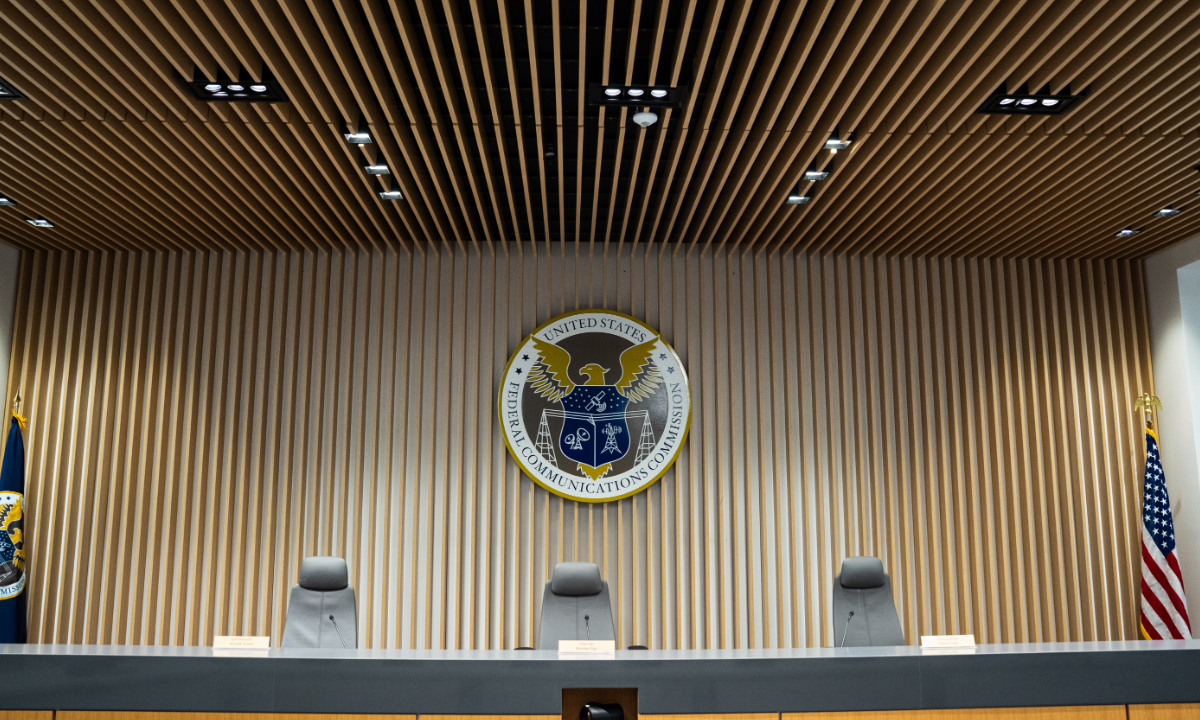
The seal of the Federal Communications Commission (FCC) prior to an open commission meeting at the agency's headquarters in Washington, DC, US, on February 18, 2026. Photo: VCG
A US plan to bar Chinese labs from testing electronic devices for the American market amounts to a non-market tactics and could disrupt global electronics supply chains, including those in the US, by raising costs for industries that rely on China's manufacturing and testing capabilities, Chinese experts said on Friday, following the latest US Federal Communications Commission (FCC)'s ban on Chinese labs.
They also described the FCC's decision as a further expansion of US technology restrictions on China.
The FCC on Thursday voted to bar all Chinese labs from testing electronic devices including smartphones, cameras and computers, for use in the US, according to Reuters.
The FCC said it will prohibit test labs and certification bodies in countries including China that deny reciprocal treatment to US-based test labs, Reuters said. The prohibitions are scheduled to take effect in December 2028.
82 percent of electronics were tested in China, which does not have an agreement with the US, while fewer than 4 percent were tested in US-based laboratories, FCC Chair Brendan Carr said that in 2025, per Reuters.
FCC's restrictions on Chinese testing laboratories, justified on security grounds, lack specific evidence of violations and instead presume risk solely on the basis of national origin, Zhang Xiaorong, director of the Beijing-based Cutting-Edge Technology Research Institute, told the Global Times on Friday.
"This approach lacks persuasiveness in technical regulation. It politicizes commercial testing and stands in stark contrast to the US' own long-standing information security controversies, revealing clear double standards," Zhang said, adding that the move represents a non-market, protectionist approach to technological competition.
Placing national security considerations above objective technical principles further aggravates fragmentation and distrust in the global technology supply chain, hinders technological progress, and damages economic efficiency, Zhang noted.
"It will create direct and significant uncertainty for US product supply chains, while forcing global enterprises that rely on the capabilities of Chinese labs to bear the adjustment costs of these policy shifts," Zhou Mi, a senior research fellow at the Chinese Academy of International Trade and Economic Cooperation, told the Global Times on Friday.
Such concerns for uncertainty have also been widely shared by some industry representatives.
International testing firm Element pointed out in July that "for years, global manufacturers have benefited from the scale of China's testing infrastructure, particularly because laboratories are located close to manufacturing facilities, reducing logistics costs and shortening development cycles. Replacing that capacity will not happen overnight."
Element has warned that shifting testing to other approved laboratories could result in longer lead times and higher costs. Manufacturers may also face greater scheduling difficulties and reduced access to specialized testing expertise, particularly for less common types of testing.
In response to a question about FCC's plan to vote on a proposal that would ban all Chinese labs from testing electronic devices used in the US, the Chinese Foreign Ministry spokesperson Mao Ning said that "China firmly opposes the US overstretching the concept of national security," during a press conference on April 9.
"This type of action has severely impeded the normal economic and trade exchanges between Chinese and US companies and does not serve anyone's interests, including those of American companies and consumers. China will continue to firmly safeguard its legitimate and lawful rights and interests," said Mao.
The FCC's latest vote on Thursday widened restrictions introduced in 2025, when the agency barred laboratories owned or controlled by the Chinese government from testing electronics for the US market, affecting several dozen facilities, according to media reports.
This is the latest in a series of FCC restrictions affecting Chinese technology, including blocks on new models of Chinese-made drones, foreign-made consumer routers, expanded equipment restrictions involving Huawei and ZTE, and moves to bar devices containing key components from Chinese firms under the pretext of national security risks.
"Recent FCC measures form part of a broader US push to build so-called 'secure supply chains' in next-generation information and communications technology and artificial intelligence, with the aim of excluding China. Such steps risk fragmenting global technology supply chains and undermining the efficiency of international industrial cooperation," Zhou said.
"These US actions are highly unreasonable and inconsistent with the consensus reached by the two countries' leaders," Zhang said.
RELATED ARTICLES