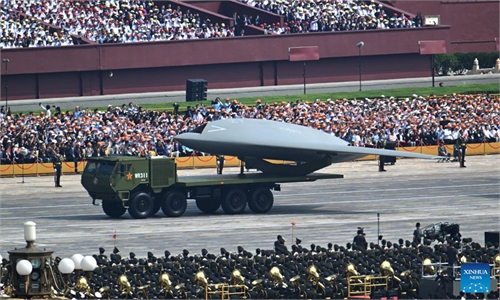
China's first Type 076 amphibious assault ship, the Sichuan, is underway on Nov. 15, 2025. The Sichuan returned to the shipyard in Shanghai at around 5 p.m. Sunday after completing its maiden sea trial. (Photo by Zhang Liang/Xinhua)
China’s GJ-21 reconnaissance and strike stealth drone recently completed its first successful takeoff and landing aboard the Sichuan, the country’s first Type 076 amphibious assault ship, marking a breakthrough in the Chinese Navy’s ability to operate fixed-wing stealth drones from large maritime
A Chinese military affairs expert told the Global Times that this is a global first, bringing the PLA one step closer to an era of drone carriers. The Type 076 amphibious assault ship has thus become the world’s first catapult-enabled drone carrier.
The GJ-21 is the Chinese military’s first carrier-borne stealth drone integrating reconnaissance and strike capabilities. Its successful takeoff and landing demonstrate the Chinese Navy’s capability to launch and recover fixed-wing stealth drones from large maritime combat platforms, according to Xinhua.
The Sichuan, bearing hull number 51, is the first Type 076 amphibious assault ship independently designed, developed and built by China. Launched and named on December 27, 2024, it incorporates a fully automated landing guidance system, a new integrated power system, and electromagnetic catapult and arresting technology. It can carry fixed-wing drones, helicopters and amphibious equipment, according to Xinhua.
Since its first sea trial in November 2025, the Sichuan has steadily conducted sea trials as scheduled, successfully completing equipment and system checks and tests of overall operational stability, per Xinhua.
Core strength
The GJ‑21 is the world’s first large stealth strike and reconnaissance drone capable of operating from amphibious assault ships. This test marks the world’s first catapult launch of a large stealth strike and reconnaissance drone from an amphibious assault ship, Chinese military affairs expert Zhang Xuefeng, told the Global Times on Friday.
Zhang outlined GJ‑21’s key strengths. First, it boasts outstanding stealth performance. Adopting a flying‑wing configuration and an S‑shaped top‑mounted air intake, the aircraft eliminates strong radar reflection sources and delivers excellent all‑aspect stealth capability. Its stealth performance is even superior to that of in‑service stealth fighters.
Suited for striking heavily defended targets, it can serve as a vanguard asset to carry out “door‑kicking” suppression missions, according to Zhang.
Moreover, GJ‑21 has a substantial combat radius. The flying‑wing design boosts subsonic cruise efficiency. Though its airframe is far smaller than the J‑35 and J‑20, its combat radius is comparable, said Zhang.
GJ‑21 is also low‑cost and reusable. Unlike hypersonic missiles, it can be recovered and redeployed multiple times. It can also deploy small, low‑cost glide guided bombs. Under high‑tempo operations, it offers greater fire‑delivery efficiency with better cost control.
If GJ‑21 is deployed aboard the Type 076 amphibious assault ship, coordination between the Type 076 and aircraft carrier will markedly enhance the carrier strike group’s anti‑surface and land‑attack capabilities. Furthermore, it can team up with manned fighters for high‑risk, complex missions such as suppression of enemy air defenses. Manned fighters can clear an aerial corridor while GJ‑21 pushes forward to neutralize hostile ground targets and air defense systems, according to Zhang.
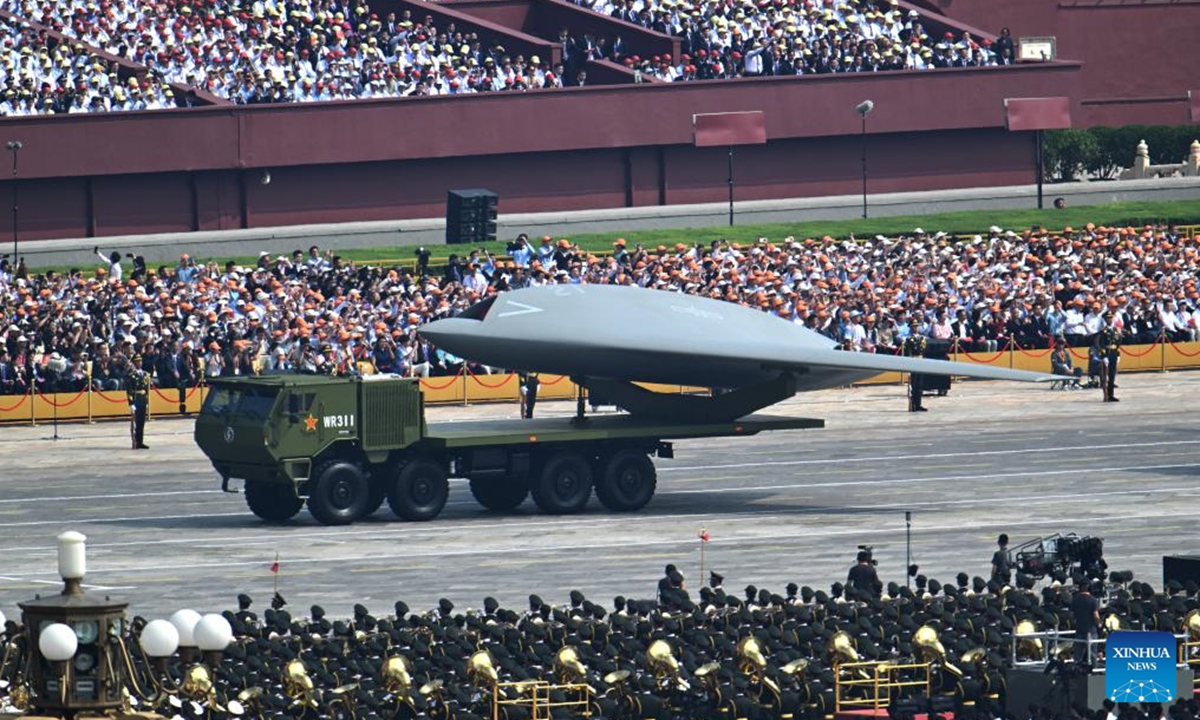
The airborne unmanned warfare formation attends a military parade in Beijing, capital of China, Sept. 3, 2025. China on Wednesday held a grand gathering to commemorate the 80th anniversary of the victory in the Chinese People's War of Resistance against Japanese Aggression and the World Anti-Fascist War. (Xinhua/Deng Hua)
The Sichuan, bearing hull number 51, is the first Type 076 amphibious assault ship independently designed, developed and built by China. Launched and named on December 27, 2024, it incorporates a fully automated landing guidance system, a new integrated power system, and electromagnetic catapult and arresting technology. It can carry fixed-wing drones, helicopters and amphibious equipment, according to Xinhua.Closer to era of drone carriers
The latest information suggests that the Type 076 amphibious assault ship has carried out technical verification related to catapult-capable drone carriers to a certain extent. The vessel will continue compatibility tests for multiple types of UAVs in follow-up work, Chinese military affairs expert Song Zhongping told the Global Times on Friday.
“As a large UAV, the GJ-21 has a takeoff weight of more than ten tons. It cannot take off on its own from a conventional ship deck and must rely on a catapult system like the one on the Type 076. Meanwhile, the Type 076 amphibious assault ship is also fitted with an arresting system to support stable and reliable arrested landings of the GJ-21,” Song said.
The completion of GJ-21 takeoffs and landings aboard the Type 076 means the ship has achieved the basic combat capability of a catapult-capable drone carrier, a global first, according to Song.
Song noted that the US X-47B carrier-based drone program was designed for aircraft carriers, yet multiple technical constraints led to its cancellation. By contrast, the GJ-21 program has advanced steadily with an efficient development timeline and boasts broad application prospects ahead.
“Besides operating from the Type 076 amphibious assault ship, the GJ-21 may also be deployed on China’s electromagnetic catapult aircraft carrier in the future. The Type 076 could serve as a testbed for cutting-edge technologies. It can operate independently as a drone carrier and build technical know-how for China’s third aircraft carrier to host manned-unmanned teaming, expanding the operational modes of carrier strike groups,” said Song.
The PLA Navy’s exploration of carrier-based drone operations using the Type 076 proves that this new equipment combination is viable. This technical path carries substantial practical value, and the Type 076 has thus become the world’s first catapult-capable drone carrier.
“The vessel could also temporarily accommodate manned fighter jets later to test catapult launch and arrested landing procedures for manned aircraft,” predicted the expert.
RELATED ARTICLES