Powering breakthroughs in agriculture through innovation and investment
Italian enterprise scales global R&D biologicals, seeds, AI to help farmers grow more with less

Global agriculture is at a critical point and the world's farmers face some unique challenges. With the world's population poised to reach almost 10 billion by 2050, farmers everywhere need to produce more food than ever before. At the same time, commodity prices are ever shifting, and regulatory frameworks are complex and dynamic. Geopolitical changes are also having seismic impacts, as the recent spike in fertilizer prices brought on by the blockade in the Strait of Hormuz proves.
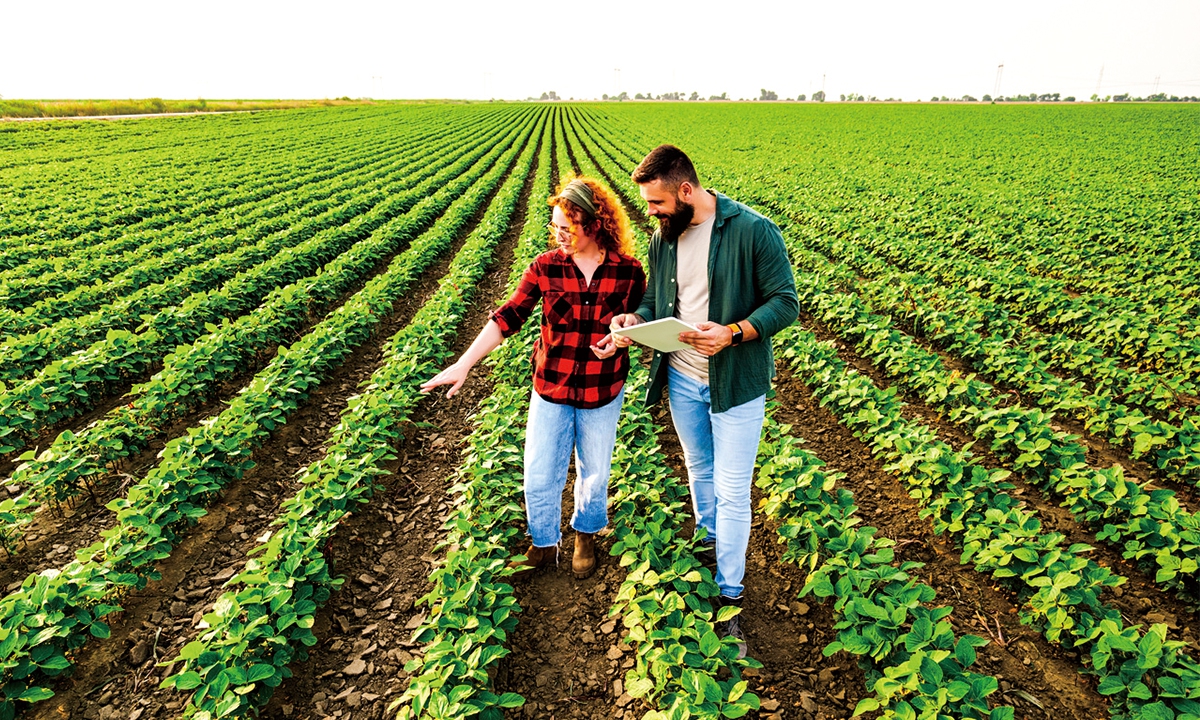
Farmers inspect soybean crop.
If we are to avoid cutting more forests to feed an increasing population, farmers must increase productivity on existing farmland. They also need to achieve those higher yields while making a lower impact on the environment. To achieve this requires collaboration that can bring new innovations to the market. Bringing breakthrough innovations to farmers everywhere is what Syngenta Group exists to do.The interlocking challenges of global agriculture require innovation. When pests change their behavior or weeds develop resistance to control methods, farmers need to find new tools to protect their farms and boost yields. With 50,000 employees around the world, including more than 7,400 scientists and researchers across over 100 R&D sites and trialing locations, Syngenta has built the most comprehensive agricultural innovation and technology ecosystem in the world.
Thanks to nearly $2 billion of annual investment in R&D, and an unparalleled geographical reach, Syngenta's focus for the next decade is to further accelerate scientific breakthroughs that empower farmers to achieve those vital higher yields at lower impact.
In the coming decade the Group will launch at least 20 proprietary innovations across crop protection. This includes new active ingredients and synthetic chemistry as well as biologicals.
This year, Syngenta has broken ground on several major R&D construction projects. This includes a $130 million investment in new facilities - BioSTaR - at the historic Jealott's Hill site in southern England. This is where VIRESTINA™ technology was developed. This isn't just a new chemical subclass but the world's first selective herbicide to control resistant grass weeds in soybean and cotton in nearly 40 years.
This year, the Group also inaugurated a landmark Innovation Center in Shanghai's Jinshan district. CEO Jeff Rowe said the Shanghai center represents "the largest investment that we've made in R&D since the formation of Syngenta Group."
Built to be both cutting-edge in its technology and carbon neutral in design, it will be a vital hub for developing new solutions expertly tailored for China's unique agronomic needs. These new facilities are examples of the commitment to using the most sophisticated scientific operations, powered by cutting-edge technologies, to drive new scientific breakthroughs in crop protection and biologicals.
Syngenta can further accelerate these breakthroughs by harnessing the colossal potential of AI and digitization to improve the business operations, raise efficiency and get new tools into farmers' hands faster. Alongside these new breakthroughs in chemistry sits the cutting-edge research into biological products to protect crops, enhance yield, help plants be more resilient to climate stress and improve the efficiency with which plants take up nutrients. Syngenta continues to build out the global infrastructure that is the lifeblood of innovation.
The beating heart of Syngenta Biologicals is in Atessa, Italy, where this world-leading site serves as both the primary global production hub and the home of the pioneering research into biologicals. But Syngenta is not just bringing new crop protection products to farmers, it's also providing them with ever-better seeds.
Across the seeds business, the Group breeds thousands of new varieties and explores millions of genes every year. Here too it's using the latest AI and machine learning technology to unlock insights from genomic and field data collected over decades to make better predictions and get the best performing seeds to farmers more quickly than ever.
Thanks to the expertise in plant breeding and genetics, Syngenta has leading trait stacks which help breed seeds with greater protection against pests, pathogens, and weeds that drive down yields and threaten global food security.
At the same time, Syngenta's proprietary technologies such as Hi-Edit and GiFT enable it to bring precise, agronomically fit products to market faster than ever before. This includes new X-TERRA™ hybrid wheat. Launching this year in France, it is the first time that hybrid wheat has been commercially scaled across Europe. Meanwhile in the US, Syngenta has launched Durastak™ - a triple protein stack corn that protects against corn rootworm, one of the most destructive pests in the Corn Belt.
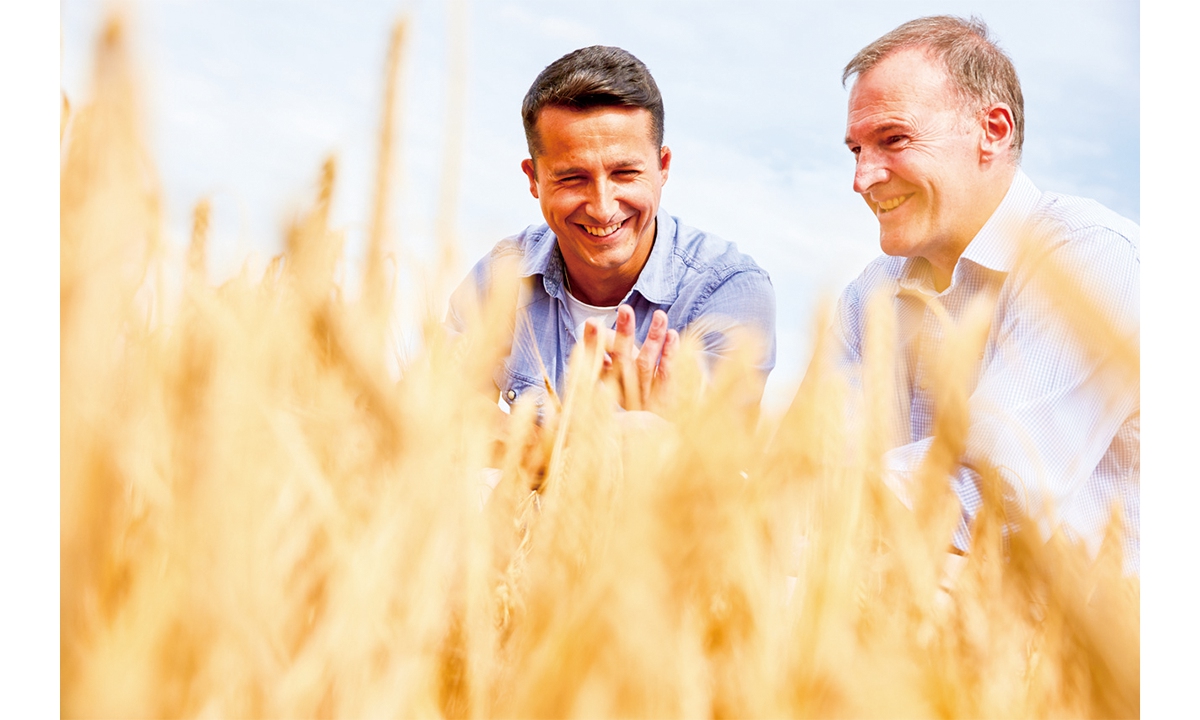
Two men check barley. Photos on this page: Courtesy of Syngenta Group
However, taking on and solving the biggest challenges facing our global food system can't be done alone. Through strategic partnerships with leading technology companies - including SAP, NVIDIA, and Google - Syngenta is accelerating discovery and shortening the path from those breakthroughs in the laboratory to their impact in the field.In every laboratory where a breakthrough experiment succeeds, and in every field where a seed outperforms what came before it, something quietly extraordinary is taking shape.
Where courage, curiosity and collaboration meet global scale, where investment becomes innovation, and where innovation means more and better food for us all.
The needs are clear and the stakes are high. But the breakthroughs ahead of us are not abstract and innovation must be more than just a hollow buzzword. Nothing less than the future of how we feed the planet depends on it.
RELATED ARTICLES

