China, Switzerland sign upgraded FTA, pledging zero tariffs on over 99% of imports
China and Switzerland Photo: VCG
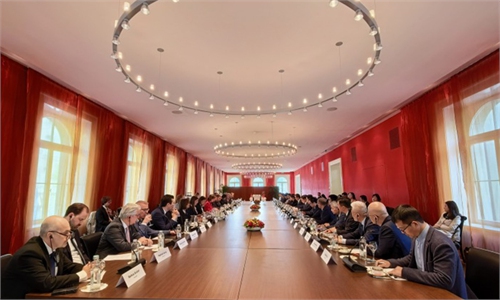
China and Switzerland on Friday signed a protocol on upgrading their free trade agreement (FTA), according to the Xinhua News Agency. The move marks a significant deepening of bilateral economic ties, some observers said.
Following the signing of a memorandum of understanding (MOU) on the FTA in August, both sides have committed to achieving zero-tariff coverage on more than 99 percent of imports under the upgraded agreement.
The signing came as President of the Swiss Confederation Guy Parmelin is paying a working visit to China from Friday to Sunday. This year also marks the 10th anniversary of the China-Switzerland innovative strategic partnership.
China and Switzerland launched negotiations to upgrade their FTA in September 2024. After five rounds of negotiations, Chinese Commerce Minister Wang Wentao and Parmelin jointly announced the successful conclusion of the talks on August 20 and signed the MOU in Bern.
The two sides committed to higher level of two-way opening up in multiple areas, including goods, services, investment and rules, which will create new opportunities for bilateral economic and trade cooperation, said Wang, according to Xinhua.
Parmelin said the successful upgrade of the agreement marks another important milestone in the development of bilateral relations and will provide a more stable, transparent and predictable institutional framework for the long-term development of businesses in both countries, per Xinhua.
Both sides intend to accelerate domestic procedures to enable the formal signing of the upgraded protocol, Huang Ling, a spokesperson for the Ministry of Commerce said on August 27.
Both sides have committed to achieving zero-tariff coverage on more than 99 percent of imports, Huang noted. And according to data from the Swiss side, approximately 99.8 percent of the value of Swiss exports to China will enjoy zero-tariff treatment under the upgrade.
Apart from trade in goods, Huang specified that in services and investment, the upgrade will provide investors from both countries with higher-level market access along with a more stable, transparent, and predictable business environment.
The two sides also plan deeper collaboration in digital trade, artificial intelligence, sustainable development, supply chains, pharmaceuticals, machinery, and the watch industry, Huang said.
"By elevating standards of reciprocal openness in goods, trade, investment, and regulatory frameworks, the FTA will create wider opportunities for collaboration between China and Switzerland in science, technology, and related domains," Hu Qimu, professor at the Maritime Silk Road Institute of Huaqiao University, told the Global Times.
The original China-Switzerland FTA, which was signed in July 2013 and entering into force in July 2014, was China's first FTA with a continental European country, according to the Chinese government's website.
A joint assessment report by Chinese and Swiss scholars, released to mark the agreement's 10th anniversary in 2023, found that the FTA had lowered trade costs, raised efficiency, and driven sustained growth in bilateral trade. The utilization rate among Swiss exporters - an important benchmark for assessing the impact of FTAs - rose 13 percentage points over five years ended 2023, from 58 percent to 71 percent.
According to data from China's Ministry of Commerce, bilateral trade expanded from $43.57 billion in 2014 to $62.77 billion in 2024 - an increase of 44 percent.
Although Switzerland is not part of the European Union, its position as a key European financial center and its strength in high-value-added industries make it an important gateway for China to expand economic and trade relations with Europe, Hu said.
Global Times
RELATED ARTICLES