China, Norway sign seafood trade protocol to expand market access, boost bilateral cooperation
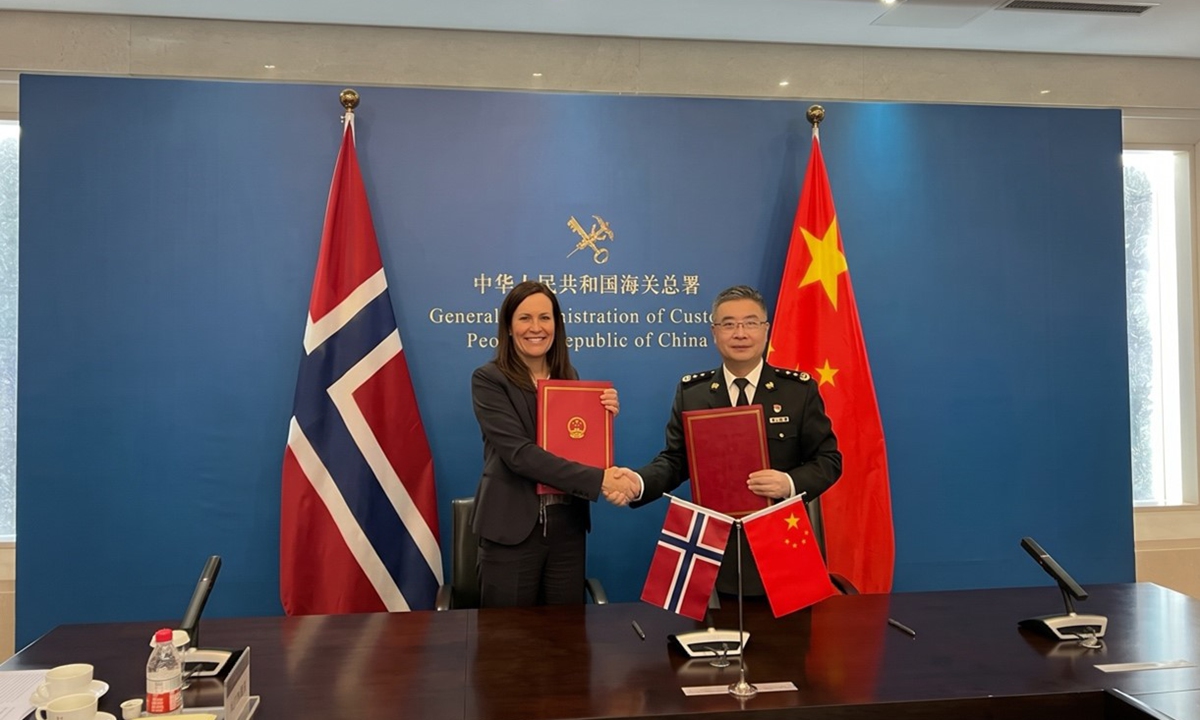
Chinese and Norwegian officials shake hands after signing a protocol on market access for Norwegian wild-caught seafood at China's General Administration of Customs on October 29, 2026. Photo: Courtesy of the Norwegian Seafood Council
China and Norway have signed a new protocol to expand market access for Norwegian wild-caught seafood, marking another step forward in bilateral trade cooperation and creating fresh opportunities for Norwegian exporters to tap into China's vast consumer market.
The agreement, signed on Thursday by China's General Administration of Customs (GAC) and the Norwegian Ministry of Industry, Commerce and Fisheries, establishes a framework for Norwegian wild-caught seafood exports to China, according to a statement that the Norwegian Seafood Council, which is part of the Norwegian Ministry of Industry, Commerce and Fisheries, provided to the Global Times on Friday.
The move comes as China ranks as Norway's second-largest seafood market in 2026, reflecting growing demand for Norwegian seafood products and the continued importance of the Chinese market to Norwegian exporters, according to industry observers.
Under the protocol, the two countries will establish common requirements and procedures covering registration, documentation, approval and regulatory compliance. The framework is expected to facilitate market access for additional Norwegian seafood products, including lumpfish, wolffish and sea cucumber, which have not previously been approved for entry into China, according to the statement.
The protocol establishes a framework for Norwegian wild-caught seafood exports to China and will pave the way for all Norwegian wild-caught seafood to be approved for the Chinese market, in accordance with the protocol's requirements and applicable Chinese regulations, according to the statement.
"China is one of Norway's most important seafood trading partners," Marianne Sivertsen Næss, Norway's Minister of Fisheries and Ocean Policy, said in the statement.
"The protocol will open up new opportunities for Norwegian wild-caught seafood in China and reflects our shared commitment to facilitating trade through close cooperation. We look forward to bringing an even wider range of Norwegian wild-caught seafood to Chinese consumers," she said.
The agreement marks progress in deepening China-Norway economic and trade cooperation and expanding market access, while also demonstrating the continued appeal of China's vast market to Norwegian businesses, Jian Junbo, director of the Center for China-Europe Relations at Fudan University, told the Global Times on Friday.
Growing demand among Chinese consumers for a diverse range of high-quality seafood products has created considerable opportunities for Norwegian exporters, the Chinese expert said.
As more Norwegian wild-caught seafood products gradually gain access to the Chinese market, bilateral seafood trade has further room to grow, Jian noted.
According to the Norwegian Seafood Council, Norwegian seafood exports to China reached 158,230 tons in the first nine months of 2026, valued at 11.69 billion Norwegian kroner ($1.27 billion).
The figures represented year-on-year increases of 15 percent in volume and 26 percent in value.
The latest protocol builds on previous progress in bilateral seafood trade. Norway's live snow crab gained access to the Chinese market in December 2024, and live brown crab followed in November 2025.
Beyond expanding the range of imported products, the new agreement will help improve the transparency and predictability of market access by establishing common requirements for registration, approval, inspection and quarantine, thereby creating more favorable conditions for long-term cooperation between businesses in both countries, Jian said.
The Norwegian minister's visit to China also included a stop in Qingdao, East China's Shandong Province, where she attended the Norway-China Seafood Summit and visited the China Fisheries & Seafood Expo. These engagements provided further opportunities for further exchanges between industry representatives, the Global Times learned from the Norwegian Seafood Council.
"Norway and China share a strong interest in developing our seafood trade through predictable procedures, high food safety standards and constructive cooperation. Continued dialogue between our authorities and engagement with industry stakeholders are essential to strengthening mutual understanding and supporting the further development of our bilateral seafood trade," Næss said in the statement.
The Norwegian seafood industry also expressed confidence in the long-term prospects of the Chinese market.
"China is a highly important and dynamic market for Norwegian seafood, and we are confident in its long-term growth potential. We are excited about the opportunities ahead and look forward to working closely with our Chinese partners to further strengthen our presence in the market, meet evolving consumer demand and bring a wider range of high-quality Norwegian seafood to Chinese consumers," said Sigmund Bjørgo, China Director of the Norwegian Seafood Council, in the statement.
Notably, Norway is not a member of the EU and retains a degree of autonomy in its foreign trade policies, allowing China and Norway to pursue economic and trade cooperation more flexibly by leveraging their respective strengths, said Jian, noting that the two countries' efforts to expand market access for seafood through consultations also set a positive example of how countries seek to promote trade liberalization and facilitation through pragmatic cooperation.
The agreement also demonstrates how China's continued efforts to open its market create new development opportunities for trading partners, including European countries, and contribute to broader international economic and trade cooperation, the expert said.
RELATED ARTICLES


