China reports sharp increases in gold, nickel and other strategic minerals; discovers huge zircon sand deposit in Xinjiang region: ministry
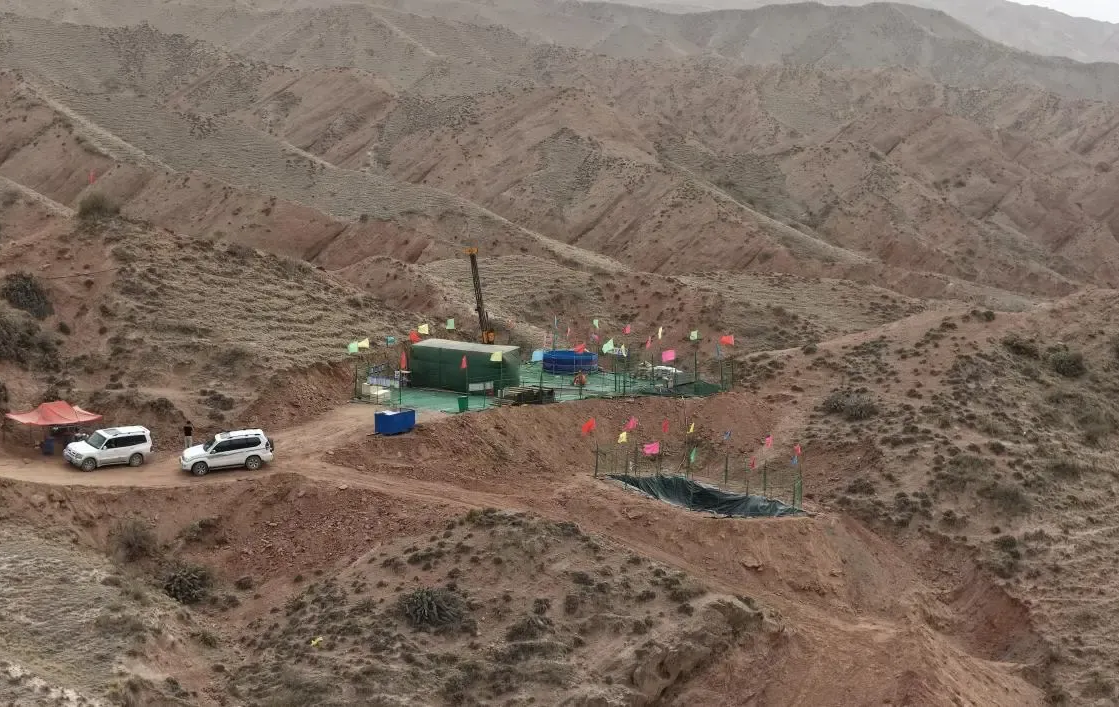
Courtesy of the Ministry of Natural Resources
China has reported substantial increases in its reserves of gold, nickel, rhenium and other strategic minerals following a nationwide reassessment of mineral deposits, the Xinhua News Agency reported on Saturday, citing the Ministry of Natural Resources (MNR).
According to MNR, the reassessment found that China's retained rhenium resources had increased by more than 200 percent. Gold reserves increased by an amount equivalent to 50 large deposits, while nickel reserves rose by the equivalent of 30 large deposits.
Reserves of 13 minerals, including gallium, germanium and indium, had risen substantially. Resources of gallium, indium, tantalum and vanadium also recorded substantial increases, each equivalent to more than 10 large deposits, said the ministry.
In 2024, a nationwide survey was launched, covering 17 strategic minerals across more than 1,800 operating mines and large and medium-sized mining areas.
The 17 strategic minerals are gallium, germanium, indium, chromite, nickel, cobalt, zirconium, hafnium, niobium, tantalum, vanadium, rare earths, rhenium, potash, gold, manganese and helium, the ministry said.
The year-long survey identified associated and low-grade resources that could be economically recovered under current technology and market conditions.
An official from the MNR said that this has provided strong support for the smooth delivery of the targets of China’s 14th Five-Year Plan (2021-25) major mineral exploration drive and help strengthen resource security, according to Xinhua.
Separately, the ministry said on Saturday that a major zircon sand deposit has been discovered in Baicheng County of Aksu Prefecture in Northwest Xinjiang Uygur Autonomous Region. The confirmed resource scale is equivalent to more than 40 large zircon deposits, and its associated hafnium deposit is also classified as super-large scale, CCTV News reported.
Zirconium is a silvery-gray transition metal with a high melting point, corrosion resistance and a small neutron absorption cross-section, making it a critical material for nuclear reactor fuel rod cladding and aerospace high-temperature alloys. Hafnium, often found alongside zirconium, boasts a high density and melting point. It is a key material for nuclear reactor control rods and is also used in rocket engines and spacecraft heat shields.
The global distribution of zircon resources is uneven, with around 70 percent of reserves concentrated in Australia, while China holds less than 1 percent.
The ministry said the discovery would help fill a major gap in domestic exploration for super-large zirconium-hafnium deposits and improve China’s supply security for the two strategic metals.
According to the ministry, China’s latest mineral exploration campaign has gotten off to a strong start during the 15th Five-Year Plan (2026-30) period, with additional breakthroughs in copper-gold exploration in Chating, East China’s Anhui Province, and the discovery of China’s first fully concealed, high-grade, thick, super-large lead-zinc deposit at Zhugongtang in Bijie, Southwest China’s Guizhou Province.
Global Times
RELATED ARTICLES

