Ulanqab transforms volcanic landscapes into year-round tourism opportunities, driving local economic growth in North China’s Inner Mongolia
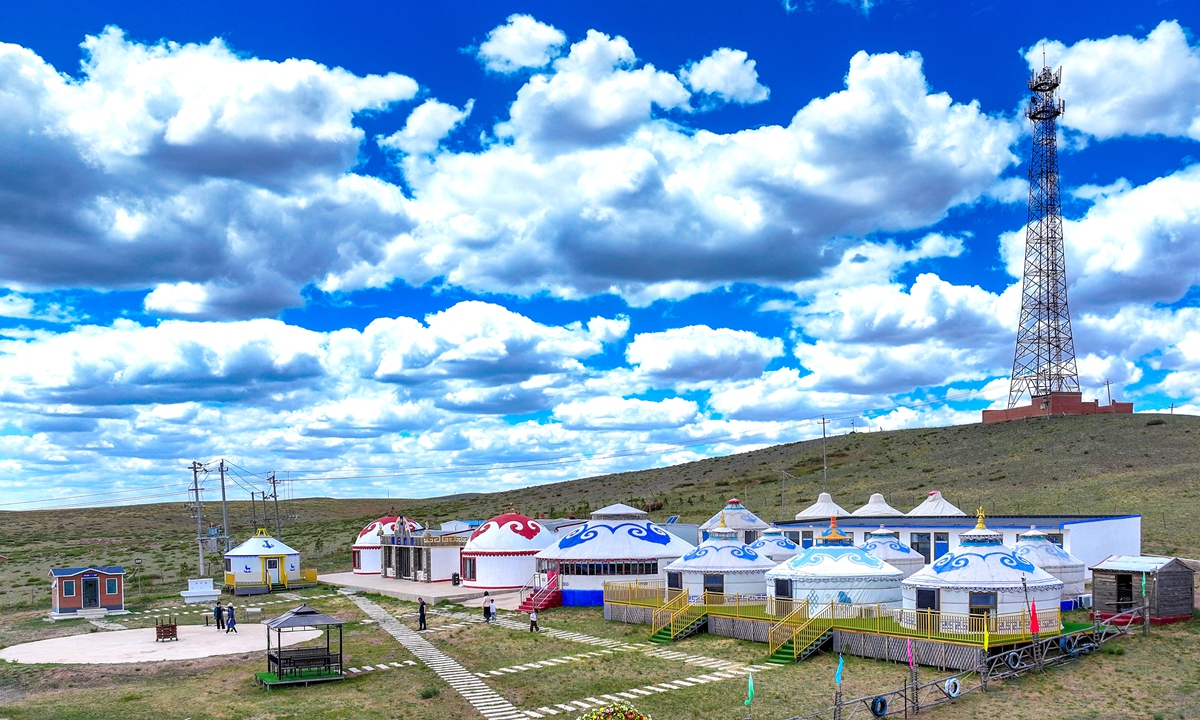
Tourists visit a homestay area in Ulanqab, North China's Inner Mongolia Autonomous Region, on July 8, 2026. Photo: VCG
A 27-year-old office worker from Beijing, surnamed Ye, first visited the Ulan Hada volcanoes in Ulanqab, North China's Inner Mongolia Autonomous Region, three years ago. She took some photos, walked around for an hour or two and then left. Recently, she returned with her family and planned to stay for two days.
"The scenic area has changed so much since my last visit," Ye told the Global Times. Beyond the volcanic scenery, she found more hotels and homestays, as well as hot springs and places where families could relax. This time, she wanted to slow down and enjoy the evening breeze and starry skies over the grasslands.
The changes are increasingly visible around the Ulan Hada volcanic area in Chahar Right Rear Banner. Visitors can now find more than volcanic landscapes, with accommodation, dining, cultural experiences and outdoor activities developing around the scenic area. In 2025, the banner received 5 million tourist visits and generated 3.77 billion yuan ($561.4 million) in tourism revenue, according to local authorities.
This shift also raises a bigger question: how can a region turn its natural attractions into an industry that benefits local communities? In Ulanqab, the answer is taking shape through small businesses, new tourism products and even an unusual connection between its volcanic landscapes and its growing computing industry.
A volcano-related economy
In March 2016, Guo Chenhui left her job in Beijing and returned to her hometown in Chahar Right Rear Banner in Ulanqab. She had spent more than a decade working in the Chinese capital's gaming industry as a visual designer and later a design supervisor. What prompted her decision was news that local farmers were struggling to sell their Houqi Red potatoes, grown in the area's volcanic soil.
Guo opened an online store, designed simple packaging and began selling the potatoes to customers outside the region. Some sold for as much as 8 yuan per 500 grams.
"My hometown did not lack good products. What it lacked was a way to bring them to the market," she told the Global Times.
Three years later, she turned an unused family courtyard into Ulanqab's first volcano-themed homestay. Volcanic rocks, tree stumps and old household objects became part of its design, while glass-roofed rooms allowed guests to watch the stars at night. The business has since expanded to two courtyards with 14 rooms.
The volcanic landscape that inspired Guo's second venture has since become one of Ulanqab's top tourist attractions. The core Ulan Hada scenic area covers a planned 70 square kilometers and features eight representative volcanoes. A 34-kilometer tourist road has been built to connect the sites, allowing visitors to explore the volcanic formations scattered across the grasslands.
Guo's business is part of a wider development trend in Ulanqab. Chahar Right Rear Banner now has 143 homestays with more than 5,000 beds, supported by 350 million yuan in social investment, according to local official figures.
At a local entrepreneurship and employment center, 73 businesses have set up shop, selling agricultural products, cultural and creative goods, food and travel photography services. The center has helped 182 people start businesses, while 135 other businesses around the scenic area have created 335 jobs for local residents.
Some of the newer attractions offer experiences beyond traditional sightseeing. Renting astronaut suits for photos against the dark volcanic landscape has become particularly popular. Some individual rental businesses generate around 300,000 yuan in annual revenue, Zhao Dan, an official with the Chahar Right Rear Banner government, told the Global Times.
A volcano museum, stargazing camps, RV facilities and evening light shows are also being developed, Zhao said.
Building a year-round destination
For Ulanqab, the next question is how to make tourism part of a broader local economy, rather than relying mainly on visitors coming to see the volcanoes. One approach is to connect tourism with industries that have little to do with conventional sightseeing.
Local authorities are planning the "Cloud Valley Pastoral" route, linking the Chahar High-tech Industrial Development Zone with the Ulan Hada volcanoes and major computing facilities. The proposed route would combine geological education with visits to data centers, allowing students to learn about the region's volcanic history as well as the computing infrastructure behind artificial intelligence.
Wang Peng, an associate researcher at the Beijing Academy of Social Sciences, told the Global Times on Monday that Ulanqab is looking beyond its natural attractions and building stronger links between tourism and other local industries.
"Having unique landscapes does not automatically translate into strong tourism revenues. The more important question is how to connect tourism with local industries, including agriculture, cultural products and emerging technology sectors. Ulanqab's combination of volcanic landscapes and computing resources gives it an opportunity to develop tourism products that are different from those of conventional grassland destinations," he said.
The relationship between environmental protection and tourism offers another example. At Daihai Lake in Liangcheng County, ecological restoration has helped wildlife return to the wetlands. In October, flocks of waterbirds could still be seen on the lake.
"There used to be more birds. Some have already begun flying south," Yu Lei, deputy director of the Daihai Nature Reserve Service Center, told the Global Times.
Daihai once faced a serious ecological crisis as declining water levels and deteriorating water quality affected its ecosystem. A series of restoration measures, including an emergency water diversion project, agricultural water-saving programs and adjustments to industrial water use, have been taken, yielding impressive results.
The number of bird species recorded in the reserve has since increased from 68 to 113, and 13 fish species have also been recorded since fish began reappearing in 2023. This year, Oriental storks were found nesting in the area for the first time, Yu said.
The recovery has also brought more visitors. By August 2026, Daihai had received around 160,000 tourist visits and generated 11.58 million yuan in tourism revenue, according to local official figures.
But Yu stressed that tourism activities must remain within designated areas to avoid disturbing wildlife.
The city is also trying to extend its tourism season into winter. At Liangcheng International Ski Resort, preparations for the new snow season are underway. The resort plans to begin snowmaking in mid-November and welcome visitors in December. Taking advantage of the area's mountainous terrain and high elevation, it offers multiple ski runs and favorable conditions for skiing, a local official told the Global Times.
"Tourism development should not be measured simply by the number of scenic spots built or visitors received. What matters is whether local residents can benefit from the industry over the long term, whether businesses can operate beyond the peak season, and whether the ecological environment remains intact," Wang said.
RELATED ARTICLES