What does rush for Chinese Diwali lights reveal about Indian manufacturing?
By Published: Nov 02, 2026 10:54 PM

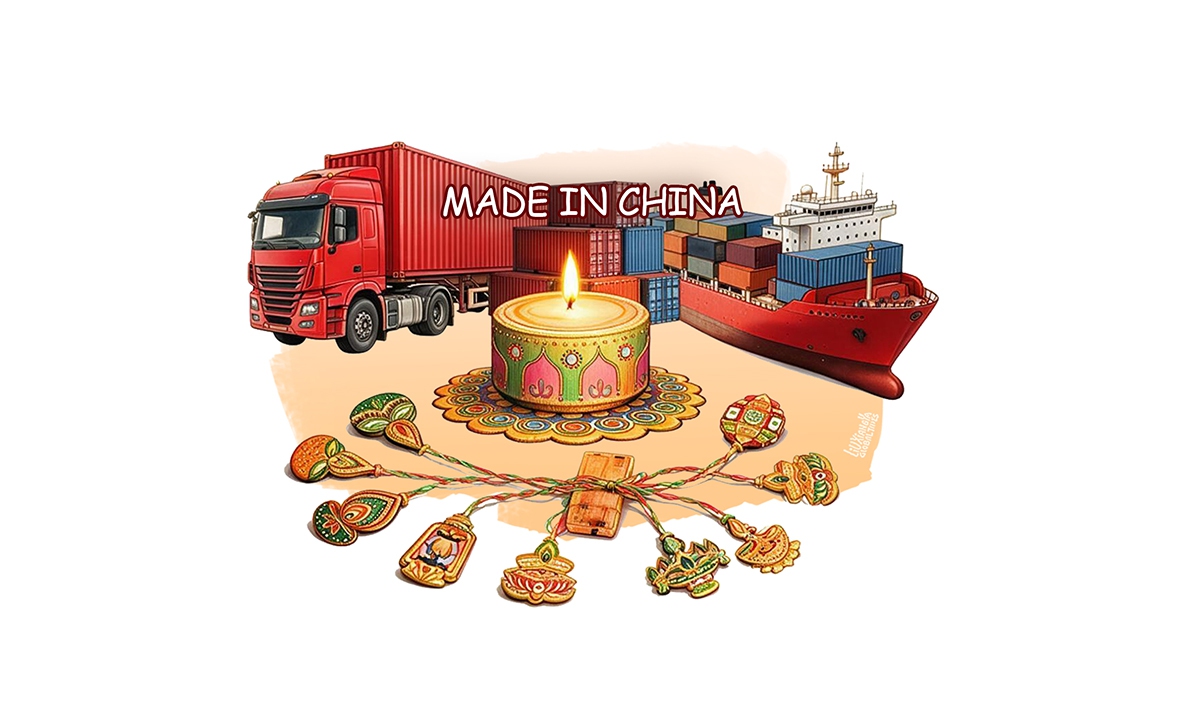
made-in China, Diwali, India, trade Illustration: Liu Xiangya/GT
As India prepares for Diwali, one of its most important festivals, Chinese decorative lights and other festive goods have again become a talking point in New Delhi. In recent days, Indian Commerce and Industry Minister Piyush Goyal, replying to a question on Chinese imports, said that "the decision to avoid Chinese firecrackers should come from the heart... We should prioritize Made in India products, but we cannot force people to do so... Anyone who pays the duty and brings goods into the country has to be allowed to do so."The remark was carefully balanced: it acknowledged the domestic preference while conceding that India cannot go against global trading rules and shut Chinese imports out. Behind the seasonal chatter sits a sharper question. What does the seasonal rush for Chinese lights, firecrackers and decorations actually reveal about China-India trade, and about the real test facing Indian manufacturing?
Festival merchandise is only a thin slice of bilateral commerce, yet it is unusually revealing. Diwali imposes a hard commercial clock. Importers and wholesalers must secure large volumes that are varied in design, competitive in price and delivered before the shelves are empty. Miss the window, and the season is gone.
In that compressed cycle, China's supply capacity — built on economic scale, product range, flexibility and a complete industrial chain — meets India's vast consumer market head-on. Yet such commercial demand also has a counterpart. Calls to "prefer Made in India" emerge every festive season, with some narratives casting Chinese goods as a threat rather than a choice.
So two forces cross in the same marketplace. One pulls toward timely, affordable, diversified imports; the other toward domestic preference. Their collision is less an ideological play than a stress test for the Indian manufacturing industry. Can India's market shut out the noise and choose rationally — on quality, price, availability and performance — or will political sentiment crowd out commercial logic?
This year, Indian consumers and retailers are already voting with their wallets.
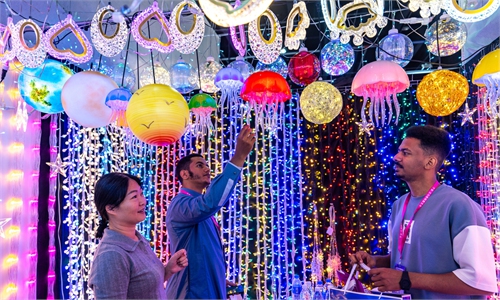
The Diwali lights from Chinese workshops again illuminate Indian streets and homes this year. The Global Times reported earlier that Chinese manufacturers in Yiwu, East China's Zhejiang Province - a manufacturing base dubbed as the "world's largest supermarket" - have seen stable festive goods orders such as decorative lighting and LED strings from India, and they are launching more tailored, diversified goods to "meet evolving local demand."
On the other side, for Indian importers, Chinese goods are a practical answer to a seasonal spike that rewards reliability. For households across income brackets, they offer access to brighter celebrations without stretching budgets.
Imports are not the enemy of India's economy — they benefit its economy. They lower costs for distributors, expand choice for consumers and keep competitive pressure on domestic producers — pressure that, properly harnessed, drives upgrading rather than decline.
What Indian manufacturing needs is a more open market, fuller competition and a policy environment in which local firms can plug into global supply chains and foreign companies dare to invest, all of which would be helpful for the world's fifth-largest economy to climb the value ladder. Shutting out imports does little to build the industrial ecosystems that turn assembly into genuine capability.
That gap shows up in the Diwali stalls. The Hindustan Times reported that prices of both Chinese and Indian decorative lights have increased by 20 percent to 25 percent this year. Despite this, Chinese lights remain a popular choice among shoppers as their lower copper content makes them relatively cheaper. An Indian importer also told the Global Times that though prices vary, Chinese-made 10-meter LED string lights can cost about 100 rupees ($1.05) or less per string, compared with roughly twice that amount for similar Indian-made products.
China's competitive edge in manufacturing goods comes from dense industrial clusters, relentless design iteration and tight cost controls—capabilities forged in open competition, not by fencing the domestic market off from rivals.
Indian firms that want to compete will not get there by urging consumers to buy out of duty. They have to win on assortment, delivery and prices that need no "patriotic premium." Where Indian producers already deliver, they win the orders, where they do not, imports fill the gap. That is how markets work.
Diwali is around the corner. But how New Delhi and Indian industry answer that manufacturing test will matter long after the festival lamps are packed away.
The author is a reporter with the Global Times. bizopinion@globaltimes.com.cn
RELATED ARTICLES