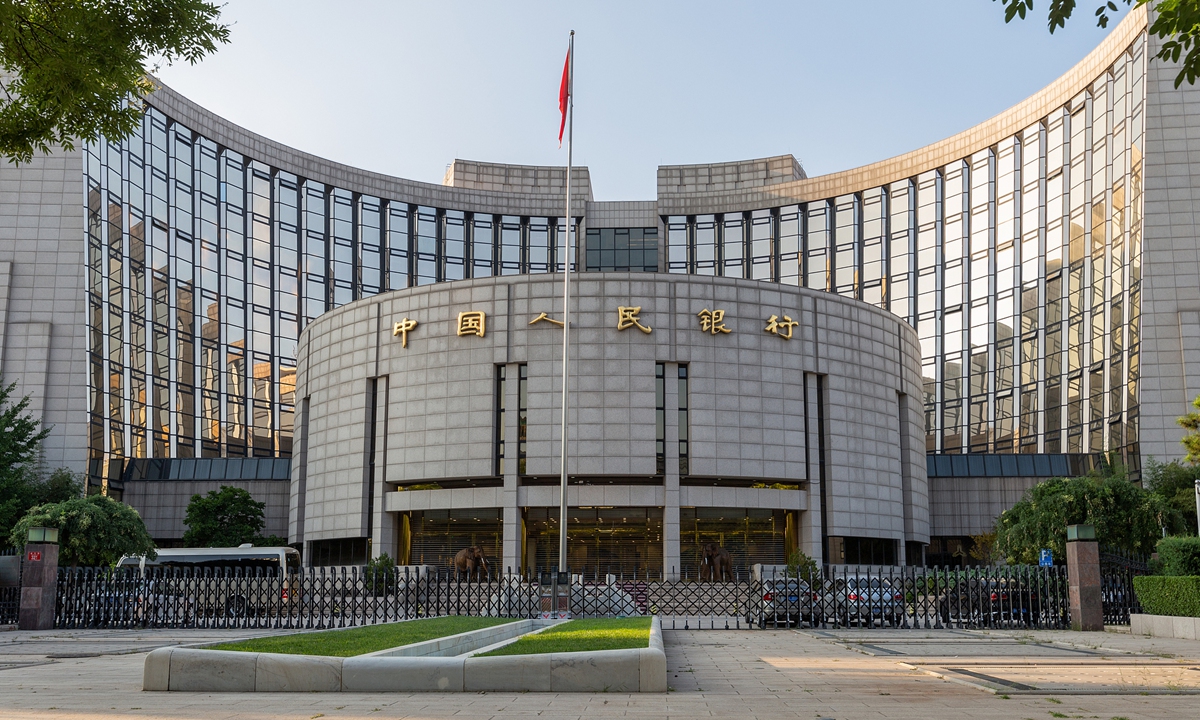
The People's Bank of China Photo: VCG
China's central bank, the People's Bank of China (PBC), announced on Tuesday that it will increase the foreign-exchange reserve requirement ratio (RRR) for financial institutions by 2 percentage points, from 4 percent to 6 percent, effective November 15, to strengthen foreign-exchange liquidity management by financial institutions.
The move comes as the yuan's appreciation has gained pace recently. An economist said that the adjustment could help ease upward pressure on the Chinese currency and prevent excessive exchange-rate swings, as changing market conditions make currency stability crucial to economic growth.
The foreign-exchange RRR refers to the proportion of foreign-currency deposits that financial institutions are required to place with the PBC as reserves. Raising the ratio reduces the amount of foreign-currency funds available for banks to use, helping the central bank manage foreign-exchange liquidity.
The adjustment primarily reflects the need to ease recent appreciation pressure on the yuan and guard against excessive exchange-rate movements, Xi Junyang, a professor at the Shanghai University of Finance and Economics, told the Global Times on Tuesday.
"A rapidly strengthening yuan could affect exporters, while large fluctuations in either direction could introduce instability into economic activity," he said.
The yuan has strengthened to its highest level against the dollar in more than four years. The currency has gained about 5 percent against the dollar this year, Reuters reported. On Monday, the PBC set the yuan's daily central parity rate at 6.7146 per dollar, slightly weaker than Friday's rate of 6.7138.
Xi Junyang attributed the yuan's recent strength to a combination of export growth, foreign investment inflows and movements in the dollar.
China's export growth has generated foreign-currency earnings, some of which are converted into yuan, adding to demand for the Chinese currency. Foreign direct investment and overseas purchases of Chinese equities, funds and yuan-denominated government bonds have also contributed to appreciation pressure as investors exchange foreign currencies for yuan, he explained.
The dollar's movements against other major currencies also affect the yuan-dollar exchange rate, independently of developments in China's domestic economy, the expert said.
"The yuan's appreciation thus reflects both domestic and external factors, rather than a single driving force."
The latest adjustment reverses a decision in September 2023, when the PBC lowered the foreign-exchange RRR from 6 percent to 4 percent to improve financial institutions' ability to use foreign-currency funds. The ratio reached 9 percent in 2021.
China operates a managed floating exchange-rate system based on market supply and demand, with reference to a basket of currencies. Market forces play a decisive role in determining the exchange rate, while the central bank neither targets a specific exchange-rate level nor intervenes in long-term currency trends, the PBC said in an October 8 statement outlining its policy stance on the yuan.
The PBC also stressed the need to guard against sharp short-term exchange-rate fluctuations, particularly rapid depreciation that could threaten financial stability. It said that macroprudential measures and guidance of market expectations, used under specific circumstances to prevent disruptive exchange-rate overshooting, are consistent with international rules and practices.
The yuan has appreciated by about 9 percent against the dollar since the beginning of 2025, while continuing to fluctuate in both directions. Despite a relatively rapid rise in the US Dollar Index and US Treasury yields in 2026, when other non-dollar currencies generally depreciated, the yuan continued to strengthen against the dollar overall.
The central bank also stressed in the statement that exchange rates are shaped by multiple factors, including economic growth, monetary policy, financial markets, geopolitical developments and unexpected risks, and have no simple linear relationship with the current account. It said that both appreciation and depreciation pressures remain, leaving the yuan's direction uncertain.
Meanwhile, China is continuing efforts to facilitate cross-border trade and foreign-exchange transactions. On Monday, the State Administration of Foreign Exchange announced draft measures to further streamline foreign-exchange procedures for current-account transactions, including cross-border trade settlements. The proposed measures aim to support trade innovation and promote high-standard opening-up.
Xi Junyang said that some factors driving the yuan's appreciation may be temporary. Slower export growth could ease appreciation pressure, while the dollar's stabilization raises the possibility of its rebound. Such changes could shift the balance of forces affecting the yuan, reinforcing the need to guard against sharp exchange-rate swings, he said.
Maintaining the yuan's stability at a reasonable and balanced level is important for creating a predictable monetary environment, supporting foreign trade and cross-border investment, and providing a stable foundation for sustained economic growth, the expert added.