Brazil to issue first sovereign panda bonds in Latin America as PBC Governor Pan Gongsheng and Brazilian Finance Minister Durigan witness application ceremony
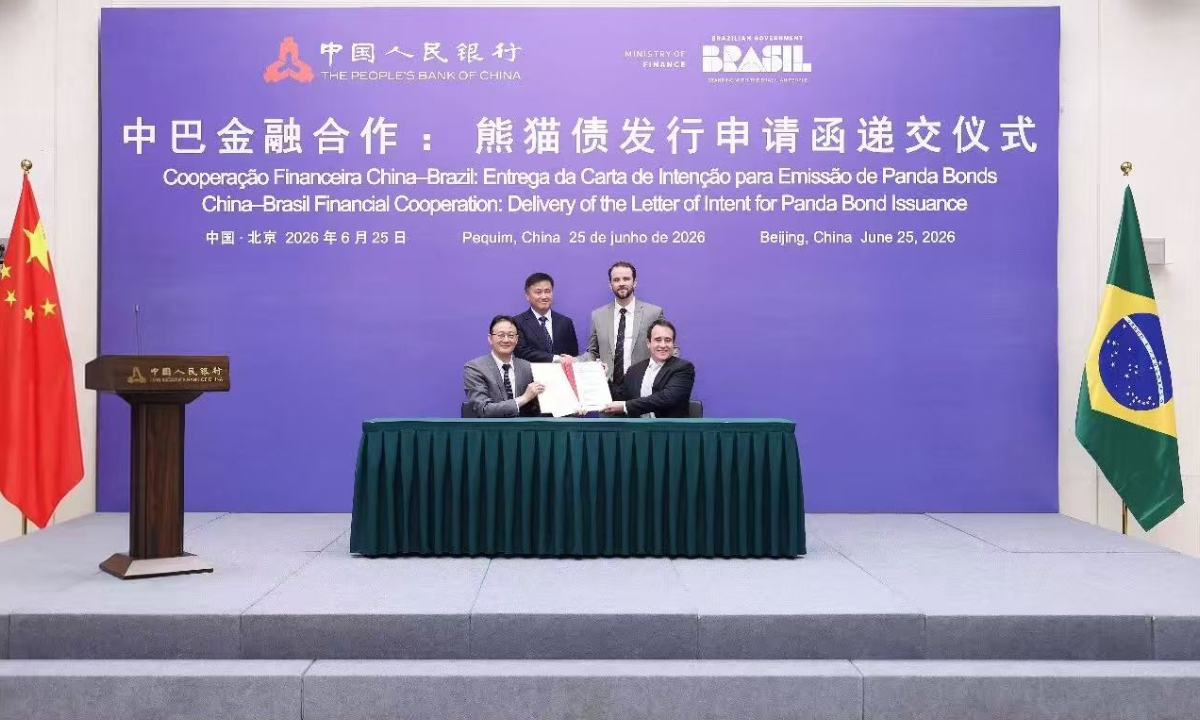
Pan Gongsheng (second from left), governor of the People’s Bank of China (PBC), meets with Brazilian Finance Minister Dario Durigan (second from right) in Beijing on June 25, 2026. During the meeting, they jointly witness the Brazilian Ministry of Finance submit an application letter to the National Association of Financial Market Institutional Investors for the issuance of Panda bonds. Photo: PBC’s WeChat account
Pan Gongsheng, governor of the People’s Bank of China (PBC), met with Brazilian Finance Minister Dario Durigan in Beijing on Thursday. During the meeting, they jointly witnessed the Brazilian Ministry of Finance submit an application letter to the National Association of Financial Market Institutional Investors for the issuance of panda bonds, making Brazil as the first Latin American country to register for sovereign panda bond issuance. China welcomes the participation of both Brazilian government and corporate entities in the panda bond market, according to a statement on the PBC’s official WeChat account.
Both sides agreed that, as important representatives of the Global South, China and Brazil should comprehensively strengthen cooperation in the financial sector, fully leverage the role of the bilateral financial strategic cooperation work group mechanism, deepen investment and financing cooperation, promote the use of local currencies in trade and investment, advance connectivity of financial infrastructure, and ensure that the outcomes of cooperation benefit enterprises and people in both countries, injecting strong momentum into global economic development and financial stability.
Both sides agreed that China and Brazil should further advance financial market connectivity. They expressed expectations that China Central Depository & Clearing Co, the China Foreign Exchange Trade System, and Brazil Stock Exchange B3 will reach consensus on signing a memorandum of understanding, according to the PBC’s WeChat account.
The two sides also supported a greater role for the China–Brazil Sustainable Development and Capacity Expansion Cooperation Fund by advancing projects in key areas such as climate change and clean energy, achieving mutually beneficial economic and social outcomes. They agreed to strengthen macroeconomic policy coordination under mechanisms including the G20, BRICS, and the International Monetary Fund, and to jointly amplify the voice of developing countries.
During the meeting, Pan and Durigan exchanged views on issues including international macroeconomic policy coordination and deepening practical bilateral financial cooperation.
Brazil plans to raise up to 5 billion yuan ($735 million) with its first-ever issuance of panda bonds, Durigan told Reuters on Thursday, marking the largest debut of yuan-denominated debt by a foreign nation in China.
The Latin American country will become the fifth sovereign issuer in 12 months to tap into China's domestic debt market, with the move seen as a "test" to help private Brazilian firms deepen their presence in the world's second-largest economy, Durigan said, Reuters reported.
Panda bonds refer to yuan-denominated bonds issued in China by overseas entities.
According to the PBC on the 18th, panda bond issuance reached 136.5 billion yuan in the first five months of this year, accounting for 74 percent of last year’s total, with full-year issuance expected to hit a record high.
"The motivation for foreign institutions to issue panda bonds has grown substantially," Tian Lihui, dean of the Institute of Financial Development at Nankai University, told the Global Times. "The fact that some overseas issuers have adopted panda bonds as a regular financing channel demonstrates that the appeal of the yuan stems not only from currency stability or interest rate differentials, but also from the financing convenience and liquidity support that China's continued financial market opening-up offers to global issuers. This represents a systemic kind of attractiveness."
Tian said that the rise of panda bonds marks a significant enhancement of the yuan's international investment and financing functions. Overseas institutions are not only willing to hold the yuan but, more importantly, to use it for long-term financing. The fact that official institutions such as foreign central banks are beginning to emerge as important investors in panda bonds implies that the yuan's reserve function is gradually gaining broader recognition.
RELATED ARTICLES