'Protectionism in disguise': Chinese experts blast US push to ban Chinese vehicles
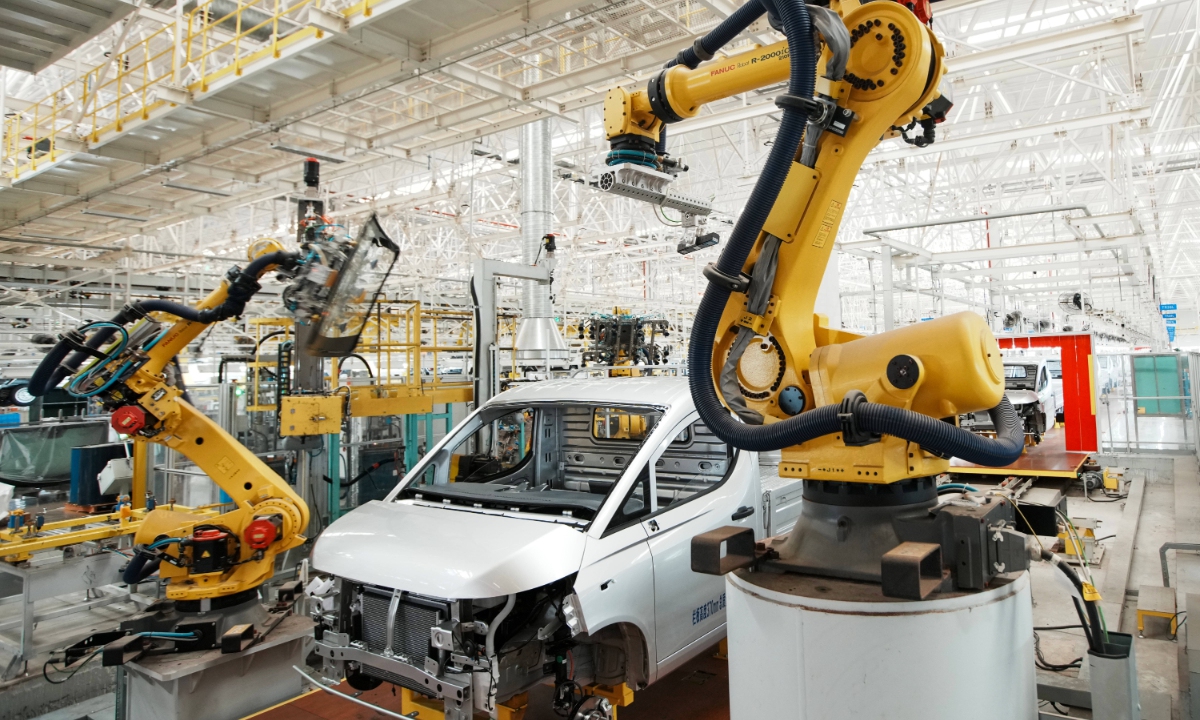
Robots assemble a new-energy vehicle at Liuzhou Wuling Automobile Industry Co in Liuzhou, South China's Guangxi Zhuang Autonomous Region, on July 18, 2026. Photo: VCG
Chinese experts on Tuesday slammed a reported auto industry push for US lawmakers to pass a permanent ban on Chinese vehicles as "protectionism wrapped in the guise of national security." They warned that if the US keeps shutting itself off, it could ultimately fall behind in the global wave of vehicle electrification and intelligentization, to the detriment of consumers.
According to Reuters, a group representing nearly all major automakers on Monday urged US lawmakers to pass a permanent ban on Chinese vehicles. In September, the Senate sponsors of the bipartisan effort to ban Chinese vehicles agreed to delay an effort to fast-track the bill until November despite overwhelming support.
John Bozzella, who heads the Alliance for Automotive Innovation, which represents General Motors, Toyota, Volkswagen and other major automakers, claimed that "we need to protect the US market from a flood of Chinese imports that carry surveillance risk and disadvantage current manufacturers that have made generational investments in American communities."
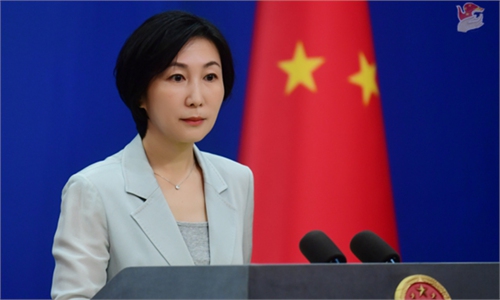
Washington's campaign against Chinese vehicles did not start with this bill. Back in 2025, Chinese Foreign Ministry spokesperson Guo Jiakun already rejected the US restrictions on Chinese connected-vehicle software, hardware and complete vehicles on so-called national security grounds as "without any factual basis," and calling the move typical protectionism and economic coercion.
"The Alliance's push is essentially about blocking low-priced, high-value competitors from entering the market — economic protectionism, not a national security concern," He Weiwen, a senior fellow at the Center for China and Globalization, told the Global Times on Tuesday.
Moreover, it claimed that Chinese vehicles pose "surveillance risk," but the allegation has never been backed by any publicly available evidence, He Weiwen said.
Bozzella also cited major Chinese gains in the European market. According to him, in the first eight months of 2026, the EU imported more than 1.1 million vehicles from China — more than all of 2025.
"Given the obvious national security risk and China's pattern of unfair behavior, Congress should protect our defense and advanced manufacturing base and stop Chinese automakers from doing here what they've gotten away with in Europe," Bozzella claimed.
He Weiwen noted that Bozzella frames ordinary cost and technology competition as "national security" and "unfair practices," turning a blind eye to the US auto industry's own problems and invoking Europe's "market share shifts" to justify an even more extreme form of protectionism.
Chinese experts say the US auto industry is grappling with multiple challenges, including a structural decline in competitiveness, policy uncertainty, high costs, and lagging behind in the global transition.
US Federal Reserve data showed that in September this year, the capacity utilization rate for US automobile and light-duty motor vehicle manufacturing stood at just about 61.2 percent, down from 64.6 percent in August and remaining persistently low — evidence that the problem does not stem from "external shocks" but lies in a demand-supply mismatch rooted in weak product competitiveness, He Weiwen said.
A combination of higher labor and battery costs, and tariffs along with rising chip and energy prices, is further pushing up costs, Zhou Mi, a senior research fellow at the Chinese Academy of International Trade and Economic Cooperation, told the Global Times on Tuesday.
Moreover, sharp policy swings have left companies facing considerable uncertainty, Zhou said. According to Reuters, an array of automotive, environmental, trade and immigration policies of the Trump administration has undermined factory projects and employment in Lordstown and across America's heartland. Cancellations of EV projects and related battery facilities have snowballed, killing or jeopardizing tens of thousands of jobs, according to data from Atlas Public Policy, a research firm that tracks clean-energy investments.
Acting in the name of an "innovation alliance" while pursuing a closed and conservative agenda will not protect the US auto industry — it will only blunt automakers' incentive to compete and innovate, Zhou warned.
Moreover, the policy ban the Alliance is pushing runs sharply counter to real market demand. According to Reuters, related obstacles haven't quieted the buzz. The Cox survey polled 802 US consumers who expect to buy a car in the next two years. Nearly half - 49 percent - rated Chinese cars as having very good or excellent value, and 40 percent say they support the idea of Chinese auto brands in the US market.
Rich Benoit, a car enthusiast whose YouTube videos reviewing Chinese models garner millions of views, said the most compelling feature is the price. He's considering buying a BYD model in Mexico and driving it across the border. "That's the only way to get one," Benoit said in the report. "They've been selling in Mexico for years... I want to own a Chinese EV in America."
"Chinese EVs and smart vehicles hold clear advantages in price, range and intelligence. Can ignoring market demand and closing itself off really promote the healthy development of the industry?" Zhou asked, adding that a permanent ban would mean US consumers keep paying higher prices with fewer choices.
What truly drives the auto industry forward is a stable market outlook, stronger incentives for companies to innovate and cooperate, and a commitment to openness and a level playing field, Zhou said.
Electrification, connectivity and intelligentization have become the defining trends of the auto industry. The US auto industry now lags behind in the new energy space; by working with Chinese suppliers and drawing on China's industrial chain can it raise its own level, Zhang Xiang, a visiting professor in the engineering department of Zhengzhou-based Huanghe Science and Technology University, told the Global Times.
RELATED ARTICLES