China’s top economic planner pledges to take ‘extraordinary measures’ to drive new breakthroughs in key fields
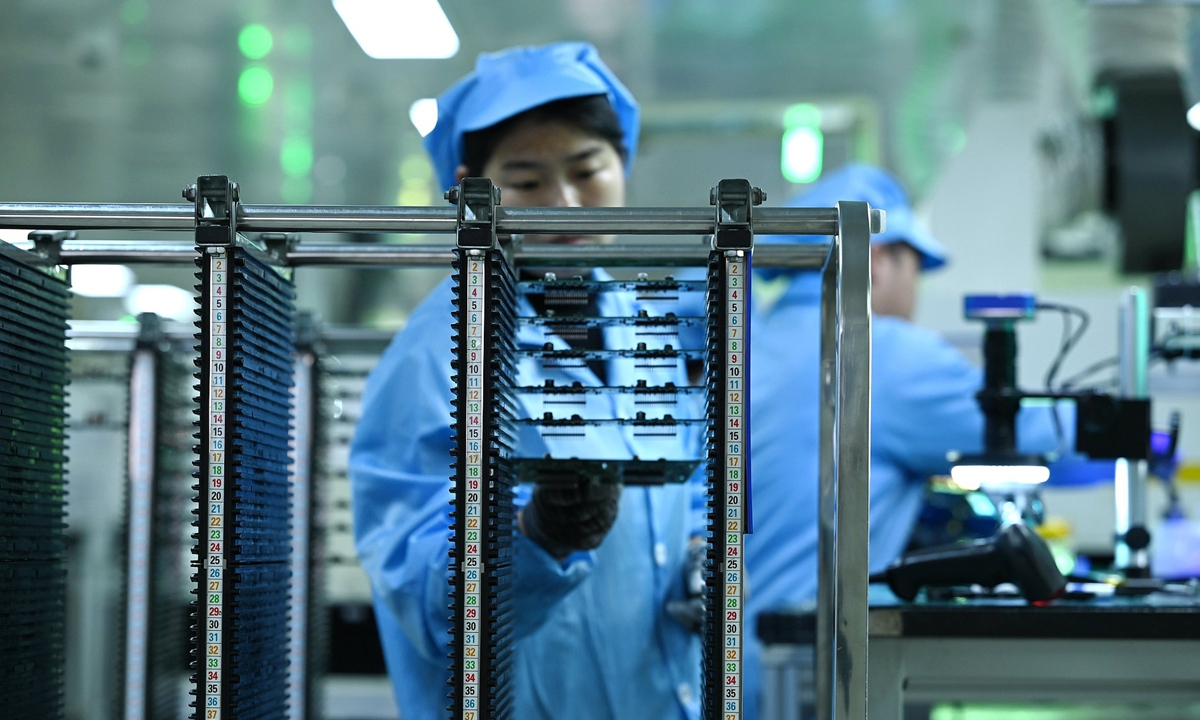
A technician conducts chip quality inspections in a factory in Yiwu, East China's Zhejiang Province, in March 2026. Photo: VCG
China's National Development and Reform Commission (NDRC), the top economic planner, said on Tuesday that it will accelerate its support for emerging pillar industries to promote high-quality economic development, pledging to take "extraordinary measures" to drive breakthroughs in key fields.
The output value of the emerging pillar industries is projected to exceed 10 trillion yuan ($1.4 trillion) by the end of the 15th Five-Year Plan period (2026-30), up from nearly 6 trillion yuan last year, Ren Zhongbao, an official with the NDRC, said at a press conference on Tuesday.
Ren said the country will increase fiscal and financial support, and guide private capital into investing in emerging pillar industries. Meanwhile, China will support enterprises in taking the lead in implementing national science and technology projects and in building innovation platforms.
China has identified six emerging pillar industries including integrated circuits, aerospace, and biomedicine to foster new growth levers during the 15th Five-Year Plan period.
China will focus on quantum technology, bio-manufacturing, hydrogen energy, nuclear fusion energy, brain-computer interfaces, embodied intelligence and 6G telecommunications. It will also encourage regions to develop sub-sectors where they have comparative advantages, the NDRC said.
Extraordinary measures will be taken to drive decisive breakthroughs in key areas across the entire industrial chain. Meanwhile, efforts will be made to promote the application of independently developed products and technologies, and foster a virtuous cycle in which real-world application drives further research and development, which in turn enables iterative tech upgrading, according to the NDRC.
The initiative aims to break away from traditional research models, strengthen the role of enterprises as the main body of innovation, and improve funding allocation and support mechanisms for research teams, in a bid to counter external restrictions and achieve a high level of self-reliance in science and technology, Cao Heping, a professor at Peking University, told the Global Times on Tuesday.
Cao said that amid intensifying global tech competition, China needs to further strengthen its capabilities in original innovation and basic research to address weaknesses in some technological fields.
Wan Zhe, a professor at Beijing Normal University, told the Global Times on Tuesday that "extraordinary" does not simply mean piling on more resources or continuously scaling up input. Wan said it means reshaping research mechanisms by changing how work is organized, resources are allocated, talent is developed, and performance is evaluated.
"When it comes to implementation, we need to start with the real pain points along the industrial chain. Technological, economic and security assessments should tell us which areas are genuinely strategic, and resources should flow precisely to the most critical links. We need to put enterprises genuinely in the driver's seat. That, in turn, calls for collaboration that cuts across sectors and disciplines," Wan said.
"China's drive for technological breakthroughs has entered a critical new stage - moving from playing catch-up to running neck and neck with, and in some areas leading, global frontrunners. In other words, there is no longer a ready-made path to follow; we must rely on our own original exploration. That is why we need extraordinary patience from investors, an extraordinary model of organization, and an extraordinary tolerance for risk," Wan said.
China's emerging pillar industries have maintained strong growth momentum, with research and development investment surging, new technologies and new products continuously emerging, and industrial scale expanding at an accelerating pace. In the first three quarters of 2026, China's integrated circuit output reached 442.8 billion units, up 23.3 percent year-on-year. The value of China's innovative drug out-licensing deals totaled $130 billion in the period, close to the total for all of last year, according to NDRC data.
RELATED ARTICLES