China's lawmakers, political advisors back commercialization, global expansion of low-altitude economy during national two sessions
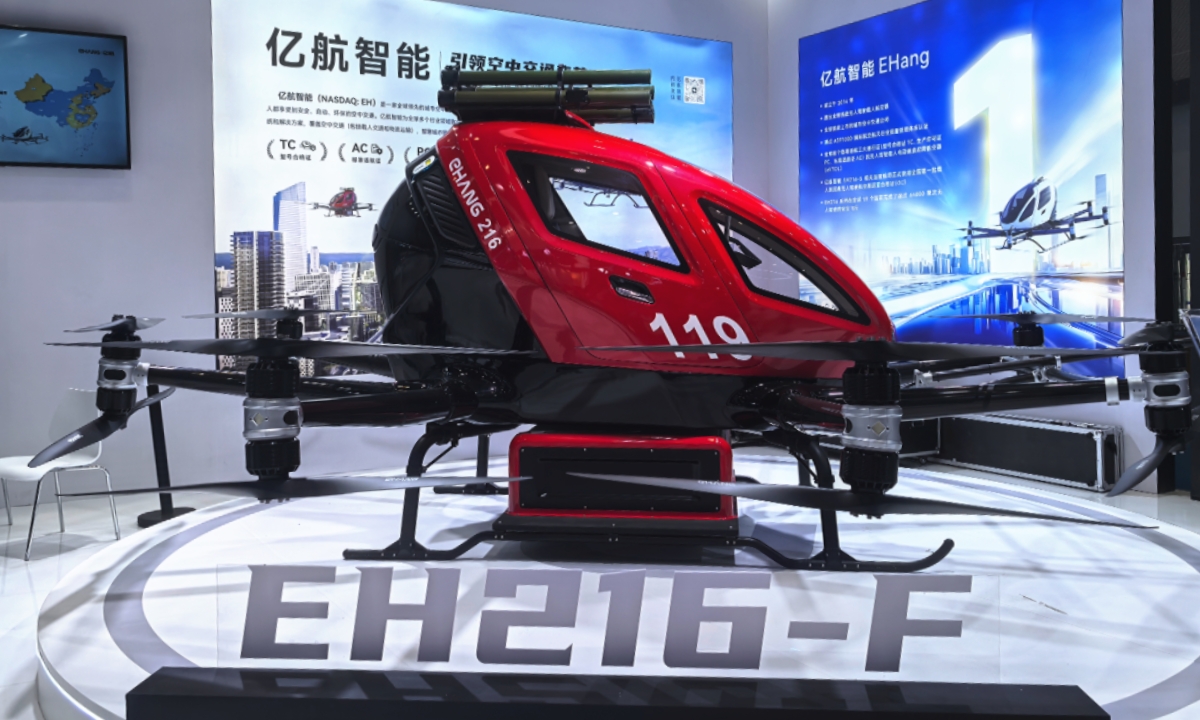
The EH216-F eVTOL from Ehang on display at the 2025 China International Consumer Products Expo on April 13, 2025. Photo: Zhang Yiyi/GT
Chinese lawmakers and political advisors have called for accelerating the commercialization and global expansion of the low-altitude economy to strengthen the country's global influence in the emerging sector, as this year's Government Work Report again underscored the push to cultivate emerging pillar industries.
The 2026 Government Work Report, submitted on March 5 to the country's top legislature for deliberation, called for nurturing emerging industries and industries of the future, encouraging central government enterprises and other state-owned enterprises (SOEs) to take the lead in making application scenarios more accessible, and fostering emerging pillar industries including the low-altitude economy.
This marks the third consecutive year the low-altitude economy has been included in the Government Work Report, with its status upgraded from an "emerging industry" in 2025 to an "emerging pillar industry" this year.
The policy signal underscores the country's strong support for the sector and provides clearer direction and fresh momentum for its high-quality development, Hu Huazhi, a member of the Guangdong Provincial Committee of the Chinese People's Political Consultative Conference (CPPCC) and founder, chairperson and CEO of EHang, told the Global Times on Wednesday.
EHang, a Chinese urban air mobility manufacturer, is the world's first company to obtain all four certifications for a crewed electric vertical takeoff and landing (eVTOL) aircraft, according to the company.
The low-altitude economy spans four major segments: manufacturing, operations, infrastructure and information services, and supporting services, according to the National Development and Reform Commission (NDRC), China's top economic planner.
The sector is also listed as a work priority in the draft outline of the 15th Five-Year Plan (2026-30), which calls for promoting the healthy and orderly development of the low-altitude sector, stepping up efforts to cultivate application scenarios and accelerating the large-scale growth of emerging industries.
"I believe that in the near future, the low-altitude economy will steadily move from pilot programs to large-scale commercial use and inclusive services, becoming a key engine for cultivating new consumption and new quality productive forces," Hu said, adding that EHang will continue to step up investment in innovation and contribute more to the development of China's new aviation industry.
Zhou Shuguang, a deputy of the National People's Congress (NPC) and chairperson of an aerospace technology company based in Xi'an, Northwest China's Shaanxi Province, called for building sustainable business models, promoting unified industry standards and advancing cluster-based development, noting that the sector still faces key challenges, mainly in developing viable use cases.
China's low-altitude economy is projected to exceed 3.5 trillion yuan ($480 billion) by 2035, according to the Civil Aviation Administration of China (CAAC), with the sector also showing strong potential for global expansion. In 2025, Chinese eVTOL companies stepped up their overseas push, securing a series of orders and partnerships across markets in Asia and Europe, CAAC News reported.
Yao Jinjian, an NPC deputy and director of the machining engineering center at Hefei-based Gotion High-Tech, suggested that domestic companies expand overseas through a bundled "aircraft plus battery" model. He added that this could include cross-border technical verification and overseas demonstration projects, enabling Chinese firms to offer integrated solutions for global markets, according to cnii.com.cn, a website under China's Ministry of Industry and Information Technology.
Yao also suggested that industry organizations participate in formulating international standards, help turn China's technological strengths into global standards, and include low-altitude energy equipment in high-quality Belt and Road cooperation to support the global expansion of Chinese technologies, standards and products.
To further advance strategic emerging industries and industries of the future, central SOEs are also stepping up investment. Zhang Yuzhuo, chairman of the State-owned Assets Supervision and Administration Commission of the State Council, said on March 5 during an interview that central SOEs will actively foster industries including quantum information, nuclear fusion and the low-altitude economy.
Policy support for the sector is also taking shape. On February 2, Chinese authorities released a guideline on building a standard system for the low-altitude economy, aiming to establish a basic framework by 2027 and develop more than 300 related standards by 2030 to form an optimized, advanced and internationally compatible system.
In addition, the revised Civil Aviation Law will take effect on July 1, 2026. The law will strengthen policy support by measures such as expanding industry demand, simplifying market access and approval procedures, and optimizing the allocation of low-altitude airspace resources, according to an article published in the People's Daily in February by Song Zhiyong, head of the CAAC.
RELATED ARTICLES