How can Europe convert AI potential into real-world benefits through global collaboration?
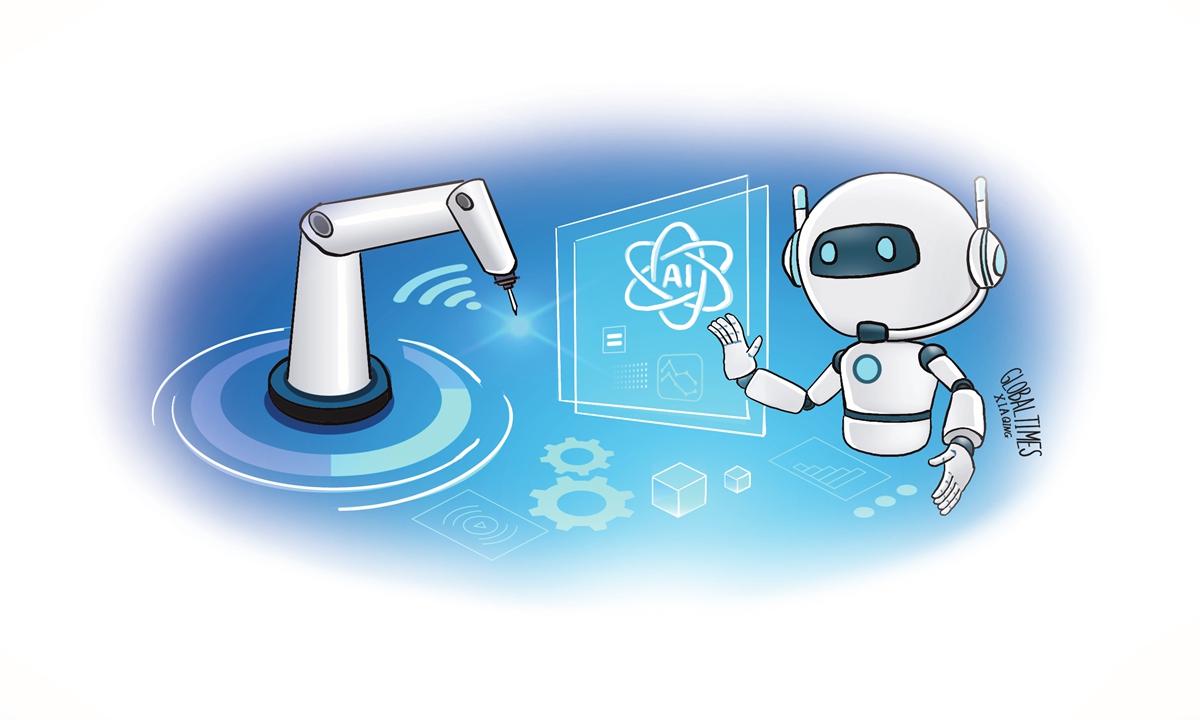
Illustration: Xia Qing/GT
European Central Bank President Christine Lagarde has said that Europe can still capitalize on artificial intelligence (AI), even without leading the way in developing frontier models, Bloomberg reported. She pointed in particular to manufacturing and industrial processes, redirecting attention from the race to develop frontier models toward the practical application of the technology within Europe's established industrial base.Bloomberg noted that Europe is widely perceived as significantly lagging behind the US in AI adoption and innovation. Until last year, this view was reinforced by Europe's relative lag in several AI-related areas, including digital infrastructure, contributing to a sense of unease about the continent's position in the global AI landscape. In response, however, Europe's approach to AI has been steadily evolving.
Policy-makers and institutions in Europe are increasingly treating AI as a strategic priority, taking a more integrated view that spans infrastructure, computing capacity, market incentives, and investment policies. Rather than relying solely on existing strengths, Europe is placing greater emphasis on building a coherent ecosystem that supports the adoption of AI across industries and economic sectors. This shift signals a readiness to engage in global AI competition in a more coordinated and systematic manner.
This strategic shift became more tangible last year. Across multiple sectors, Europe began to accelerate AI development. According to media reports, the European Commission unveiled two initiatives - the Apply AI Strategy and the AI in Science Strategy - aimed at advancing the use of AI in both industry and research.
A measured degree of concern can be constructive, but cultivating confidence in Europe's ability to advance AI is equally important. Striking a balance allows the continent to pursue AI growth that is grounded in practical realities, while fostering investor confidence and encouraging further commercial collaboration.
Does Europe have reason to be confident? According to Bloomberg, which summarized Lagarde's remarks, Europe is said to start from a position of strength in using AI and big data as well as in the deployment of robotics, particularly in manufacturing and industrial processes. Europe's industrial base may turn out to be its most important asset.
For Europe, developing AI should be grounded in its current realities, rather than attempting to abandon its traditional strengths in pursuit of entirely new frontiers. Europe still possesses substantial accumulated advantages in industrial foundations, engineering capabilities, and related areas. These are all real strengths that can be leveraged in AI applications. Pursuing direct competition in AI models while neglecting these existing advantages could be counterproductive.
A more pragmatic path is to build on Europe's established industrial and technological base and identify entry points and application scenarios for AI. By embedding AI into manufacturing, industrial processes, and supply chain management, Europe can enhance the efficiency and competitiveness of its existing industries while establishing a clear and recognizable position in the global AI landscape.
In this sense, if Europe wants to advance in AI, it should rely on its traditional strengths and integrate AI technologies into existing industrial systems, rather than trying to start from scratch. This approach allows AI to enhance the efficiency and value of current industries while supporting Europe's transition to new industrial models and economic structures, emphasizing incremental change grounded in practical realities rather than a headlong pursuit of frontier technologies.
In practice, especially in applied fields, China and Europe have ample opportunities to collaborate in AI. Experience from past efforts in digital transformation, financing, and innovation shows that both can benefit by learning from one another and developing more effective ways to work together. The key is to identify entry points that can effectively link traditional industrial investment, trade, and modern technology, thereby creating complementary advantages. Through such cooperation, Europe can absorb advanced external technologies and drive its own industrial upgrading and digital transformation.
China, the US, and Europe each hold distinct advantages in AI. While the potential for cooperation is substantial, the challenges cannot be overlooked. For China and Europe, there is considerable complementarity in research and development capabilities, technological applications, and market operations. Yet integrating traditional industries with new technologies, and establishing effective collaboration in institutional frameworks, investment, and market mechanisms, still requires further exploration. Successfully addressing these issues would make China-Europe AI cooperation more productive and provide a foundation for long-term competitiveness for the two parties in the global AI landscape.
The author is a professor at the Academy of Regional and Global Governance at Beijing Foreign Studies University. bizopinion@globaltimes.com.cn
RELATED ARTICLES