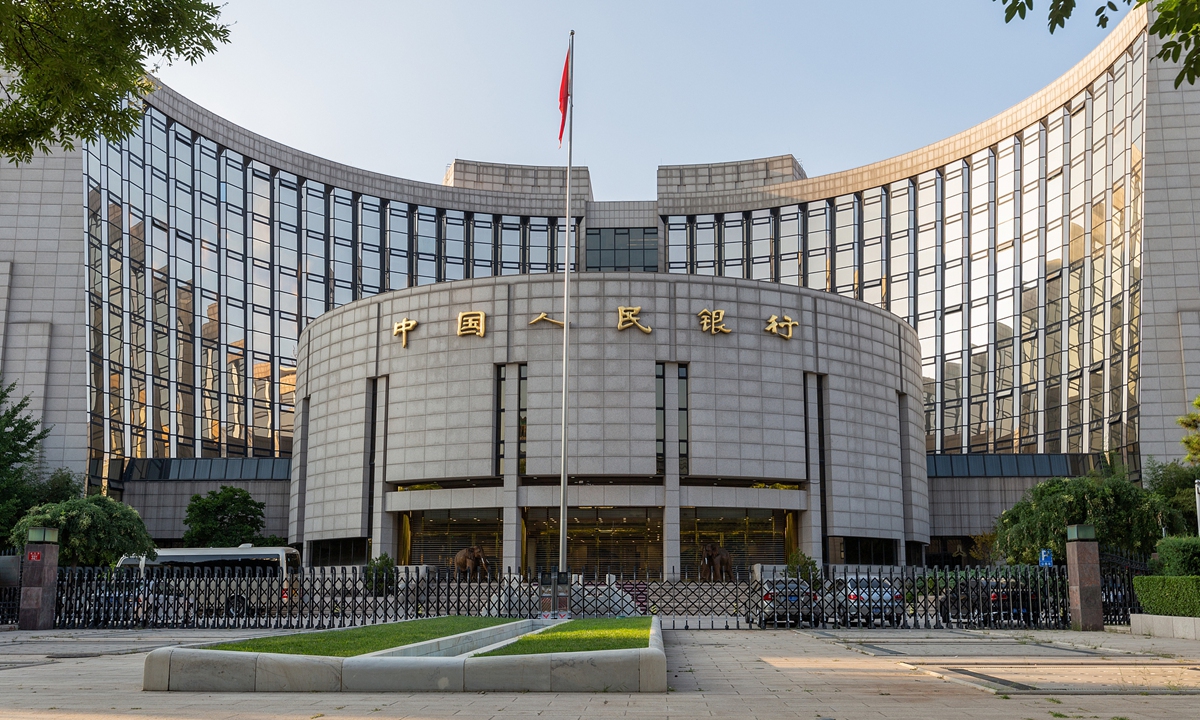
The People's Bank of China Photo: VCG
Chinese equities staged a powerful rebound on Wednesday, buoyed by supportive policies aimed at stabilizing the capital markets and boosting investor confidence, with artificial intelligence (AI) and technology shares leading the surge.
The STAR Composite Index, which reflects the performance of stocks on China's sci-tech innovation board, closed 9.9 percent higher at 1,525.31 points.
More than 150 stocks on the sci-tech innovation board hit their daily price limit or gained more than 10 percent, reflecting broad-based buying across the technology sector, according to the Securities Times. Among the standout performers, CXMT jumped 13.63 percent, with turnover exceeding 20 billion yuan ($2.99 billion).
The rally was accompanied by a sharp increase in trading activity, with total A-share turnover reached 2.0519 trillion yuan, up 336.8 billion yuan from the previous trading session. More than 4,600 stocks advanced on the day.
Market observers said that the sharp rally was supported by coordinated policy efforts by multiple government departments to stabilize market expectations and boost investor confidence. Previously, the People's Bank of China (PBC), the National Financial Regulatory Administration, and the China Securities Regulatory Commission held two separate meetings aimed at stabilizing the capital market. In addition, other coordinated measures have been introduced to bolster market liquidity and confidence.
The PBC, China's central bank, said on Wednesday that it has stepped up the implementation of stock repurchase and share buy-back relending policies, cutting the relending facility rate by 25 basis points to 1 percent effective immediately, in an attempt to maintain stable operation of the country's capital market.
The facility is available to 21 national-level commercial
banks and five systemically important city-level banks. It covers 100 percent of eligible loans, has a term of one year and can be extended according to the banks' needs, according to a PBC announcement on Wednesday.
Banks are allowed to add a reasonable margin on top of the relending rate and independently determine the maturities and pricing of loans for stock repurchases and shareholding increases. They are encouraged to accelerate loan disbursements and enhance listed companies' and major shareholders' capacity for market value management, the PBC said.
According to Li Chang'an, a professor at the Academy of China Open Economy Studies at the University of International Business and Economics, lowering the interest rate on stock repurchases and the relending facility carries multiple positive implications for the market.
Li told the Global Times on Wednesday that the move would reduce financing costs for listed companies, making it easier for them to repurchase shares and increase holdings at a time when capital markets remain relatively weak, helping to support stability in the stock and securities markets.
The central bank also pledged to provide sufficient relending quota, a move that experts said would release more liquidity and draw additional funds into equities, further bolstering market confidence.
Following several meetings on the program on Monday, banks submitted quota applications totaling more than 200 billion yuan, and the PBC said that it will continue to fully meet banks' relending needs and support them in actively addressing the financing demand of listed companies and major shareholders, according to the statement.
As long-term capital gradually enters the market, the medium- to long-term outlook remains positive. Li added that banks and brokerages have responded positively, with applications for repurchase and shareholding increase relending quotas continuing to rise, signaling strong interest in supporting market stability.
However, he emphasized that long-term market stability depends on deeper institutional reforms, including stricter IPO screening, improved delisting mechanisms and better dividend policies, so that higher-quality listed companies can deliver sustainable returns and provide a stronger foundation for the market.
Wednesday's rate cut followed an announcement by the PBC earlier this week to shift the relending program from a temporary arrangement to a permanent institutional arrangement, and lower the relending rate from 1.25 percent to 1 percent. The program is one of two policy tools supporting the capital market, alongside the Securities, Funds and Insurance Companies Swap Facility.
Industry analysts said that the latest PBC measures are fresh moves to support the stable and healthy development of the capital market. They are expected to channel more funds into the stock market by helping financial institutions expand their investment capacity, while broader participation by institutional investors could help strengthen market confidence.
On Wednesday, Chinese chipmaker CXMT announced a fresh plan to raise the amount of its share repurchase. Under the proposed adjustment, the buyback amount would increase from the original range of 1 billion yuan to 2 billion yuan, to a new range of 2.5 billion yuan to 5 billion yuan, with both the floor and ceiling 2.5 times the original plan and the upper limit increased by 3 billion yuan.
The company said that the proposal reflects its confidence in its future sustainable development and its strong recognition of the company's value. The move is intended to protect investors' interests, strengthen market confidence, and support the company's stable and healthy growth.
"It is both necessary and beneficial to use policy tools such as stock repurchase and related refinancing to inject liquidity into the market," Dong Shaopeng, a senior research fellow at the Chongyang Institute for Financial Studies at Renmin University of China, told the Global Times on Wednesday.
The expert also rejected foreign media claims that China's stock market volatility is mainly driven by external shocks, structural economic pressures and sell-offs in the technology and AI sectors. He said that the volatility is largely a result of domestic market dynamics. As most Chinese listed companies remain heavily reliant on the domestic market, corporate earnings and operating efficiency are key factors underpinning the equity market.
The market is expected to gradually shift from sentiment-driven trading to performance driven by fundamentals. As the foundation of China's economic recovery continues to strengthen, corporate earnings are expected to improve steadily, providing fundamental support for the equity market, according to Chinese analysts.
Wednesday's rally reflected both a technical rebound from oversold conditions and a policy-driven improvement in expectations, Yang Delong, chief economist at Shenzhen-based First Seafront Fund, told the Global Times.
Yang said that the coordinated measures have significantly eased downward pressure and could help Chinese equities gradually recover.
RELATED ARTICLES