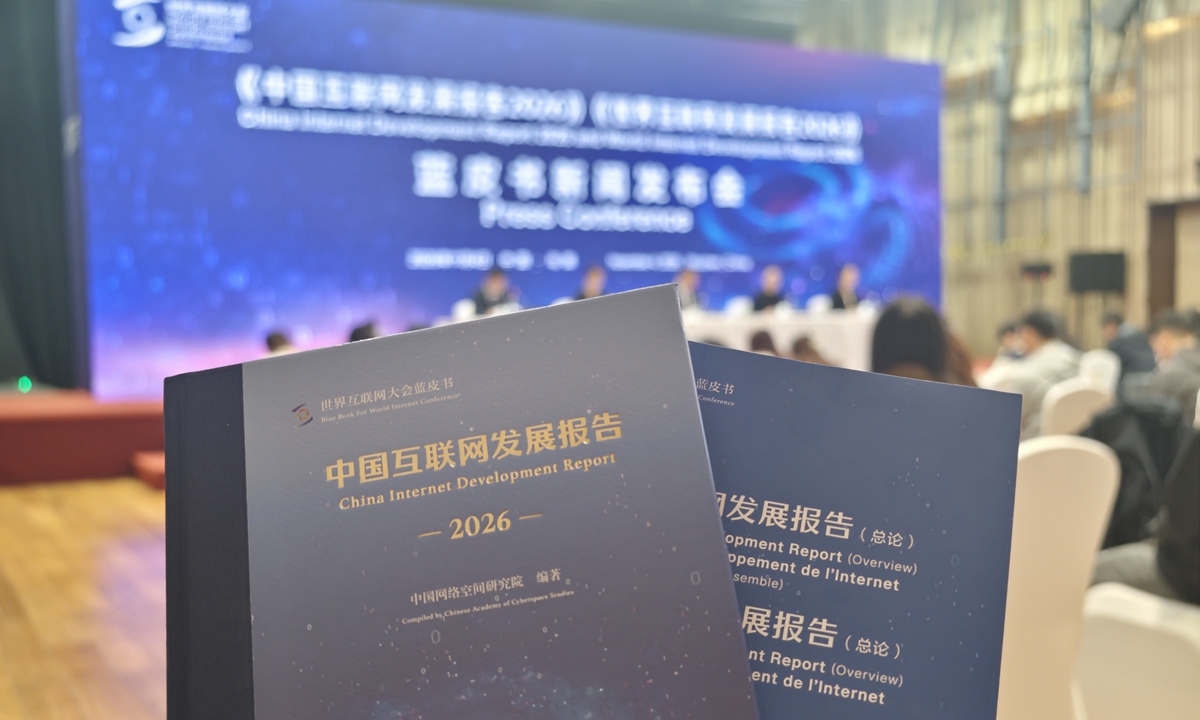
Blue Book for World Internet Conference Photo: Tao Mingyang/GT
China's daily AI token use reached 140 trillion in March, according to a blue book released on Wednesday at the 2026 World Internet Conference Wuzhen Summit in East China's Zhejiang Province. Tokens are the basic units that large AI models process when handling a prompt or generating a response.
The report documented how Chinese companies are making large AI models available on demand while putting AI to work in many sectors ranging from banking to manufacturing.
The Blue Book For World Internet Conference (WIC), including China Internet Development Report 2026 and the World Internet Development Report 2026, compiled by Chinese Academy of Cyberspace Studies, were released at the summit. The China report cited monitoring data from the National Data Administration.
Liu Dingding, an industry analyst, told the Global Times on Wednesday that token use is rising as people use AI more often and give it more demanding tasks. Producing a short drama with AI can consume far more tokens than drafting an article, he said.
A separate report from the China Internet Network Information Center (CNNIC) showed that China had more than 700 million generative AI users at the end of June, representing more than half of the population. The uses of general-purpose AI assistants and AI office tools more than doubled year-on-year.
China's market for enterprise AI agents reached 21.2 billion yuan in 2025, the report said. China Merchants Bank has built a system spanning computing infrastructure, models and applications to speed up the training and deployment of models tailored to banking. In Northeast China's Liaoning Province, an AI agent helped the 12345 public service hotline route requests with more than 90 percent accuracy and cut response times by 30 percent, said the report.
For companies to keep paying for AI after a trial, Liu said, they need to see that it saves money or helps them get more work done.
AI office tools are also reaching shoppers through livestreams. During the Double 11 shopping festival, livestreamer Li Jiaqi "sold something shoppers couldn't hold in their hands on Monday night: tokens." Li and Chen Yusen, an Alibaba Group vice president and CEO of QwenWork, sold 100,000 monthly QwenWork memberships in 30 minutes, equivalent to about 2 trillion tokens.
AI is moving into physical tasks too. China's embodied AI market reached about 915 billion yuan in 2025, up 20.4 percent year-on-year, according to the report. It cited applications for humanoid robots in manufacturing, public services and emergency response. More than 140 Chinese companies made complete humanoid robots in 2025 and collectively released more than 330 products, the report said, citing official data.
AI is already in use at more than 30 percent of China's manufacturing firms above designated size, the CNNIC report said, citing applications in research and design, quality inspection and equipment maintenance.
Businesses can tap into China's growing computing capacity through local service platforms. In Wuhu, East China's Anhui Province, a platform offers access to models including Qwen and DeepSeek through standard interfaces, allowing companies to use them without building their own models. Nationwide, China had built 47 AI computing facilities in the 10,000-card class by the end of the first quarter of 2026, the report said.
The report also tracked the rollout of generative AI services. By June 2026, 924 services had completed filing, while 573 generative AI applications or features had completed registration.
The world report said that AI was moving into the physical world and expanding the scope of scientific research. It warned that uneven progress in AI development was widening the digital divide in the world.
China is among global front-runners in Internet development, with advantages in industrial applications, the scale of the digital economy and infrastructure development, and has become an important force shaping global Internet evolution, said the report.
RELATED ARTICLES