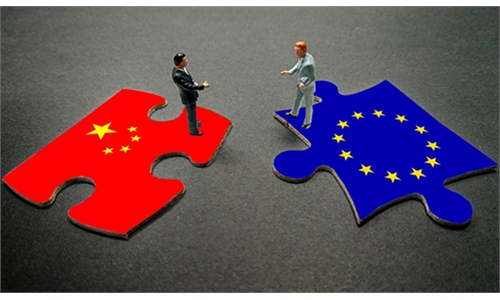
EU and China should pursue ‘symbiosis’ to turn their trade differences into opportunities
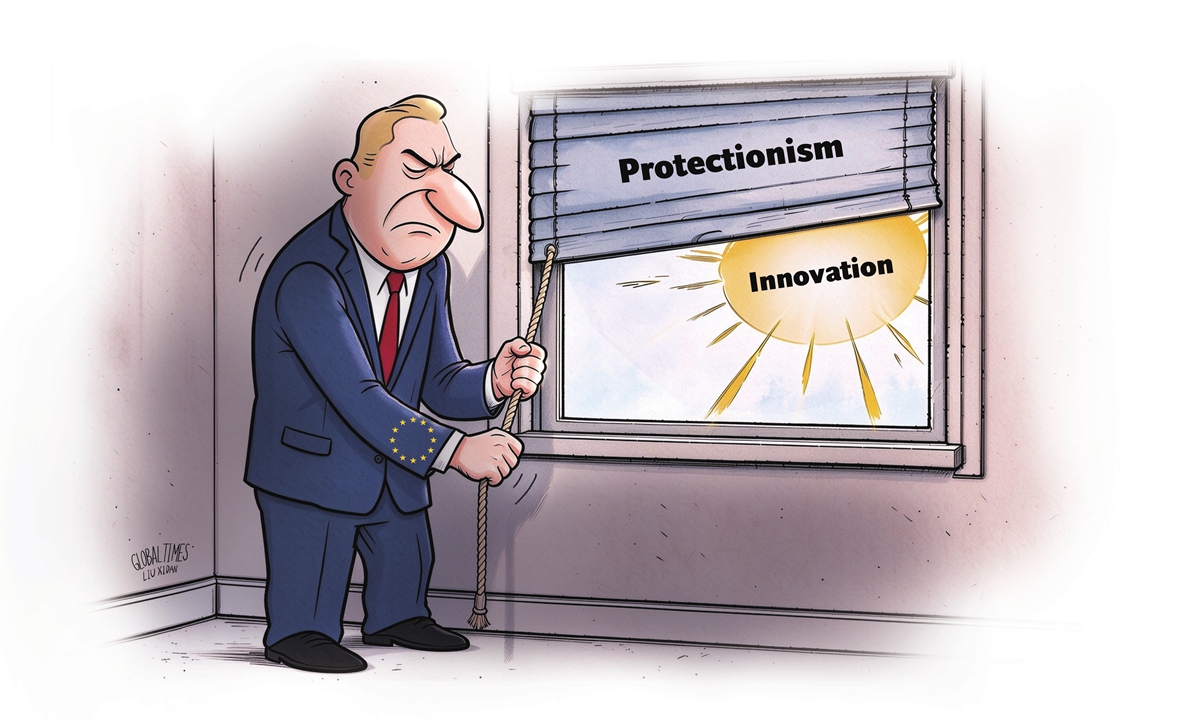
Europe's protectionist barriers risk shutting out innovation and opportunities for cooperation with China Illustration: Liu Xidan/GT
The EU and China recently conducted the second meeting of the China-EU trade and investment consultation mechanism. Both sides displayed their willingness to resolve trade and investment differences through dialogue rather than fueling trade disputes.
The agreement on trade in hybrid vehicles leaves ample time and space for a longer-term solution. The same goes for the agreement to continue and deepen discussions on export controls, which is of great significance for European industries. However, this temporary pause should be turned into a longer-lasting mechanism that is not contingent on sudden geopolitical shifts.
What EU officials express as a so-called China 2.0 shock is not really a shock but a panic reaction to a crisis that has been creeping along for many years while going unnoticed by complacent political elites. The EU's economic problems have been in the making for decades. These problems reflect insufficient investment in infrastructure, education, research and development, alongside reliance on traditional industries that were believed to produce revenues forever.
The automotive and machinery industries are good examples. Strong brands cannot substitute for improvements in product technology and efficiency, the areas in which European manufacturers have increasingly been overtaken by Chinese and other competitors. The chemical industry has been undermined by a misguided energy policy - which, for example, killed nuclear power in Germany - and geopolitically motivated foreign policies that completely undermined the availability of cheap and secure sources of energy, which are extremely important for such an energy-intensive industry.
If Europe's troubles are largely homegrown, the more useful question is what China has done differently. For me, the answer lies not in any single breakthrough, but in the system that produces them.
The most impressive aspect in my eyes of China's innovation drive is the top-down and coordinated policy focus on education and scientific research combined with industrial advancements. It is the totality of the system that has enabled the emergence of these breakthroughs not by chance, but as a natural result of the integration of education and scientific research into the whole industrial system of China.
This used to be the norm in Europe in its best times. Innovation emerges within an environment that creates the culture and incentives for innovation. For example, China's leading position today in shield tunnel boring machinery is a function of China's incredible investment in building the world's largest network of high-speed rail and highways. Behind it there has been a conscious decision for many years to enable such a surge in innovative areas.
Now, China is a world leader in robotics. What I have found amazing is the consistency and clear purpose behind this approach. The fact that China's 15th Five-Year Plan (2026-30) has decided to take all the most advanced technologies that have been in the incubators of laboratories, such as AI, robotics and brain-computer interfaces, and integrate them into the industrial system of the country will propel a massive wave of innovation across every possible sector of the economy.
I believe that the European and Chinese economies should develop a "symbiotic relationship" in which growth in one economy helps raise productivity in the other. Sharing advanced technologies rather than creating monopolies will benefit both sides. Now that both sides are at relative parity, they should increase cooperation.
For example, some innovative European corporations are finding out that moving part of their research and development operations to China will enormously benefit and hasten their transformation. That is due to the existence of a massive pool of highly skilled engineering human resources, a compact supply chain with which to produce prototypes and test them rapidly, and the opportunity to commercialize their products in the immense Chinese market at the same time.
At the same time, European countries must open up to Chinese innovative companies willing to invest in production on European soil, without all the restrictions that have accumulated through the years.
Finally, Europe should work with China through initiatives such as the China-proposed Belt and Road Initiative to support development in third countries. The most important regions for the EU are West Asia and Africa, where there are huge opportunities for European companies to participate in infrastructure, industrial, and agricultural development for the benefit of all parties.
For me, this is where the two sides should end up. We need to learn from the Chinese that a challenge or a problem could be turned into an opportunity - and that, ultimately, is what turning trade differences into opportunities means in practice.
This article is compiled based on an interview with Hussein Askary, vice chairman of the Belt and Road Institute in Sweden. bizopinion@globaltimes.com.cn
RELATED ARTICLES