Apple rolls out beta update with Apple Intelligence for Chinese mainland market, receiving mixed responses
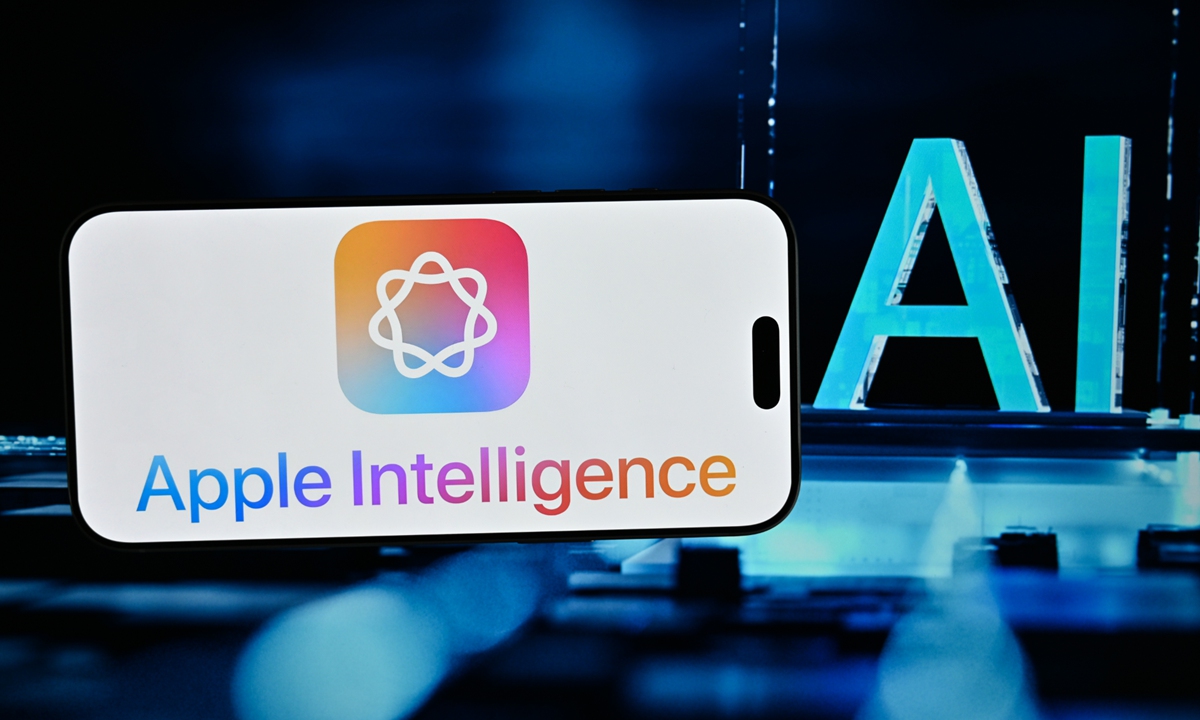
Apple Intelligence Photo: VCG
US technology giant Apple pushed out its iOS 27.3 developer beta version on Wednesday, giving Chinese mainland users first test access to Apple Intelligence.Chinese developers who were eager to give the beta version a try are now giving mixed responses, with some acknowledging Apple's long-awaited Apple Intelligence features and others pointing out the deficiency of the beta version and declaring that it is not a worthy upgrade, according to reports on Wednesday.
The move marked a significant step for Apple in bringing its artificial intelligence (AI) to the Chinese market since Executive Chairman Tim Cook revealed during a visit to China in October that Apple Intelligence and the Alibaba Qwen large-language model (LLM) had received regulatory approval in the country.
Apple Intelligence is driven by Apple's self-built generative models and deeply integrated into the apps and experiences people use every day for writing, self-expression, and getting things done. It is integrated with the Qwen LLM, allowing users in China to access Qwen's text and image understanding capabilities and content generation directly within Siri, Writing Tools and Visual Intelligence.
The topic of "What is your expectation from Apple Intelligence?" was one of the trending topics on Chinese social media platforms such as Sina Weibo and Xiaohongshu, or Rednote, on Wednesday, with early users giving mixed reviews.
A post by Xiaohongshu blogger Apple Researcher, which compiled media tests and user feedback, noted that some users encountered network errors when logging into the Qwen extension, even with normal mobile network connections. Others reported overheating, increased battery consumption and interrupted AI responses in weak network environments.
Siri's capabilities also drew criticism. According to the post, some users found that Siri still returned Baidu search results rather than AI-generated answers when asked questions. Others said it provided brief responses to complex requests and sometimes ended conversations after declining to use Qwen, without offering alternatives.
However, some basic features received positive feedback. Domestic news portal Jiemian News reported after a test conducted on Wednesday that Apple Intelligence's photo-cleanup tool worked well when removing objects from relatively simple backgrounds. Siri also responded quickly to basic commands and adjustments to settings. Some users said the integration of these features into Apple's native apps offered convenience in everyday use.
Apple's AI features will be available to all Chinese users with the official iOS 27.3 release in December.
Chinese analysts said the move shows how global tech firms are adapting AI products to China's regulatory and industrial landscape, with local model partnerships becoming a practical path for system-level deployment.
Fu Liang, a Beijing-based independent telecom analyst, told the Global Times on Wednesday that as the AI function comes with cooperation with local Chinese companies, a break-in period is needed for companies to iron out various issues.
"Given time and resources, these small glitches can be ironed out," Fu said, adding that what truly stands out from these partnerships is how Apple can maintain its competitiveness in the Chinese mainland market.
Apple reported on Monday that sales revenue in the Chinese mainland, the Taiwan region, Hong Kong and Macao rose 21 percent year-on-year in the September quarter but fell more than $1 billion short of estimates - results that came as its new iPhone Duo faces mounting user complaints.
"Tim [Cook] and [Apple Chief Operating Officer] Sabih [Khan] were just in China meeting with customers, developers and partners, and it has been wonderful to see the customer reaction to our latest lineup of products, including iPhone Duo," Apple CEO John Ternus said during a conference call on Monday.
With China set to remain a key market for Apple, having the AI function on the ground in the Chinese market is of great importance to the company, as the Chinese mobile phone market has well entered the AI era, and the absence of AI functions is sure to affect the company's sales, Fu said.
Domestic AI models also have an acute understanding of users' habits and needs, the expert said.
Chinese handset makers are increasingly shifting from standalone AI features toward deeper "system-level" integration of AI with operating systems and apps.
For instance, ByteDance's Doubao rolled out a smart phone featuring deep AI integration in cooperation with Chinese smartphone manufacturer ZTE in September.
Global sales of the iPhone 18 Pro and Pro Max during the first three weeks after launch were 3.1 percent higher than those of the iPhone 17 Pro series during the equivalent post-launch period in 2025, according to Counterpoint Research's Smartphone Weekly Sales Tracker.
The Chinese market posted the strongest growth, with sales rising 29 percent year-on-year. This was driven by better early supply compared with 2025 and by price increases on competing flagship models from Chinese Android OEMs.
In earlier October, China's Ministry of Industry and Information Technology granted approval for Alibaba's AI models to be integrated into several Apple handsets, including the new iPhone Duo, in the Chinese market.
RELATED ARTICLES