SCI-TECH / OTHERS
Chinese scientists use homegrown LLM to solve world-class math problem
Powerful reasoning capabilities put domestic AI models in role of ‘research assistant’
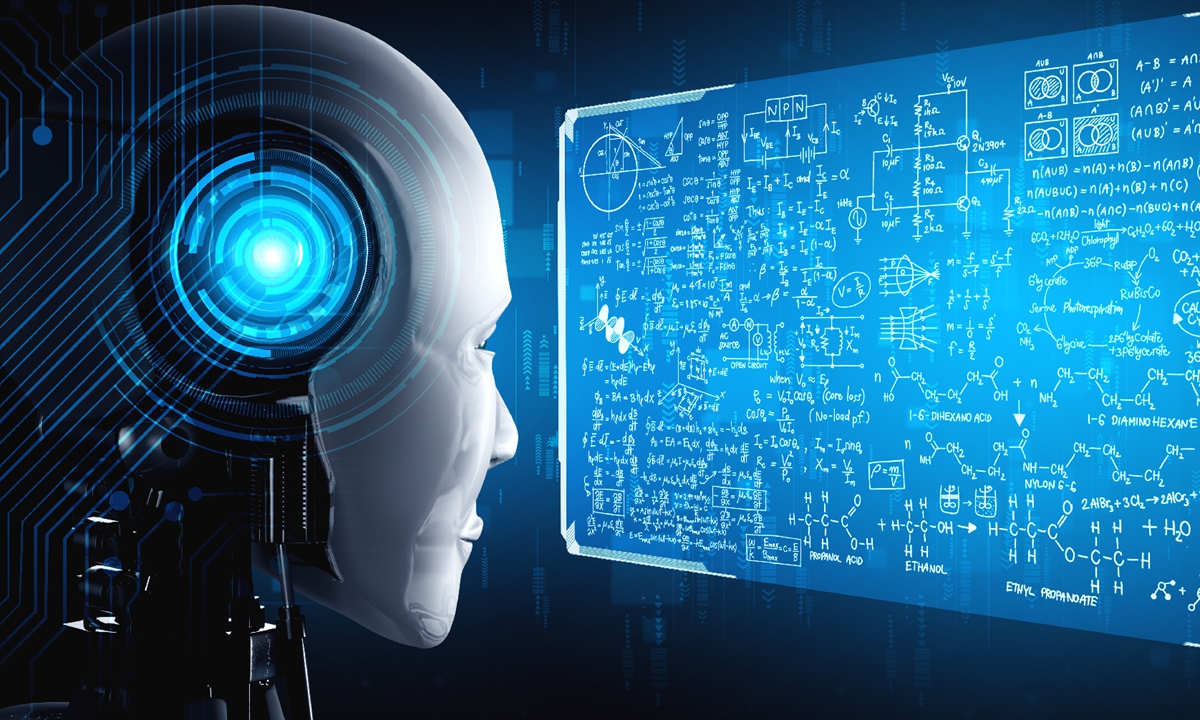
Photo: VCG
For the first time, Chinese researchers have used a domestically developed large language model (LLM) to help solve a world-class mathematical problem, marking what experts say is a milestone for AI-assisted scientific discovery.A research team led by Xu Disheng, a visiting scholar at the Shanghai AI Laboratory and professor with the Guangdong-based Greater Bay University, have completed the proof of the three-dimensional Ghys conjecture, a world-class mathematical problem that had remained open for more than 30 years, using the homegrown Intern-S2 LLM developed by the Shanghai Artificial Intelligence Laboratory.
This marks the first time Chinese researchers have cracked a world-class mathematical conjecture with a Chinese AI model.
The breakthrough was achieved through human-machine collaboration based on the "general-specialized fusion" technical path, the Shanghai-based AI lab told the Global Times on Thursday.
A formal verification of the proof was completed by two research teams at Peking University using their self-developed SHEAF framework.
The Ghys conjecture, proposed by French mathematician Etienne Ghys in 1995, asks whether the behavior of chaotic dynamical systems can determine their geometric classification. It has long been regarded as one of the key open questions in the field of dynamical systems and a benchmark for testing mathematical reasoning capabilities.
Analysts said that the breakthrough highlights not only the potential of Chinese AI models in basic frontier research, but also a new model of "human-machine collaboration" in scientific work.
According to the research team, Intern-S2 completed a full chain of tasks from model reasoning and human interaction to formal verification during the project. The model was able to perform large-scale recursive reasoning and iterative exploration, while scientists guided the overall direction, evaluated the value of possible approaches and identified the most promising path forward.
The Intern-S2 LLM's work included combing through relevant literature, breaking down the proposition, exploring multiple proof branches in parallel, checking logical steps and rapidly testing a large number of possible ideas. The researchers then used their expertise to refine the framework, make key judgments and provide feedback to steer the model's next round of exploration.
The Shanghai AI Laboratory says it will package the workflow as a reusable mathematical verification module for its scientific discovery platform, which connects the Intern-S2 LLM, AI agents, data and real experimental equipment, allowing the model to serve as a "research assistant" supporting end-to-end verification across the full scientific discovery workflow in a real research setting.
The lab cited an earlier application of the platform, which helped a research team from the Lei Group lab at Wuhan University shorten the development cycle in electrochemical synthesis from five to 10 years to just one to two years.
A team representative said the case demonstrates that the scientist-plus-AI "human-machine collaboration" research paradigm is likely to expand into physics, chemistry, life sciences and other fields, where AI can help compress trial-and-error cycles and broaden the search space for human thinking.
The team said AI models are expected to play an increasingly important role as "research assistants," adept at taking over massive, tedious, heavily branched trial derivations, literature review, proposition decomposition and step verification.
RELATED ARTICLES