China’s Moonshot AI open-sources key infrastructure technologies behind Kimi K3, as it becomes ‘world's largest open-weight model’
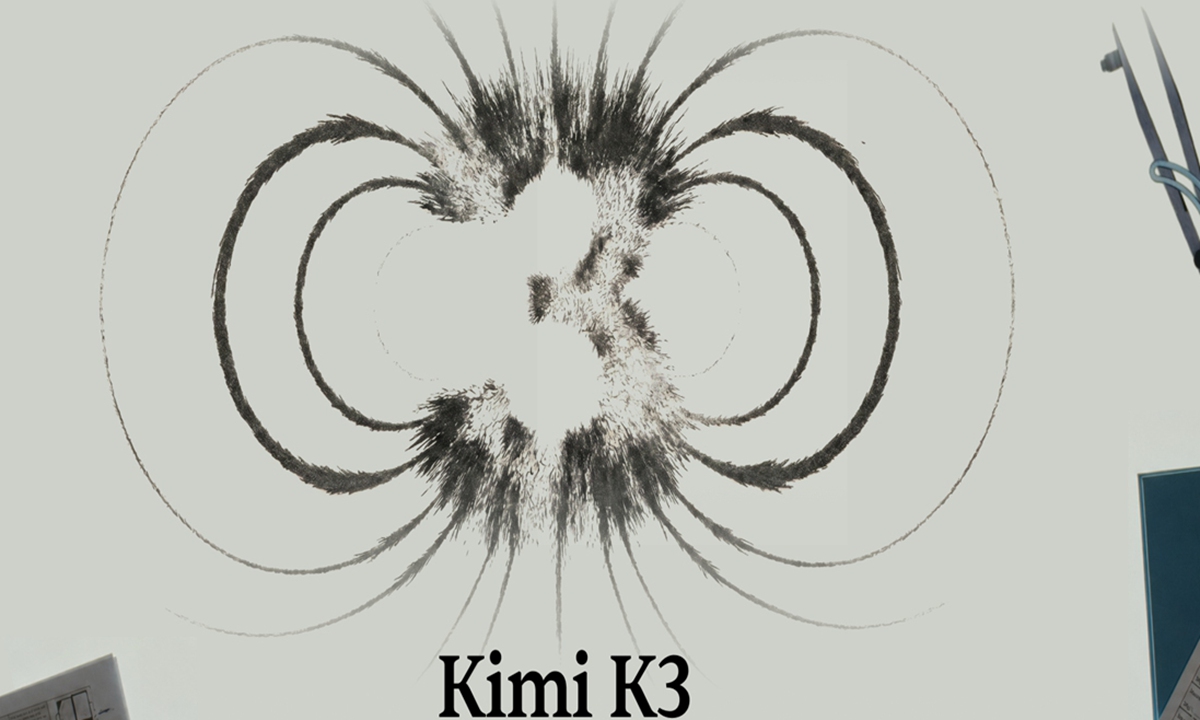
Photo: Courtesy of Moonshot AI
As Chinese artificial intelligence (AI) start-up Moonshot AI's newly released model Kimi K3 gained wide attention, the company on Monday released its model weights and technical report, and open-sourced the key infrastructure technologies that supported its training, in a bid to accelerate the deployment and popularization of frontier intelligence and promote artificial general intelligence (AGI) research.
Chinese experts noted that the move marks another effort by Chinese AI companies to open-source their near-frontier models, which will enable more countries, small and medium-sized teams, and independent researchers to access capabilities close to the frontier, thus lowering the barrier to frontier intelligence rather than being monopolized by a handful of closed-source giants.
Moonshot AI states that the Kimi K3 is available for anyone to download and deploy, can be used for both internal research and development and integration into end-user products.
The company noted that it believes in the value of open-weight models, which lower the barrier to accessing intelligence, drive innovation, and empower users with greater control over their data, as well as stronger privacy protection and ownership.
"We believe that for a technology as far-reaching as AGI, a broad and open ecosystem is the best soil to nurture it. To this end, we will continue to contribute our part," Moonshot added.
Moonshot described Kimi K3 as the world's first open-source model at the 3-trillion-parameter level, designed for advanced intelligent scenarios including long-horizon coding, knowledge work and reasoning tasks. It is a 2.8-trillion-parameter mixture-of-experts model with native visual understanding capabilities and support for a 1 million token context window.
Bloomberg reported on Monday that Moonshot developed K3 with 2.8 trillion parameters ̶ a rough measure of AI complexity ̶ making it the world's largest open-weight model at a time when leading US companies, such as Anthropic, are keeping the size of models including Claude private.
"Moonshot's latest move is to clearly define its positioning within the open-source ecosystem, and also to address external skepticism about Kimi's algorithms by open-sourcing the infrastructure technologies, thereby demonstrating the company's achievements in algorithmic innovation," Pan Helin, a member of the Information and Communication Economy Expert Committee of the Ministry of Industry and Information Technology, told the Global Times on Tuesday.
In sharp contrast to the closed-source approach favored by the US, China has embraced an open-source strategy, a move that has drawn positive reactions from many countries and regions worldwide.
Hu Qimu, a professor at the Maritime Silk Road Institute of Huaqiao University, told the Global Times on Tuesday that although Chinese AI models are not the strongest in the world, they are already in the first tier and their performance is sufficient to meet most types of market demand.
Pan said that China's open-source models offer higher cost-effectiveness. For the same algorithmic performance and computing power consumption, Chinese companies quote lower prices, and the resource consumption of Chinese large-language models is also lower.
"After being open-sourced, the investment cost for enterprises is relatively low. Moreover, compared with the closed-source models, which carry the risk of being blocked or cut off from supply, an open-source ecosystem is less likely to be controlled by a few entities and is therefore safer for enterprises undergoing digital transformation," Hu said.
Data from OpenRouter showed on Monday that the top five models by call volume in July on the platform were all Chinese models, including Xiaomi MiMo-V2.5, DeepSeek V4 Flash and Tencent HY3, crn.cn reported.
According to the report, OpenRouter previously disclosed that the global market share of Chinese models overall surpassed that of US models in early June. As of Sunday, Chinese models accounted for approximately 63.5 percent of the share over the previous 28 days, while US models accounted for only 35.5 percent, occupying nearly two-thirds of the global market share, with the gap further widening.
Meanwhile, some US officials are reportedly calling for investigating and threatening to sanction Chinese AI firms. In response, a spokesperson of the Chinese Ministry of Commerce said on Monday that such moves lack factual basis and legal justification, and that China will take all necessary measures to safeguard its legitimate rights and interests.
Innovation is not the exclusive domain of any single country. Chinese AI companies have long been committed to advancing fundamental research, balancing technological self-reliance with open cooperation. Guided by the principles of consultation, joint contribution and shared benefits, they have driven the rapid development of AI technologies and achieved notable progress in areas such as coding capabilities, the spokesperson said.
Hu said that China's sustained investment in the open-source direction has become one of the most important "open forces" in the current global AI ecosystem, making substantial contributions to accelerating the popularization of intelligence and the diversification of research.
"Some US officials' remarks reflect America's strategic anxiety. However, facts have proven that the AI development is by no means something a single country can control alone, nor does there exist a zero-sum game with predetermined winners and losers. Only through openness, inclusiveness, and cooperation can win-win outcomes be achieved," Hu noted.
RELATED ARTICLES