Smog engulfs Delhi ahead of Diwali: Can China's clean-air experience offer lessons?
By Published: Nov 04, 2026 11:58 PM

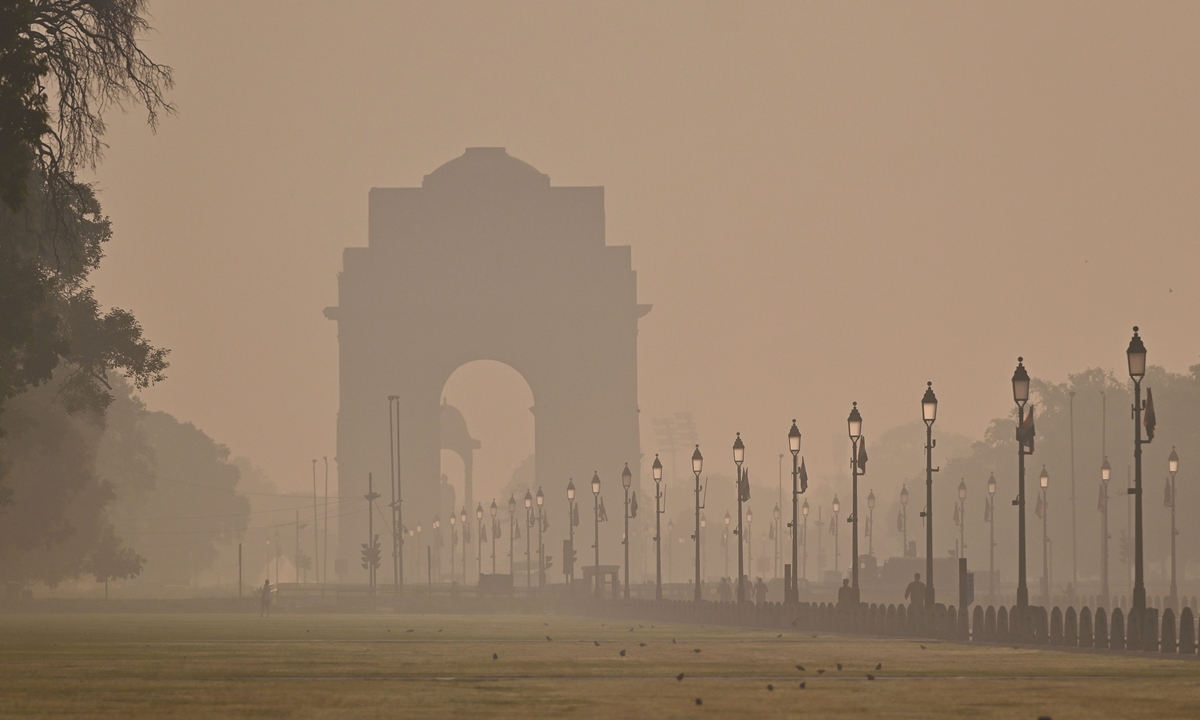
A layer of haze shrouds India Gate in New Delhi on October 27, 2026, as air pollution in the Indian capital continues to rise. Photo: VCG
As Indians prepare for Diwali, a public holiday across India that falls on Sunday this year, the city of Delhi has entered its most polluted fortnight of the year. A toxic cocktail of crop residue burning, festival-related firecracker emissions, urban discharges and stagnant winter weather has driven air quality sharply lower, bringing the capital's pollution crisis back onto national headlines, according to local media.
The haze bears striking similarities to the heavy smog China endured during its high-speed economic growth, prompting debate over which of Beijing's hard-won environmental lessons could be adapted for India, another major developing economy.
Delhi's air quality deteriorated to its worst level in 287 days on Tuesday, with the overall air quality index (AQI) reaching 350 in the "Very Poor" category, amid a sharp rise in stubble burning incidents in Punjab and unfavorable weather conditions, according to a report from the Indian Express on Wednesday.
According to the Central Pollution Control Board (CPCB), 57 of Delhi's 59 monitoring stations recorded data on Tuesday, with PM2.5 emerging as the dominant pollutant. The impact of the rising pollution load was heavily visible across neighboring cities, per the report.
While a Times of India report on Monday noted that CPCB data from 2015 till now revealed that November 1-15 is the capital's most polluted period in a year, with a high number of severe days and average AQI of 374.
It also noted that "This year, Diwali will be celebrated on November 8 and the share of the stubble burning in Delhi's air quality is expected to rise significantly in the coming days. Ahead of the wedding season and festivals, the city also witnesses an increase in traffic congestion, firecrackers, moreover, add to the existing pollution load."
Stubble burning, festive fireworks and rural brick kilns all add to India's air and soil pollution. The country's reliance on domestic coal that is high in ash and low calorific value further worsens pollution from power generation and winter heating, Liu Zongyi, director of the Center for South Asia Studies at the Shanghai Institutes for International Studies, told the Global Times.
Growing vehicle numbers also increase India's dependence on imported oil, while the geography of the Himalayas limits air circulation, trapping pollutants over northern India and spreading pollution beyond its borders, said the expert.
Like northern China, India frequently experiences temperature inversions and stagnant weather in autumn and winter. A lower atmospheric boundary layer limits the vertical dispersion of pollutants, while weak winds hinder their horizontal dispersion, worsening pollution, said Ma Jun, director of the Institute of Public and Environmental Affairs, a nongovernmental organization in Beijing.
Both directly emitted particles and secondary aerosols - formed through chemical reactions involving precursor gases - contribute to elevated PM2.5 levels, Ma said.
Indian authorities activated a series of measures under Delhi's Winter Action Plan on November 1, including vehicle emissions restrictions, according to The Indian Express. Meanwhile, the Supreme Court has alternated between imposing a complete ban on firecrackers and allowing green crackers during Diwali, according to the newspaper.
Yet most of these measures remain stop-gap fixes. Powerful interest groups tied to automakers, farmers and small kiln operators are politically hard to take on. Progress on green energy transition and on retiring polluting industries has stalled, leaving the root causes largely unaddressed, Liu noted.
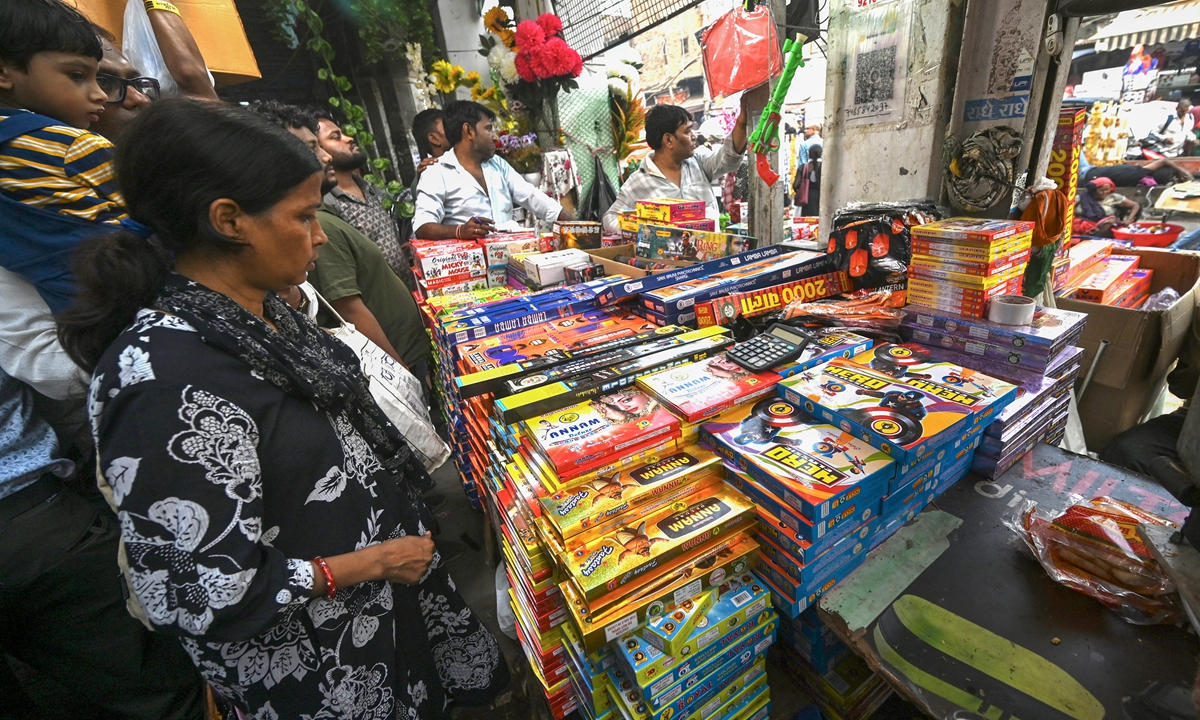
Environment-friendly firecrackers are on sale at Sadar Bazaar in New Delhi, India following the Supreme Court's decision permitting the sale of certified green firecrackers ahead of Diwali, which falls on November 8, 2026. Photo: VCG
Learning from China's experience
As air pollution became a focus of public attention, some Indian experts called for learning from China's experience. The debate was sparked in December 2025 after Yu Jing, a spokesperson for the Chinese Embassy in India, posted on X platform about how China had tackled air pollution, by curbing vehicle emissions, reducing coal use and controlling dust.
In an article published by the University of Chicago titled "What India can learn from China's approach to improving air quality?" Tanushree Ganguly, director of the Air Quality Life Index at the university's Energy Policy Institute, highlighted several lessons from China: Integrating environmental protection into the growth agenda; treating particulate pollution as part of a complex chemical system involving multiple pollutants; pairing ambient air quality targets with binding emissions reduction commitments; and using transparency and central oversight to strengthen accountability.
On a practical level, Ma highlighted real-time monitoring and public disclosure of industrial emissions as practical measures that could help developing countries strengthen enforcement. Many have environmental standards in place, but weak enforcement allows polluters to gain an advantage over businesses that comply, he said.
Other effective measures include installing industrial emission-control systems, coordinating carbon emissions and air pollution control, electrifying transport, and combining satellite, airborne and ground monitoring with clearly assigned local enforcement responsibilities, according to Ma.
China's cross-regional joint prevention and control mechanism is also central to its fight against severe air pollution. It covers cross-regional data sharing, joint assessments during pollution episodes, coordinated enforcement, cost-sharing and ecological compensation, Ma said, noting that such implementation capacity may be difficult for other countries to replicate.
Liu also noted that weak cross-regional coordination complicates India's fight against air pollution. Concerns about the economic cost of clean-air policies can make policymakers reluctant to take bold action. Nationalist sentiment and a degree of hubris in some quarters also stand in the way of India learning from others' experience.
Indian media Outlook Business published an article on November 1, saying that Indian officials have long been uncomfortable with comparisons with China because of differences in their political and economic systems. It said that Beijing exercises a degree of control over businesses and economic activity that New Delhi relinquished decades ago as it pursued a more open, market-oriented economy.
Ample room for cooperation
As the saying goes, a good cat, whether black or white, is one that catches rats. Liu said that tackling air pollution is a matter of public health and national development, and it must not be held hostage by nationalism. As neighboring countries, China and India have ample room for cooperation on environmental issues.
Ma added that countries need durable pollution solutions tailored to their institutional, economic and social conditions. China's own efforts faced setbacks and drew on international experience along the way. Given the similarities between the two countries, India can learn from China's rapid progress, including in digital governance and coordinated cuts in carbon emissions and air pollution.
He noted that pollution control is an investment in green transition and new growth. By adapting global and Chinese experience to local conditions and using proven technologies, India can cut carbon emissions and pollution while advancing economic development.
In a tweet posted in December 2025, Chinese Embassy spokesperson Yu Jing also said air pollution is a shared challenge for China and India. "There is no one-size-fits-all formula and no single standard answer. We firmly believe that India will find its own path to cleaner skies, suited to its national realities," wrote Yu.
RELATED ARTICLES